


Necessary


 تسجيل الدخول
 Arab (عربي)
2026-04-17
مشاركة
By Jonathan Gifford, Climate Copy
Editor's Note: Since unveiling its SigenStor battery system in June 2023, Chinese battery and power electronics manufacturer Sigenergy has scaled at remarkable speed. Now, less than four years after its founding, the company has reached another milestone: the launch of its Initial Public Offering (IPO) on the Hong Kong Stock Exchange (HKEX). Sigenergy’s IPO officially launched on April 8, 2026, with trading expected to begin on April 16 under stock code 06656.HK, marking a notably rapid listing for a Chinese energy technology company.
To understand how Sigenergy has moved so quickly – from product launch to global expansion and now public markets – the company invited veteran solar and energy storage journalist Jonathan Gifford to visit its European projects, headquarters, and manufacturing facilities in Shanghai. During the visit, he met with founder and CEO Tony Xu and the leadership team to explore the company’s rapid rise and its ambitions for the future.
Cool grey meets elegant beige tones at Sigenergy's newly established headquarters in Shanghai's Pudong district – a sleek, design-forward space that reflects a company already thinking well beyond its years. Having relocated only months earlier, the site serves as both corporate headquarters and R&D hub. Little in its polished surroundings hints at the company's youth.
In most markets, a technology company in its fourth year would still be considered a startup. For Sigenergy, however, that label no longer seems to fit. After for a time capturing the number-one position in distributed battery energy storage system (BESS) market share in Australia and South Africa, according to industry analyst SunWiz, and building a strong installer base across Europe, the perception of the company is of a business that's simultaneously established and accelerating.
On April 8, Sigenergy notched what may prove to be its most consequential milestone yet: the official launch of its IPO on HKEX. Backed by what was described as a "dream team" of 19 cornerstone investors – including Temasek, Goldman Sachs Asset Management, UBS Asset Management, Hillhouse Investment, and AXA – the offering signals strong institutional confidence in Sigenergy's technology and growth trajectory.
That confidence is underpinned by strong financial momentum. The company's revenue surged from RMB 58 million in 2023 to RMB 9 billion in 2025, while gross margins climbed to over 50%, positioning Sigenergy as not only fast growing but also financially disciplined.
Taken together, the IPO represents a validation of Sigenergy's execution to date and is a powerful signal of the ambitions for its next phase of growth.
In Shanghai, the foundations of that growth are apparent. In the expansive CEO Room at the company's headquarters, Sigenergy founder and CEO Tony Xu sits down with customers, many of them installers from the relatively mature distributed BESS markets of Germany, Austria, and Switzerland (DACH). But instead of delivering a presentation, Xu opens up the floor to their input.

"As a startup company, we have increased so fast in the past three years, and the main reason has been your support, your trust," Xu says, facing the group of nearly 50 installers, while seated alongside his leadership team. "I am interested in your suggestions – how we can be better in the future."
Over the next hour, questions and comments come hard and fast. Subjects include a possible expansion into heat pumps, supply-chain bottlenecks, service models, data protection and compliance, microinverters, durability, and smart EV charging. Discussions move fluidly between German and English, with Sigenergy's local teams translating in real time. And Xu and his lieutenants lean into the discussion rather than sidestepping the, at times, challenging questions.

"We have already built a dedicated European supply chain," Xu says, addressing the need to ensure reliable and fast delivery across the region. "Currently, it is time to build because we already have a huge market in Europe and we should build our own supply chain."
Building, executing and innovating have defined Sigenergy's market entry since its launch in 2022. The company has taken on several of the key barriers to mainstream BESS adoption, including fire safety, system commissioning, user interfaces and scalability, by addressing them head-on. Feedback from customers, particularly the installers who sell the systems and carry out the installations, appears to be shaping the company's development as it moves from startup phase into broader expansion.
There is little doubt that supplying battery systems is becoming an increasingly competitive business. But it is also an increasingly attractive one.
In 2026, BESS installations are expected to surge across many parts of the world and in all major market segments: residential, commercial and industrial (C&I), and utility-scale. Continued growth in EV sales is another positive trend, especially given the emerging opportunities created when electric vehicles are paired with energy storage systems and, where possible, bidirectional charging.
Looking first at stationary storage, the global outlook for BESS is strong. Research firm Wood Mackenzie reported in its Energy Transition Outlook 2025–26 that 104 GW of battery energy storage was installed worldwide. Surpassing the 100 GW milestone reflects both the maturity of the technology and its rapidly declining costs. Wood Mackenzie’s analysis concludes that a new BESS project installed in 2025 could deliver around three times more storage capacity than a project of the same cost in 2022.
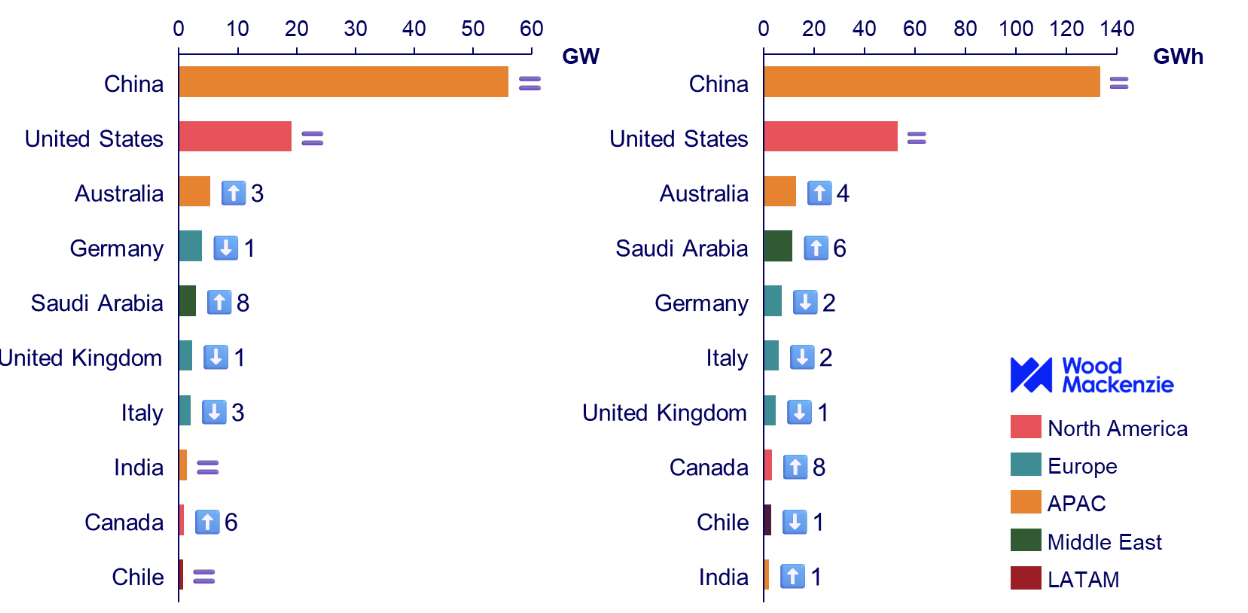
Source: WoodMac / Volta Battery Report 2025
Breaking down the market into residential, C&I, and utility-scale segments reveals growth across all three. Utility-scale systems still account for the lion's share of installed capacity, representing about 82% of global installations in 2025.
Growth in the C&I segment is being driven by a combination of market-specific factors. These include retail tariff structures – such as demand charges, time-of-use (TOU) spreads, and peak penalties – the availability of PV, the value of increasing solar self-consumption, and the resilience benefits of avoiding power outages or reliance on costly backup diesel generation.
For businesses with modern BESS, another important driver is the ability to stack revenues. This can include supplying the grid with demand response, capacity, ancillary services and local flexibility.
Battery installations by market segment
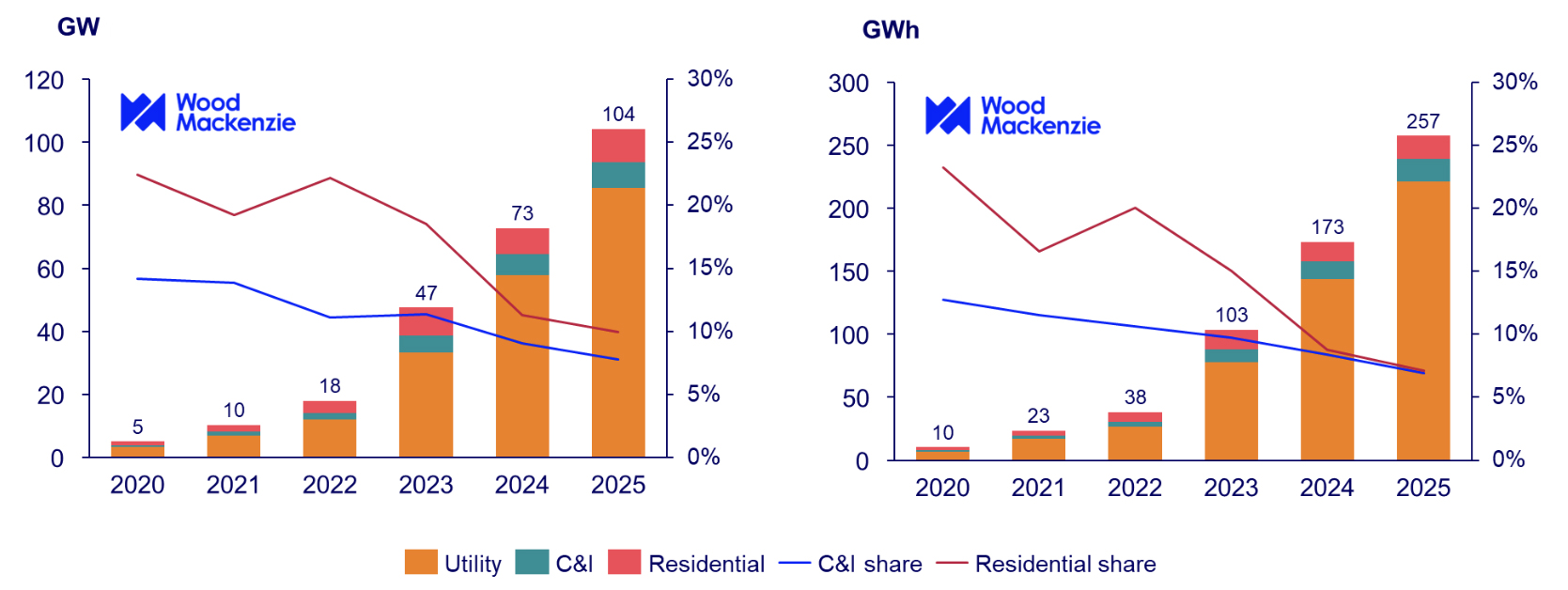
Source: WoodMac / Volta Battery Report 2025
Europe's battery storage market is also expanding rapidly. According to the EU Battery Storage Market Review 2025 from SolarPower Europe, 27.1 GWh of battery storage was deployed across the EU in 2025, representing 45% year-on-year growth, supported largely by utility-scale systems. The report also notes that since 2021, Europe’s battery fleet has grown tenfold – from 7.8 GWh to 77.3 GWh. By 2030, another tenfold increase, to around 750 GWh, may be needed to provide the flexibility required for a highly renewable power system.
And although market expansion is not uniform across the continent, similar drivers are emerging in key national markets.
In Germany, data from the country's Federal Network Agency, Bundesnetzagentur, shows that more than two million home battery systems have already been installed. Data from Fraunhofer ISE, published via Energy-Charts, indicates 17.1 GW of installed storage power and 25.8 GWh of capacity.
These figures reflect a broader reality: in Germany, rooftop solar is now seldom installed without batteries. BESS attachment rates were already around 80% by 2024, according to BloombergNEF. Previously niche applications, such as "balcony solar" – small-scale PV and battery systems that can be DIY installed with a power limit of up to 800 W – are also moving into the mainstream, presenting apartment dwellers with the opportunity to participate in solar-plus-storage.
In the Netherlands, the planned removal of net metering for solar installations has accelerated interest in residential storage. Research agency Dutch New Energy Research reported in late 2025 that the country was on track to add 1.55 GWh of storage capacity by year-end, representing around 89,200 installations – up 140% year on year.
Daren Shi, managing director of Düsseldorf-based distributor PV Selected, says the Sigenergy team has focused squarely on installer pain points as a way to penetrate the crowded German residential BESS segment. Germany is home to both domestic suppliers with long track records and a growing field of Asian competitors.
"The innovation on the hardware and also innovation on the software is unique," says Shi. "It's a unique ecosystem."
Switzerland is also experiencing rapid BESS expansion. In mid-2025, industry body Swissolar reported that the number of battery storage systems had nearly doubled each year since 2022, bringing total installed capacity to around 1 GWh.
Frédéric Bichsel, founder and CEO of Swiss distributor Solexis, travelled to Sigenergy's Shanghai headquarters in late 2025. He says falling solar feed-in tariffs in Switzerland have led to a surge of interest in distributed battery storage.
"The owner of a PV system sees a retrofit with a storage system as a good way to get less exposed to the reduction of the buyback rate on the grid for the surplus of solar," says Bichsel. "We also have some flexibility services that are coming up in Switzerland where storage could be used without PV but only to support the grid."
For solar installers, Bichsel adds, the potential to retrofit BESS to existing solar systems is an important new revenue stream – one with relatively low customer acquisition costs, as it builds on an existing client base.
Australia is another standout market for residential battery growth. The country's national Cheaper Home Batteries subsidy program offers substantial cost reductions to homeowners, slashing the upfront cost of a home BESS by roughly 30%.
In March 2026, the Australian government estimated that around 250,000 battery systems had been installed in less than a year, adding an impressive 6.3 GWh of energy storage capacity to homes and businesses. Some of these systems participate in virtual power plant programs or are coordinated by energy providers to support the grid.
While the expansion of stationary storage has been remarkable, battery production and supply remains heavily dominated by the electric vehicle sector — and EV adoption shows no signs of slowing. Global EV sales in 2025 were 22% higher than in 2024, reaching 21.6 million units. China achieved majority EV penetration for the first time, with EVs accounting for 51% of new car sales, according to BloombergNEF.
Annual Lithium-ion Battery Demand by Application
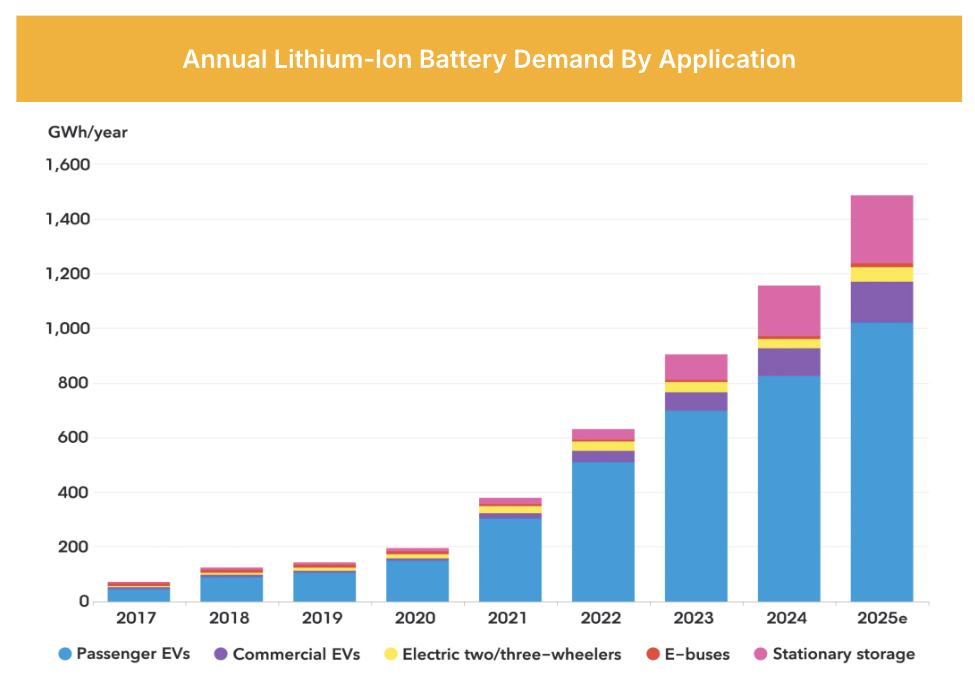
Source: BloombergNEF
While the booming residential battery market is attractive, horizontal expansion has also been central to Sigenergy's growth strategy. The company entered the BESS market with its innovative stackable distributed battery system, SigenStor. Within roughly two years, it had expanded its portfolio with the larger SigenStack systems, designed specifically for the C&I segment.
In 2024, Sigenergy commissioned a 2.88 MWh BESS project at the historic Bodega Familia Gil winery in Murcia, Spain. Instead of deploying a single large battery installation, the project distributed storage across three separate sites, each located alongside existing or newly installed PV systems. More than 60 SigenStor units were deployed, creating a unique configuration in which a residential-scale product was used to build a megawatt-scale C&I system.
When visiting the site, the region's renewable resources immediately make themselves known. Rolling hills shimmer under the Spanish sun, while grapevines, some more than 100 years old, ripen in its glow. Harnessing that abundant solar resource is the most efficient and cost-effective way to power the winery's operations.
As an added feature, three Sigen EVDC charging units were installed for winery visitors, delivering 25 kW fast charging — or around 130 km of range in a one-hour charge.
It's evident that Sigenergy's ambitions extend well beyond BESS. Its EVDC chargers give homeowners and businesses the ability not only to "drive on sunshine," but also to participate in emerging vehicle-to-grid (V2G) and vehicle-to-home (V2H) applications.
Taking what it describes as a "whole-of-system" approach, Sigenergy expanded its portfolio again in 2025 with the launch of its own range of solar microinverters, providing installers with tighter system integration, connectivity, and intelligence.
"With one microinverter, one panel, you can run a system independently – which makes it very easy to build and offer more solutions without any additional gateway or material," said Xu, speaking candidly about the challenges module-level power electronics (MLPE) hardware has faced in the past, and Sigenergy’s strategy for turning the trend around. "We also introduced the first WiFi mesh network, which is very easy compared to other solutions. It's just plug and play, and does not need any additional configuration for communication."
The breadth of the company's product offering, rolled out at relentless pace, is on full display at its new Pudong headquarters. The ground-floor showroom trades the calming tones of the executive offices for sleek black walls and floors illuminated by blue-white LEDs, set against towers of battery-system stacks.
Inset screens line the walls, showcasing the software and digital intelligence that connect the Sigenergy ecosystem with both installation partners and end customers. The company's MySigen app acts as a window into these systems, offering monitoring and control while using embedded intelligence to help homeowners and businesses optimize the performance of their power electronics and energy storage assets.
Digital technologies, including artificial intelligence, are another centrepiece of the Sigenergy playbook. Xu says that pursuing the promise of AI was one of the key motivations behind founding the company.
Before launching Sigenergy, Xu had a long career at Chinese communications and power electronics giant Huawei, where he led a large team exploring AI applications across the company's vast product portfolio. But he saw particularly strong potential for AI in clean energy – an industry where electrons are replacing molecules, and where gigabytes are rapidly becoming as important as gigawatts.
New revenue opportunities are emerging for large-scale and coordinated distributed energy systems that go beyond simply supplying electricity for onsite consumption. One of the most promising layers is intelligent arbitration, forecasting, and optimization software that can extract additional value from energy assets – an opportunity Xu identified early, and one Sigenergy is now actively pursuing.
Advanced energy management systems, increasingly powered by AI, are improving the way storage interacts with solar PV, flexible loads, and dynamic electricity prices. These systems can also integrate EVs through bidirectional charging and V2G or V2H capabilities. In markets that allow aggregation, residential storage systems can be combined into coordinated energy fleets, while C&I installations can operate more like virtual power plants (VPPs) than standalone assets.
Sigenergy's own AI applications are built into its SigenStor AI-optimized 5-in-1 energy storage system. The platform integrates a solar inverter, EV DC charger, battery power conversion system (PCS), battery pack, and energy management system (EMS) into a single platform. Using granular telemetry, it can continuously optimize performance and energy flows.
This is an area where machine learning and model predictive control excel. Sigenergy's platform enables energy planning, VPP scheduling, AI-assisted safety protection for anomaly detection, and enhanced service support. Sigen AI analyses historical energy-use patterns and predicts upcoming demand based on factors such as weather forecasts, solar production, seasonal trends, and electricity tariff structures.
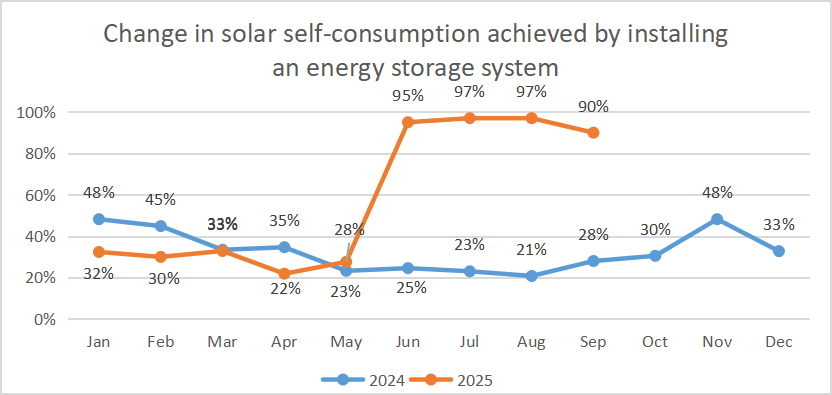
The benefits of Sigen AI can be seen in real-world installations. One residential SigenStor system in Warsaw, Poland, demonstrates how the platform forecasts energy prices and demand using power data, weather forecasts, and historical household consumption patterns. Based on these inputs, it automatically optimizes operating strategies – prioritizing low-cost charging, selling energy during higher price periods where possible, and protecting battery health – while continuously refining its decisions over time.
Poland Case Study Data
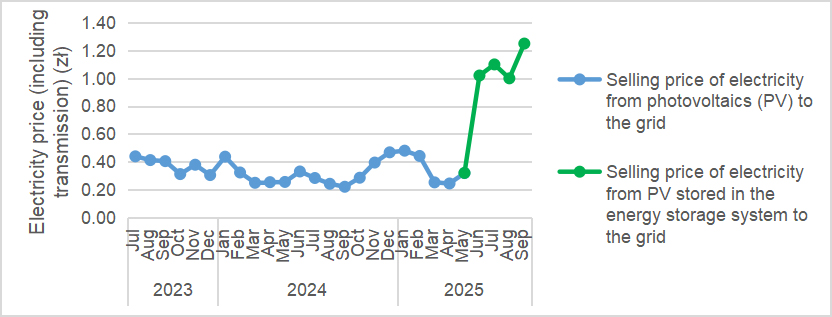
Source: Sigenergy
If Sigenergy's early years have been defined by speed, the next phase appears set to be defined by scale.
Looking ahead, the company's leadership is increasingly focused on building the capital and organizational structure needed for its next stage of growth. With the IPO now formally launched, Xu notes the strategic value of the move in terms of ongoing expansion.
"An IPO is not for money," says Xu, "it's more creditability, to be more transparent." It also allows non-Chinese funds and institutional investors to buy into the company. For Sigenergy’s step into the utility-scale segment, both developments matter.
Plans to expand the product range into specialized utility-scale projects are under way in 2026, building on the experience gained in 2025.
On the edge of the wild Strandzha Nature Park in Bulgaria, Sigenergy supplied a 10 MW / 20 MWh battery array to the Malko Tarnovo solar site, allowing the project to capitalize on low daytime electricity prices and capture morning and evening peaks.
On the edge of the wild Strandzha Nature Park, Bulgaria, Sigenergy supplied a 10 MW / 20 MWh battery array to the Malko Tarnovo solar site, allowing the project to capitalize on low daytime electricity prices, and capture morning and evening peaks.
The dark-hued modules of the 11 MW solar project cascade down the hillside, framed by dense forest, with 90 Sigenergy 110 kW inverters and 240 kWh SigenStack batteries clustered at the base. The BESS units stand in silent sentry adjacent to the PV system, shining white under the stinging south-Bulgarian sun. By virtue of having been designed and built to the exacting IP66 standard, the SigenStacks don't require additional housing.
Notably, despite the site's remote location, the Malko Tarnovo BESS array was installed in only 12 days – 10 for installation and two for commissioning. By contrast, a traditional containerized BESS would have required complex logistics, extensive site preparation, and a lengthy commissioning process. Speed, once again, translated directly into value for Sigenergy and its project partners.
Expansion into utility-scale storage represents something of a crowning achievement for Sigenergy – opening the door to larger projects and more established grid-level developers and investors. The timing also appears prescient, with room still available for fast-moving suppliers before the BESS market consolidates more firmly around major infrastructure suppliers.
That development mirrors the broader transformation of the energy system itself. As renewable energy penetration rises and electrification accelerates, BESS provides valuable time-shifting services to renewable asset owners while also delivering a growing range of flexibility services to electricity networks. At the same time, batteries are becoming intelligent nodes within a digitalized power network. Platforms that can combine the benefits of hardware, software, and data-driven control are unlocking value across residential, commercial, and grid-scale applications.
For Sigenergy, the opportunity lies precisely at that intersection. The company's strategy – linking integrated hardware, AI-enabled energy management and rapid product innovation – is designed to position it not only as a battery supplier, but as a provider of intelligent energy infrastructure.
The scale of that ambition is also visible in its manufacturing footprint. Sigenergy reports that it has established three production bases in Shanghai and Nantong, with inverter design capacity approaching 360,000 units annually and energy storage battery capacity exceeding 5.6 GWh as of the end of 2025.
Four years after its founding, Sigenergy has demonstrated how quickly a new entrant can rise in a fast-moving industry. And if the pace of its first phase is any indication, the company may even play a meaningful role in shaping this next decisive period for global energy storage – one in which flexibility, intelligence and integration will increasingly define the future of the energy system.
According to the company, proceeds from the IPO will be used primarily for research and development of next-generation AI energy systems, expansion of the global sales network and overseas branding, as well as general working capital.




 إعداد ملفات تعريف الارتباط

These cookies are essential for the proper functioning of my website. Without these cookies, the website would not work properly
| Name | Expiration | Description |
| PHPSESSID | session | Cookie generated by applications based on the PHP language. This is a general purpose identifier used to maintain user session variables. It is normally a random generated number, how it is used can be specific to the site, but a good example is maintaining a logged-in status for a user between pages. |
| cookielist-consent | 1 year | Sets this cookie to remember users' consent preferences so that their preferences are respected on their subsequent visits to this site. It does not collect or store any personal information of the site visitors. |
| sl-session | 1 day | Anti-crawler and machine behavior recognition |
Analytical cookies are used to understand how visitors interact with the website. These cookies help provide information on metrics such as the number of visitors, bounce rate, traffic source, etc.
| Name | Expiration | Description |
| _ga | 1 year | The _ga cookie, installed by Google Analytics, calculates visitor, session and campaign data and also keeps track of site usage for the site's analytics report. The cookie stores information anonymously and assigns a randomly generated number to recognize unique visitors. |
| _ga_6JGTHLPYFN | 1 year | This cookie is installed by Google Analytics. |
| _gcl_au | 3 months | Provided by Google Tag Manager to experiment advertisement efficiency of websites using their services. |