


Necessary



 Login
 Australia (English)
23 Jul, 2026
Share
In today's Commercial and Industrial (C&I) solar storage market, peak-valley tariff arbitrage is a primary lever for businesses to optimize energy costs. However, traditional energy storage systems (ESS) heavily rely on rigid, static timers. This deterministic approach increasingly fails when confronted with highly volatile day-to-day operational variables like changing weather and the peak demand penalty trap, where sudden factory load spikes over-rely on the grid, triggering massive monthly demand charges.
To master these dynamic variables, Sigenergy introduces it intelligent energy assistant—Sigen AI, which deeply integrated into the energy system's core layer. Real-world operational data from three distinct commercial deployments in China demonstrates how this predictive assistant seamlessly optimizes asset dispatch and unlocks superior financial returns.
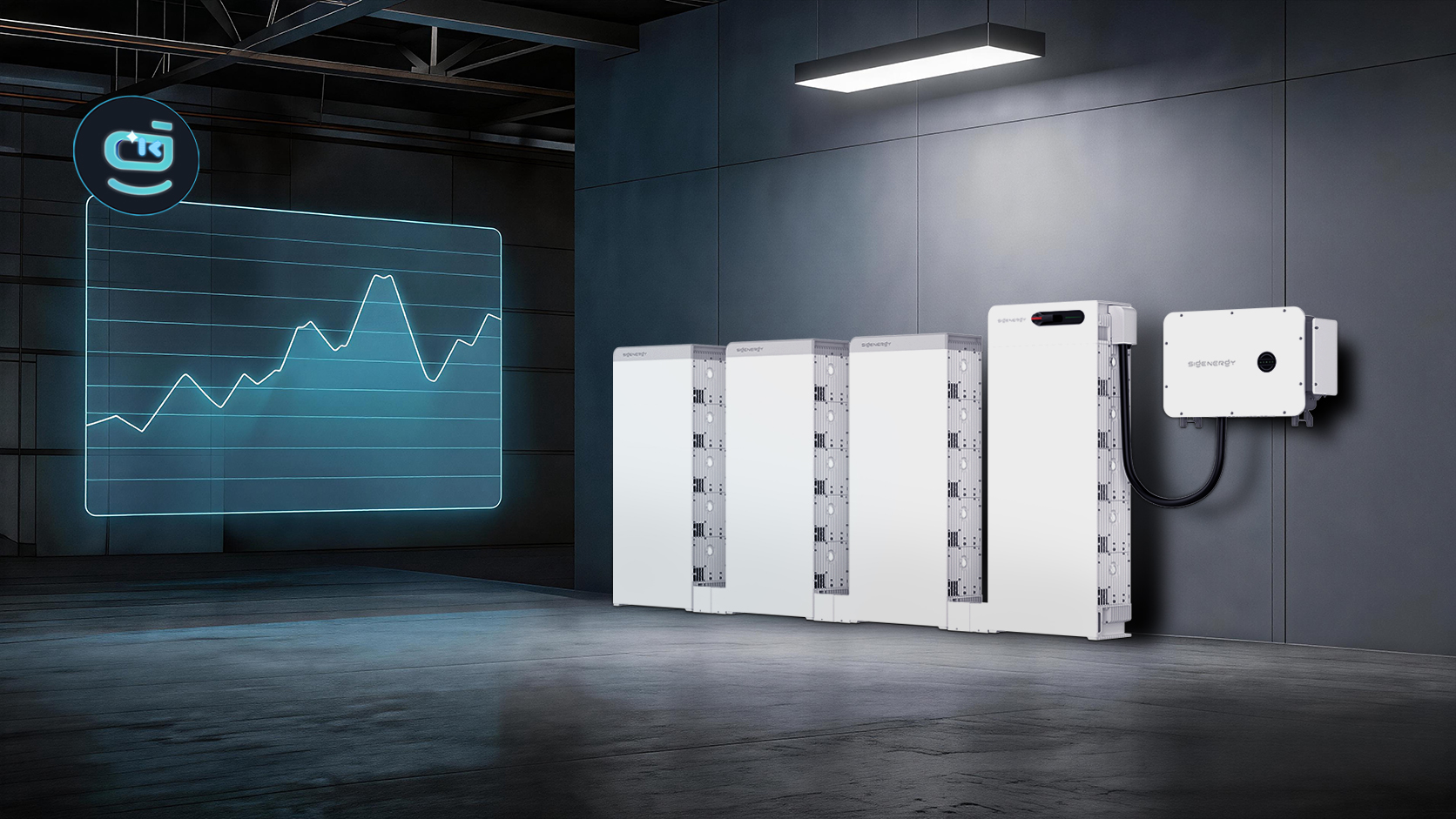
At a manufacturing facility in Shandong, China, a C&I system comprising a 382.2 kWp PV array and a 220 kW / 482.4 kWh ESS was deployed. By leveraging advanced solar generation and load profile forecasting, Sigen AI dynamically self-corrects the ESS dispatch strategy based on shifting weather patterns.
Case Study: A Manufacturing Facility in Shandong
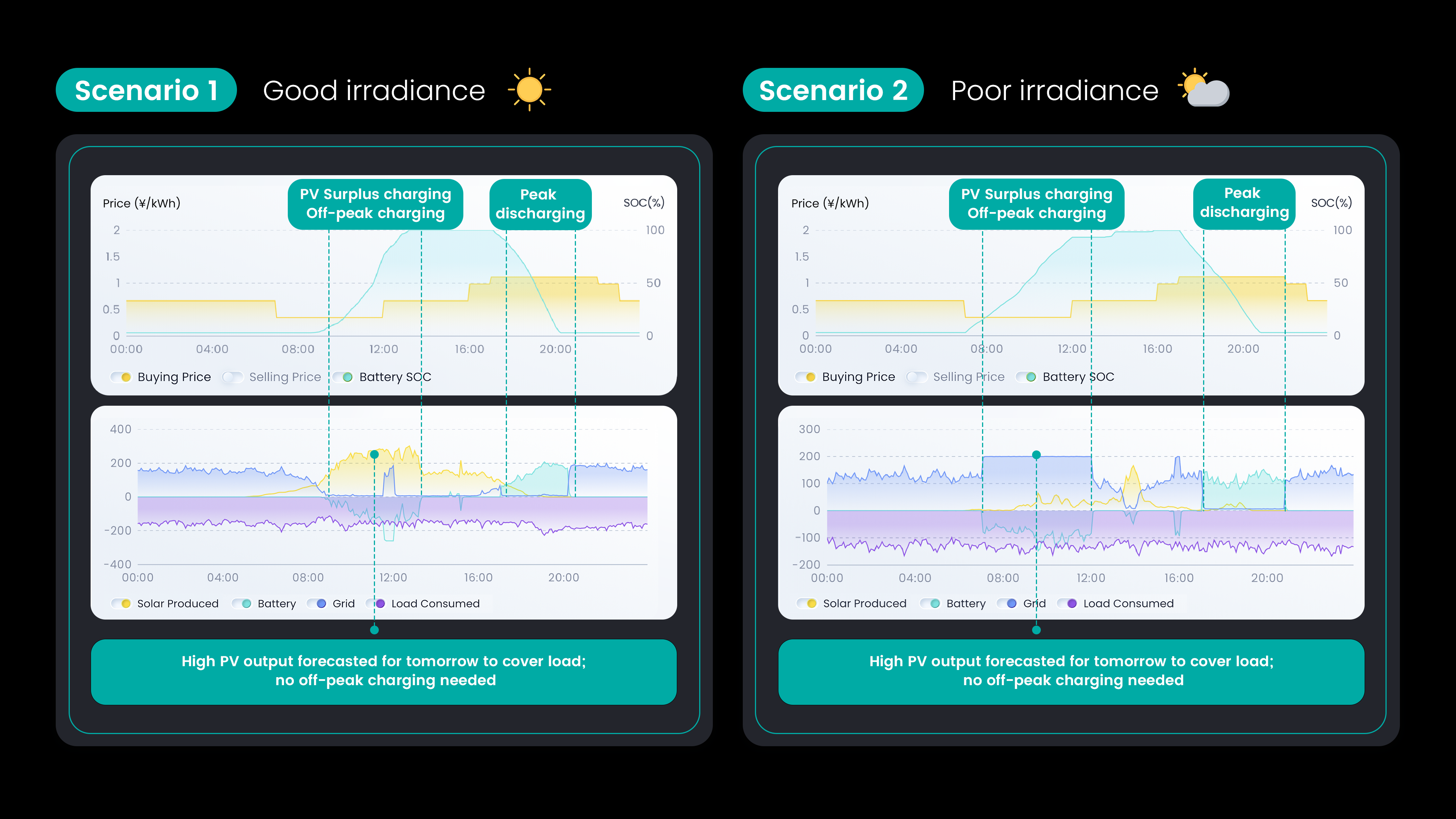
After 75 days of continuous comparative operation, the AI-driven dispatch strategy delivered a 13% net revenue increase over standard static operating modes.
In a brownfield expansion project for a high-tariff industrial site in Guangdong, China, the energy mix included a newly added 160 kWp PV array and a 125 kW / 241.2 kWh ESS, alongside an existing, pre-installed 300 kW third-party solar inverter.
Navigating this mixed-hardware environment alongside intricate local time-of-use (ToU) tariffs required holistic, unified orchestration. Sigen AI treats the entire site as a single ecosystem. Instead of managing the new storage in isolation, the platform dynamically correlates the output of the third-party inverter, battery State of Charge (SoC), real-time building load profiles, and grid tariff structures.
During peak sun hours, the system prioritizes localized self-consumption and slashes unnecessary grid interaction. Under adverse conditions, it intelligently balances peak-shaving and tariff arbitrage based on live load behaviors, adjusting charge rates on the fly to maximize system efficiency without disrupting the pre-existing legacy setup.
Case Study: A Brownfield Expansion Project in Guangdong
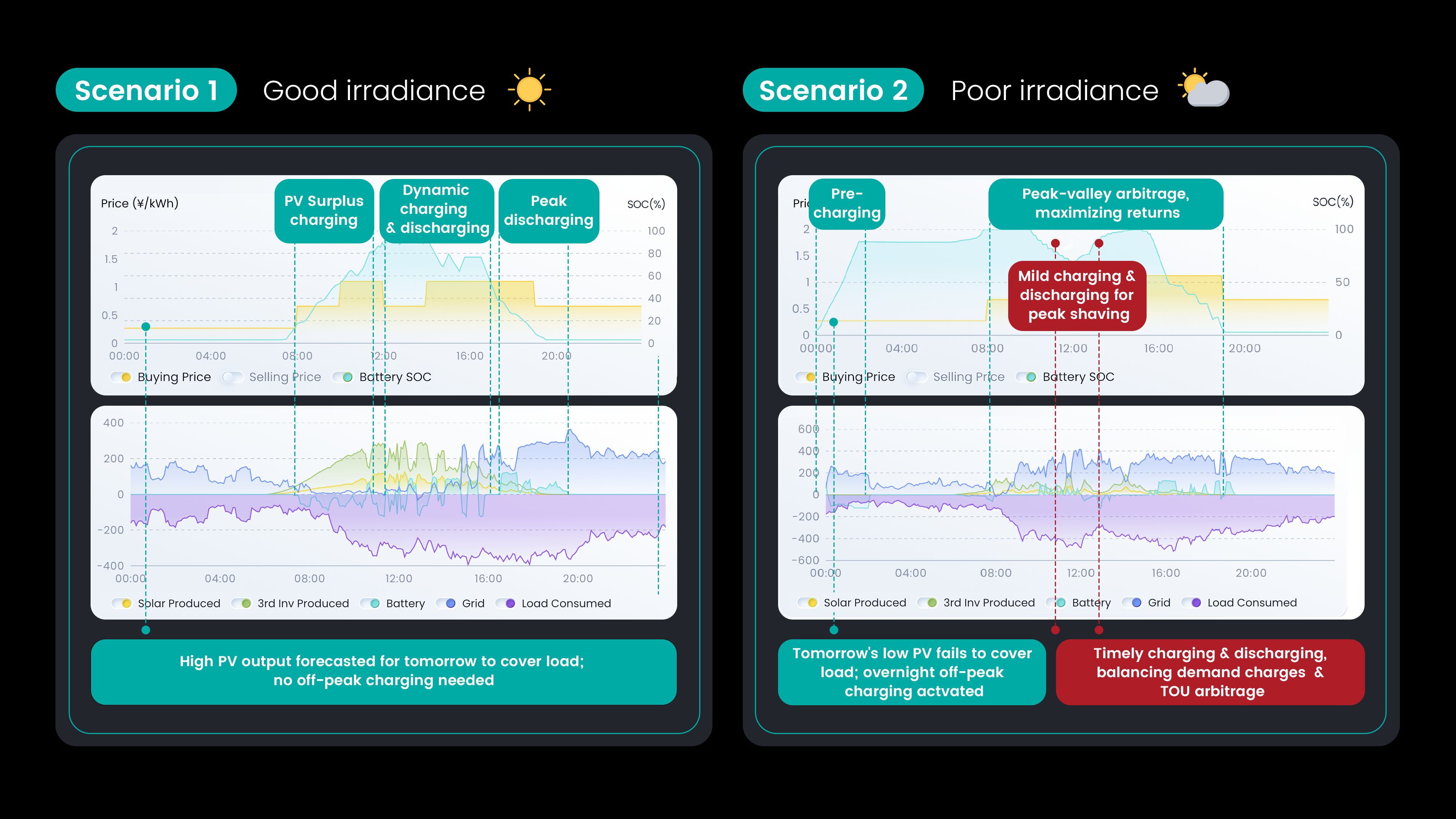
Over a 64-day operational cycle, Sigen AI successfully optimized the site's hybrid infrastructure, yielding a 35% boost in financial returns compared to standard operating parameters.
For heavy industrial energy consumers bound by strict maximum demand tariffs, keeping grid power draw under an ironclad threshold is vital to cost control. At a newly constructed industrial plant in Zhejiang, China, equipped with a 468 kWp PV array and a 390 kW / 410.04 kWh ESS, this exact challenge put traditional automation to the test.
On April 16, 2026, during a midday low-tariff window, a traditional automated timer attempted to charge the batteries at maximum power to prepare for evening arbitrage. However, static timers cannot adapt to real-time industrial production lines. The simultaneous stacking of maximum battery charging power and a sudden surge in factory machine activity pushed the grid draw to a monthly peak of 248.45 kW. This rigid charging behavior triggered massive demand penalties, completely erasing the economic benefits of the arbitrage itself.
Detecting this threshold breach, Sigen AI instantly adjusted its operational logic. Beginning April 17, the system automatically logged 248.45 kW as the absolute maximum demand ceiling for the billing cycle. Throughout all subsequent charging phases, Sigen AI dynamically throttled and smoothly regulated battery charging power, ensuring that the aggregated total of battery charging and factory load never crossed the upper threshold.
Case Study: A Constructed Industrial Plant in Zhejiang
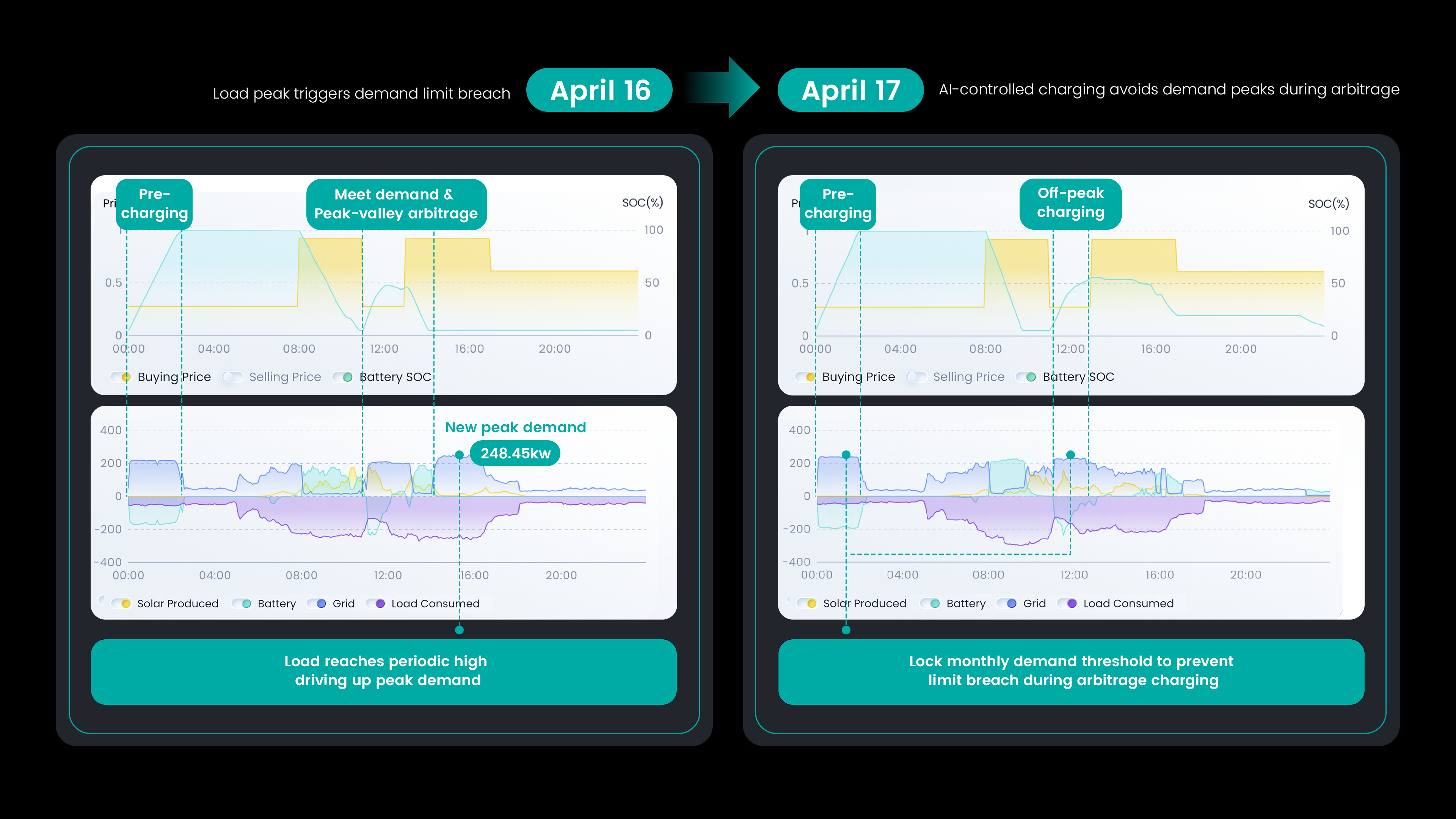
Over a 98-day continuous evaluation period, the AI's granular scheduling successfully defended the maximum demand boundary while optimizing arbitrage. The AI mode achieved a 30% revenue expansion compared to the standard automated benchmark.
The convergence of renewable energy and artificial intelligence is shifting C&I energy management away from passive cost-cutting toward highly precise, calculated asset operation.
The value of Sigenergy's AI extends far beyond simple charge-and-discharge decisions; it drives solar self-consumption optimization, demand management, load forecasting, anomaly alerts, predictive diagnostics, and efficiency analytics. Through forward-looking engineering and robust solution design, Sigenergy ensures green energy assets transition from mechanical operation to intelligent yield enhancement, ensuring maximum value from every kilowatt-hour.




 Cookie Set

These cookies are essential for the proper functioning of my website. Without these cookies, the website would not work properly
| Name | Expiration | Description |
| PHPSESSID | session | Cookie generated by applications based on the PHP language. This is a general purpose identifier used to maintain user session variables. It is normally a random generated number, how it is used can be specific to the site, but a good example is maintaining a logged-in status for a user between pages. |
| cookielist-consent | 1 year | Sets this cookie to remember users' consent preferences so that their preferences are respected on their subsequent visits to this site. It does not collect or store any personal information of the site visitors. |
| sl-session | 1 day | Anti-crawler and machine behavior recognition |
Analytical cookies are used to understand how visitors interact with the website. These cookies help provide information on metrics such as the number of visitors, bounce rate, traffic source, etc.
| Name | Expiration | Description |
| _ga | 1 year | The _ga cookie, installed by Google Analytics, calculates visitor, session and campaign data and also keeps track of site usage for the site's analytics report. The cookie stores information anonymously and assigns a randomly generated number to recognize unique visitors. |
| _ga_6JGTHLPYFN | 1 year | This cookie is installed by Google Analytics. |
| _gcl_au | 3 months | Provided by Google Tag Manager to experiment advertisement efficiency of websites using their services. |