


Necessary



 Login
 Australia (English)
05 Dec, 2025
Share
Having Power but
Unable to Use It: The Hidden Contradiction in Zero-Export Scenarios
When
examining real-world commercial and industrial (C&I) facilities, one
problem repeatedly appears: large amounts of usable solar energy are wasted
every day.
The root cause is not the PV system itself, but the inherent three-phase load imbalance found across most factories. Different machines start at different times, single-phase and three-phase devices coexist, and power consumption varies constantly. As a result, it becomes nearly impossible to maintain equal loads across all phases. Scenarios such as 30 kW / 20 kW / 10 kW per phase are extremely common.
Sigenergy’s
Three-Phase Independent Power Dispatch Unlocks Full PV Utilization
To address this challenge, Sigenergy C&I inverters (HYB) feature independent power
dispatch on all three phases, enabling optimized operation under zero-export
conditions.
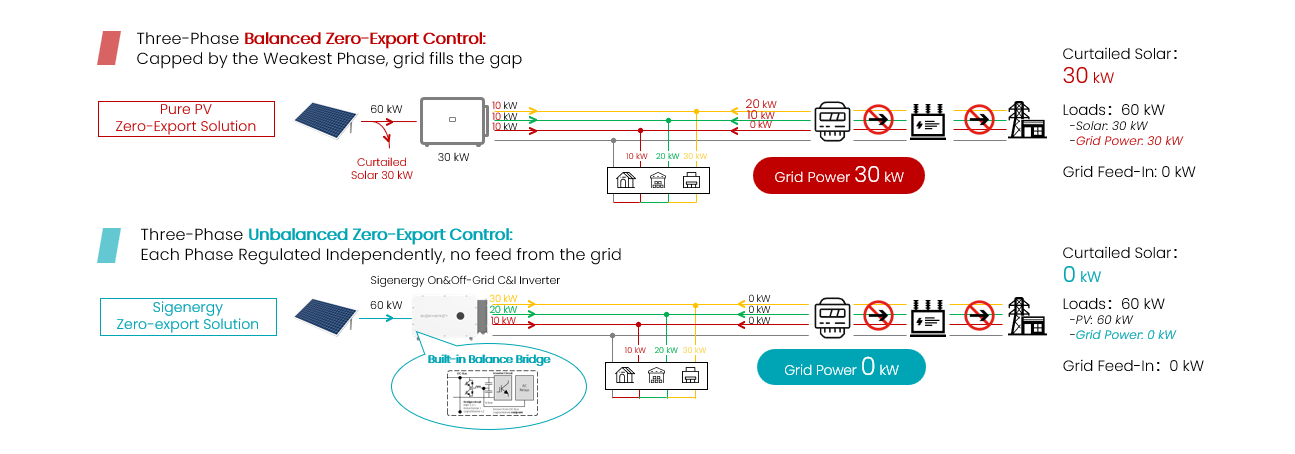
Consider the figure example above:
For
C&I facilities with hundreds of kilowatts or megawatt-level PV systems,
this difference scales dramatically, impacting operational efficiency, energy
yield, and long-term financial performance.
Seemingly
Simple ‘Three-Phase Independence’: The System-Level Redesign Behind It
Three-phase
independent dispatch may sound simple but enabling it requires fundamental
changes in both hardware and software architecture.
1.
Hardware Innovation: Neutral-Line Integration for True Unbalance Control
Traditional
inverters use the neutral line only for voltage sensing. While Sigenergy’s
design goes further by integrating the neutral line directly into the internal
inverter topology. This allows the system to internally absorb and regulate
unbalanced currents instead of relying on the grid balance. This hardware
architecture creates the physical foundation for real per-phase control.
2.
Millisecond-Level EMS for Dynamic Industrial Loads
Industrial
equipment switches on and off abruptly, instantly changing phase loads. To
prevent reverse power flow and misallocation, the inverter must respond in real
time.
Sigenergy’s
system uses a self-developed EMS, built into the inverter and supporting
parallel operation across hundreds of units without external data logger. By entirely
self-developing the EMS, Sigenergy eliminates the latency and mismatch issues
typical in multi-unit parallel C&I systems.
3.
High-Speed Communication: 100 Mbps vs 9,600 bps
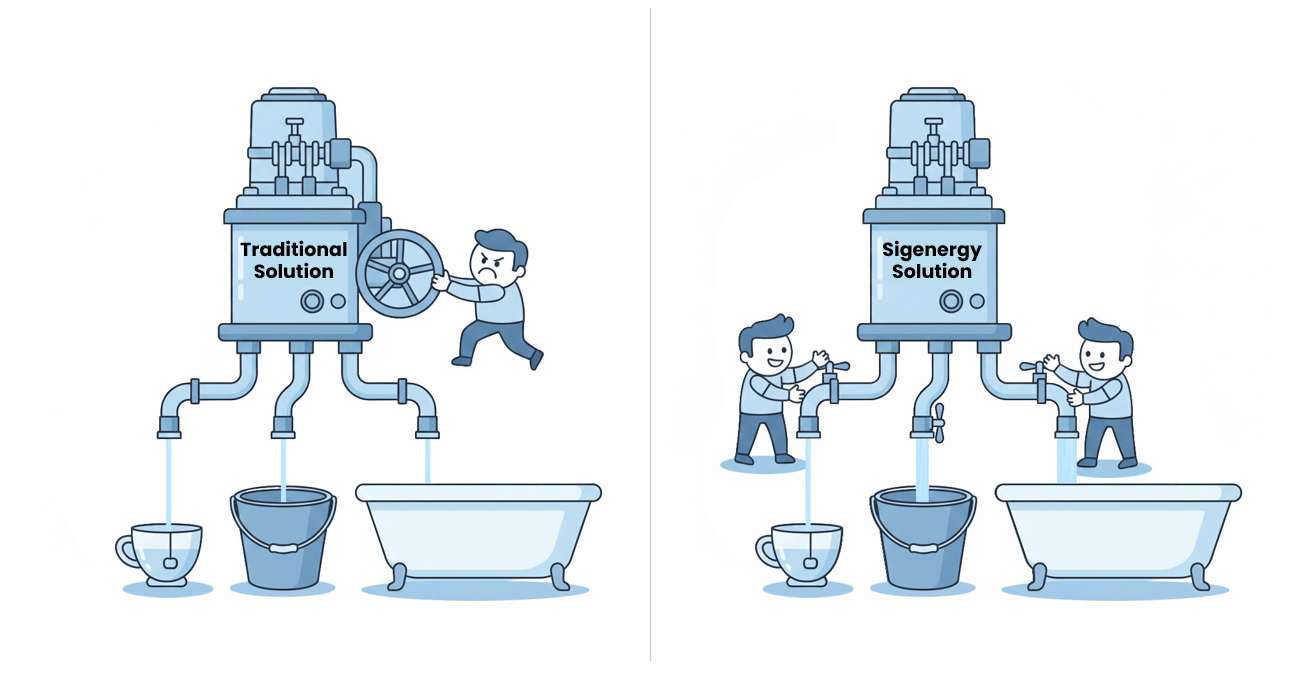
The communication layer is equally critical. Sigenergy employs an FE full-duplex architecture with speeds up to 100 Mbps. By comparison, most C&I inverters rely on RS485 half-duplex at around 9,600 bps, more than 10,000 times slower. In real zero-export scenarios, this difference is decisive:
Importantly,
Sigenergy’s zero-export feature is designed to be exceptionally simple to use.
No additional hardware is required. Users simply enable “Grid
Export Power Limit”
in SigenCloud, and the system automatically enters zero-export mode while
simultaneously activating three-phase independent regulation.
As
energy management becomes increasingly precise, no ray of sunlight should be
wasted. Three-phase unbalance is only one example. Sigenergy continues to turn
technology into tangible value, ensuring every kilowatt-hour is fully captured
and put to meaningful use.




 Cookie Set

These cookies are essential for the proper functioning of my website. Without these cookies, the website would not work properly
| Name | Expiration | Description |
| PHPSESSID | session | Cookie generated by applications based on the PHP language. This is a general purpose identifier used to maintain user session variables. It is normally a random generated number, how it is used can be specific to the site, but a good example is maintaining a logged-in status for a user between pages. |
| cookielist-consent | 1 year | Sets this cookie to remember users' consent preferences so that their preferences are respected on their subsequent visits to this site. It does not collect or store any personal information of the site visitors. |
| sl-session | 1 day | Anti-crawler and machine behavior recognition |
Analytical cookies are used to understand how visitors interact with the website. These cookies help provide information on metrics such as the number of visitors, bounce rate, traffic source, etc.
| Name | Expiration | Description |
| _ga | 1 year | The _ga cookie, installed by Google Analytics, calculates visitor, session and campaign data and also keeps track of site usage for the site's analytics report. The cookie stores information anonymously and assigns a randomly generated number to recognize unique visitors. |
| _ga_6JGTHLPYFN | 1 year | This cookie is installed by Google Analytics. |
| _gcl_au | 3 months | Provided by Google Tag Manager to experiment advertisement efficiency of websites using their services. |