


Necessary



 Login
 Denmark (Dansk)
2026-09-02
Share
Home energy management is becoming more complex, while household needs are becoming more personal. Sigenergy’s Personal Strategy addresses this shift by letting users express what they want in natural language, powered by SigenAgent, the energy industry’s first all-domain AI agent. This article expounds the intelligence behind Personal Strategy and explores three real-world cases showing how AI can support different ways of managing and personalizing home energy.
As rooftop solar, home batteries, and EVs become increasingly common, more households are taking an active role in generating, storing, and managing their own energy. Meanwhile, time-of-use and dynamic tariffs are creating more opportunities to decide when to consume, store, buy, or sell electricity.
As a result, home energy management is no longer simply about producing and using electricity. Households increasingly need to decide when to charge, discharge, buy, or sell, and these decisions can vary significantly from one household to another. One may prioritize solar self-consumption, while an EV owner may need to coordinate charging with household energy use. There is no single definition of the “best” way to manage energy because the right approach depends on each household’s goals, habits, and priorities.
This raises a new question: What if homeowners could simply tell their energy system what they want, instead of figuring out how to configure it? That is the idea behind Sigenergy’s Personal Strategy, which allows users to express their desired outcomes in natural language. Behind this feature is SigenAgent, the energy industry’s first all-domain AI agent.

Before introducing SigenAgent, it is important to distinguish an LLM from an AI agent.
A Large Language Model (LLM) can understand natural language, reason through questions, and generate responses. But on its own, it mainly works with the information available to it. It does not inherently have access to a live energy system or the ability to independently execute actions across connected devices.
An AI agent goes a step further. Built on an LLM, it can understand user intent, access relevant data and tools, plan actions, and execute them toward a specific outcome. In energy management, for example, an agent can go beyond explaining why a battery is not discharging by checking real system conditions and, with user confirmation, taking action accordingly.
In simple terms, an LLM can provide an answer. An AI agent can understand, decide and act.
What does it actually take for an AI agent to understand, decide and act in the real world? The architecture behind SigenAgent provides the answer.
SigenAgent can be thought of as an intelligent energy team with different capabilities working together. On the left, multiple AI models provide language understanding and reasoning capabilities. SigenAgent can work with leading models such as Gemini 3.1 Pro, GPT-5.5, and DeepSeek V4, drawing on their different strengths.
The other components connect SigenAgent with Sigenergy’s energy ecosystem, user interfaces, and supporting resources. A unified MCP gateway provides secure access to the data, tools, and devices it needs to operate. Users can interact with SigenAgent through different entry points, including mySigen App, WhatsApp, and WeChat. In the future, it could also collaborate with other specialized AI agents as the ecosystem evolves.
Together, these components give SigenAgent three defining strengths: deep professional expertise, truly real-time capabilities, and trust and safety.
Deeply Professional:
· Built on data from 200,000+ solar-plus-storage systems and over 10 million operating hours
· Cloud algorithms continuously integrate frontier models
Truly Real-Time:
· End-to-end sensing across PV, storage, EV charging, home loads, and the grid
· Millisecond-level data acquisition and closed-loop control through the built-in EMS
· System data refreshed every 10 seconds
Trust and Safety:
· Data stored locally across six global AWS regions, aligned with GDPR and regional requirements
· Strategies can continue briefly during cloud outages before switching to local control
· Up to 48 hours of strategy explanations for greater transparency
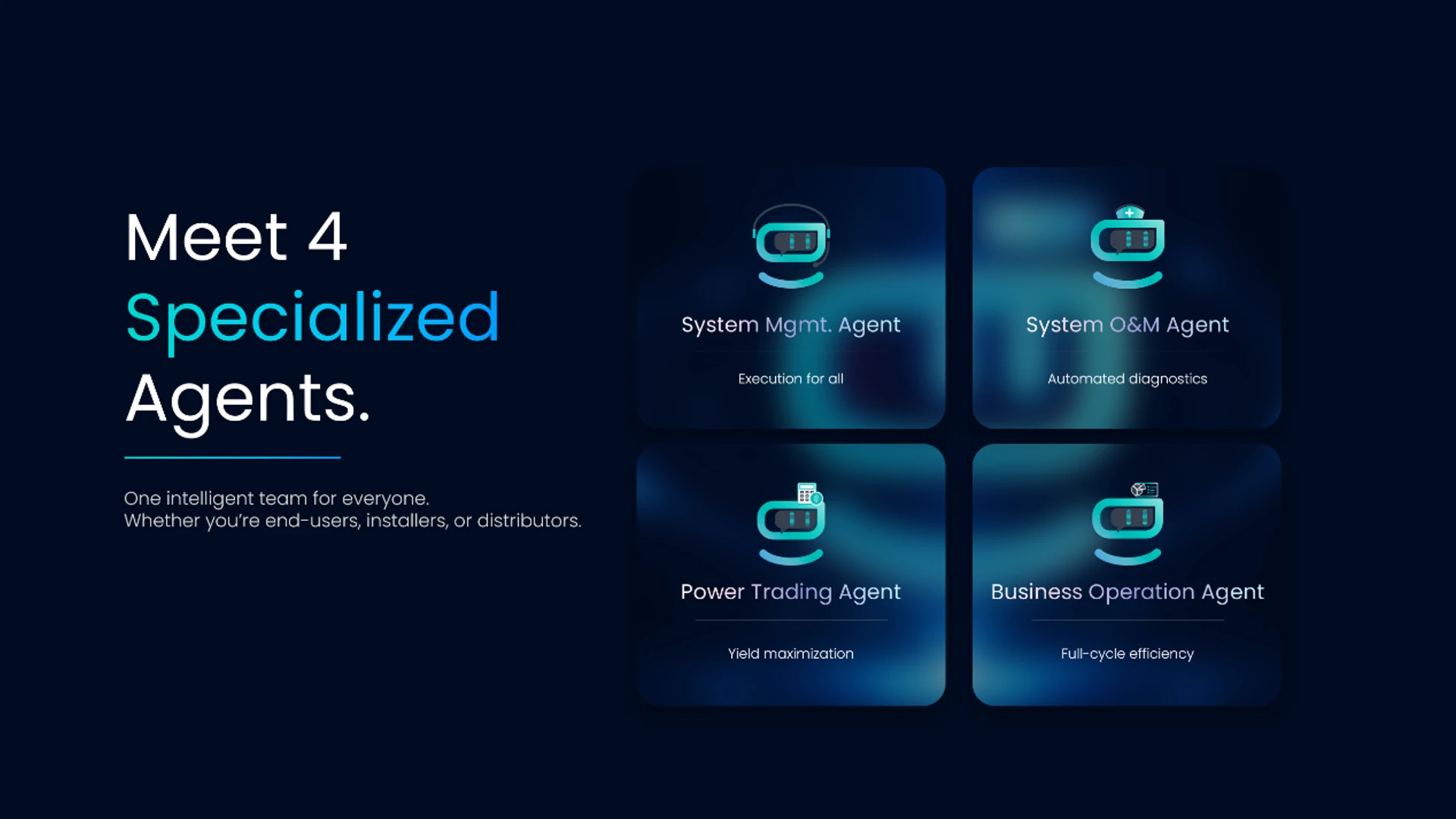
SigenAgent is built around four specialized agents, each designed for a different part of the energy lifecycle.
For residential users, the System Management Agent focuses on personal energy management, including device control, energy analysis, and personalized strategies. It is the specialized agent behind Personal Strategy in mySigen App, turning individual energy preferences into strategies the system can understand and execute.
For other energy scenarios, the System O&M Agent supports automated inspections, fault diagnosis, and O&M reporting. The Power Trading Agent forecasts electricity prices and optimizes charging and discharging to improve energy returns. The Business Operation Agent connects business data with operational insights to support better decisions.
Although their roles differ, all four follow the same fundamental loop: sense, think, act, and optimize.
Since its launch with mySigen App 4.0, Personal Strategy has successfully addressed diverse energy needs across different countries. The following cases show three distinct ways users are personalizing energy management: managing multiple needs across seasons, going beyond predefined modes, and setting personal boundaries for AI.
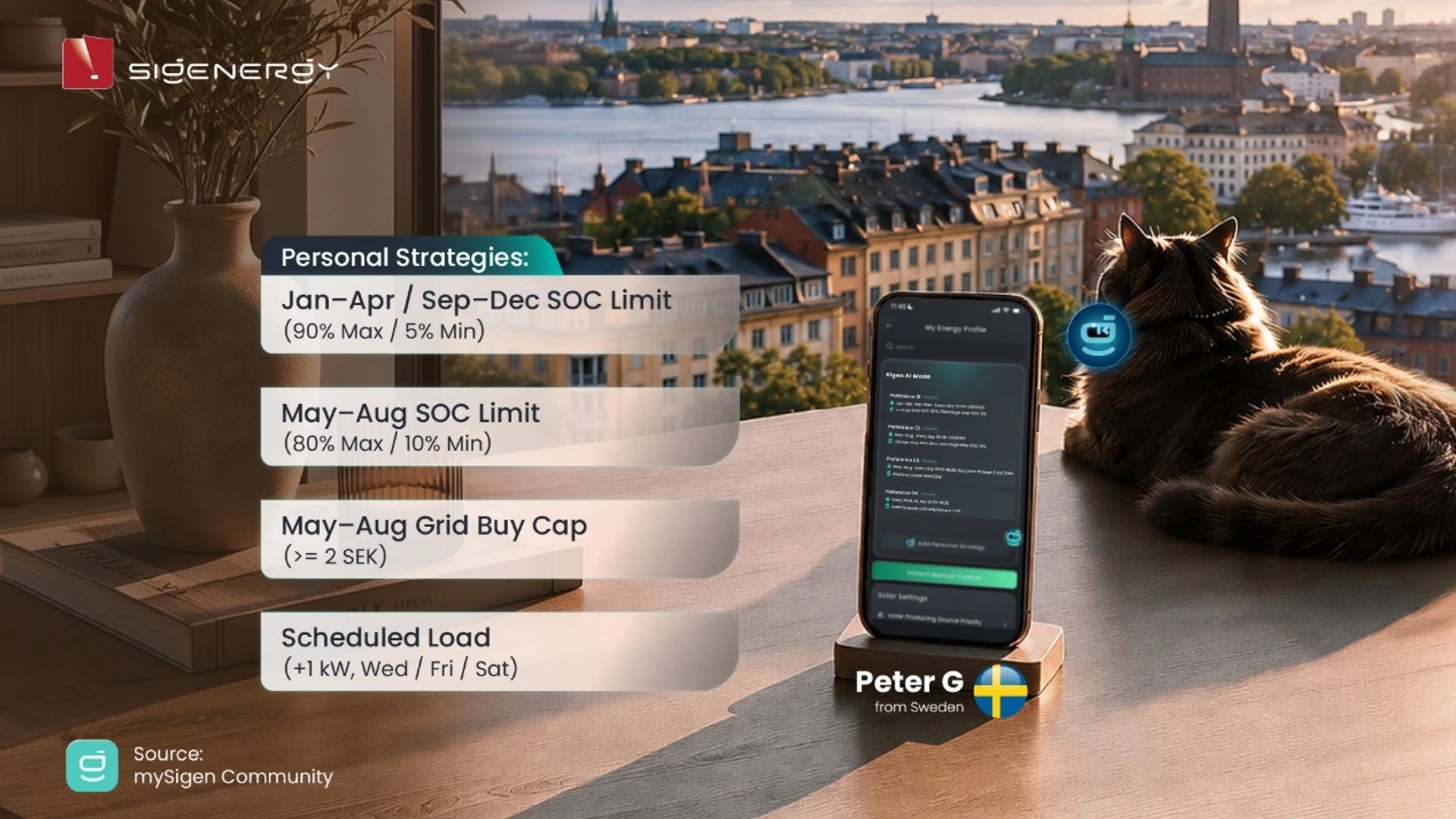
Peter G., Sweden: Adapting Battery Management to Seasonal Needs
Peter wanted to optimize battery usage while reducing unnecessary charge and discharge stress. The goal was to make fuller use of the battery capacity during winter while avoiding deeper cycling during the warmer months.
Peter described these requirements directly to SigenAgent and built four Personal Strategy preferences around them. The first two establish different seasonal SOC limits. From January to April and September to December, the battery is set between 5% and 90% SOC. From May to August, the limits change to 10% to 80% SOC, reducing the depth of charge and discharge during the warmer period.
The third preference addresses electricity prices. Peter told the system to avoid buying electricity between 10:00 and 15:30 unless it is cheap enough. The reasoning is that solar generation should normally cover charging and self-consumption during the summer, while daytime electricity is typically more expensive during the winter in the SE3 region of Sweden. The fourth preference accounts for an additional 1 kW household load on Wednesdays, Fridays, and Saturdays from trickle charging an EV.
Together, these four preferences give the system a clearer picture of the household’s needs, helping it adapt across seasons, prices, and daily routines.
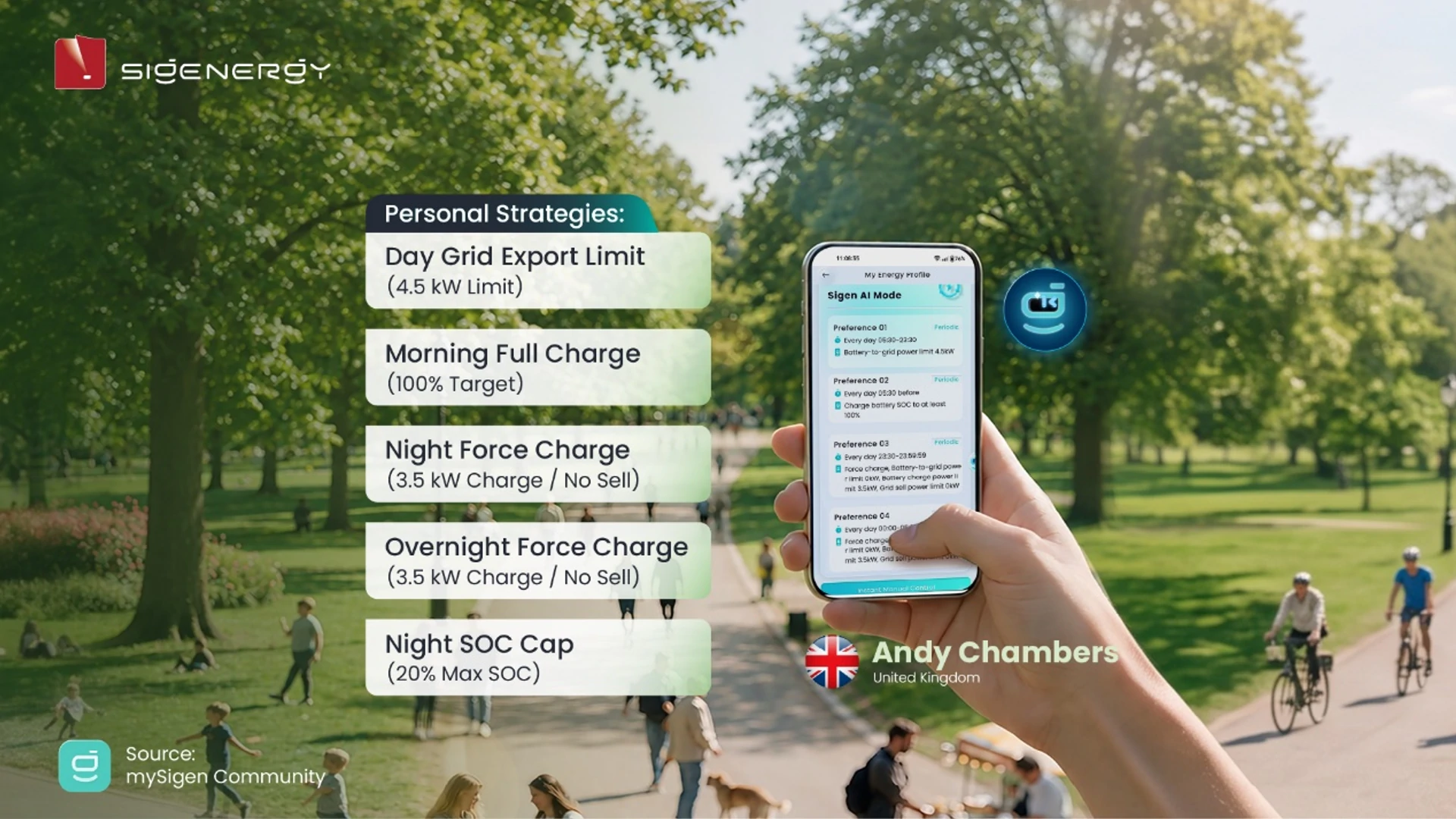
Andy Chambers, United Kingdom: Balancing Profit and Battery Wear
Andy had previously stopped using AI because neither of the available modes matched the way the battery needed to operate. The priority was to benefit from cheaper overnight electricity without adding unnecessary battery wear.
Personal Strategy allowed these requirements to be combined into one setup. The battery charges overnight to 100% at a maximum rate of 3.5 kW, while overnight battery-to-grid export is disabled to avoid unnecessary cycling.
For the evening, the system is set to discharge at up to 4.5 kW and reach 20% SOC by 23:30. Rather than requiring a fixed discharge schedule, the AI determines when to start discharging based on the target, so the battery reaches the required SOC at the right time and can then recharge during the cheaper overnight period.
This gives Andy a level of control that predefined modes could not provide, while leaving the AI to determine the timing needed to meet those personal requirements.
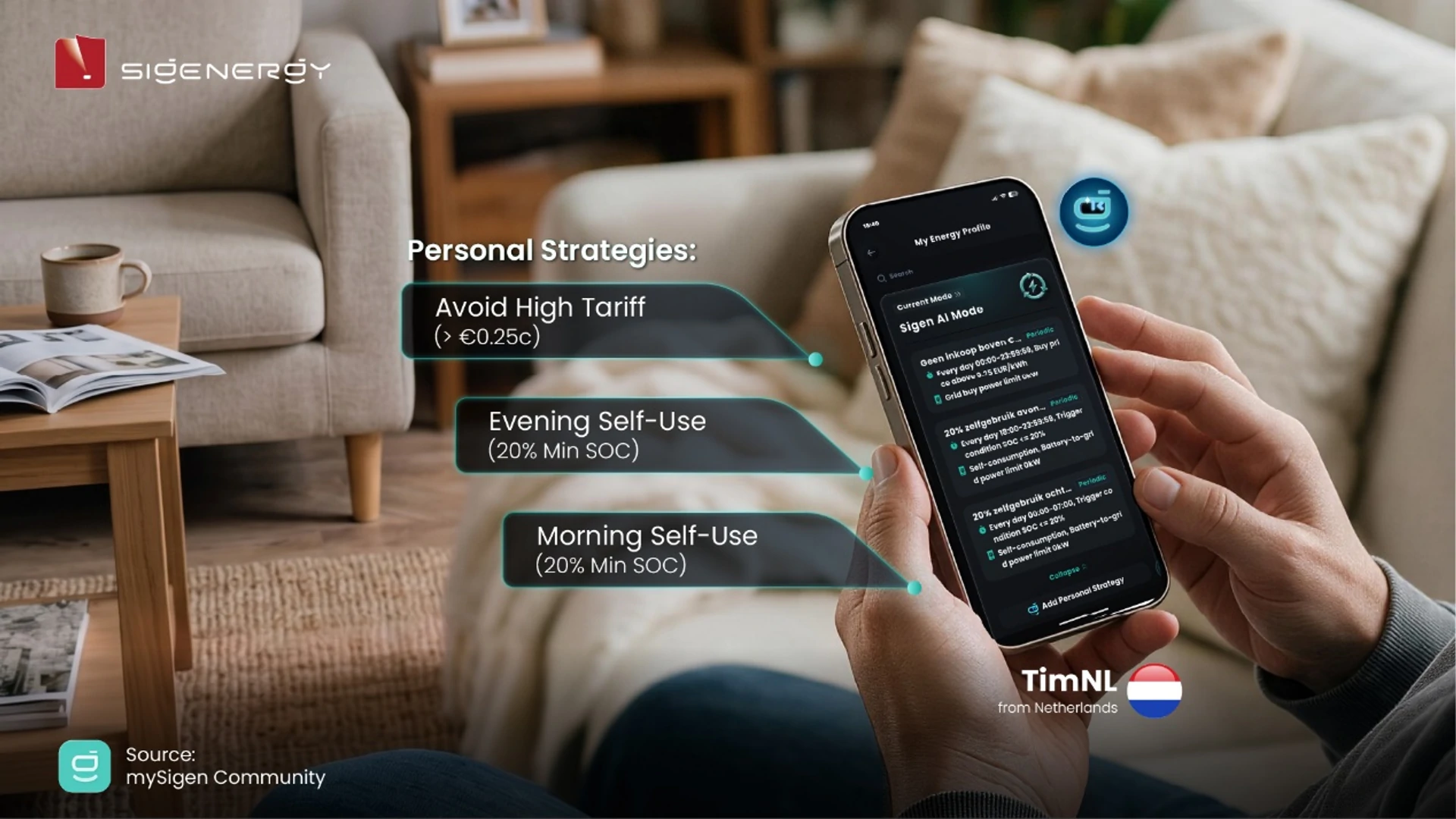
TimNL, Netherlands: Setting Personal Guardrails for AI
TimNL wanted to make full use of self-generated solar energy while keeping grid purchases below a personal price limit. The key requirement was to never buy electricity above €0.25/kWh, while reserving around 20% SOC for household use during the night and morning.
TimNL first asked the AI to prevent any grid purchase above €0.25/kWh, creating a 24/7 Personal Strategy. Meanwhile, another request asked the AI to keep 20% SOC for self-consumption from 18:00 to 07:00, creating separate night and morning strategies.
TimNL also wanted to limit unnecessary energy trading. Although the actual difference between the buy and sell prices was 9 cents, this user felt this would make the AI trade too frequently. By lowering the sell price to keep the gap with the buy price within 3–9 cents, the strategy significantly reduced trading activity—to no more than about once a day, resulting in an average of around 0.9 battery cycles per day over the year.
Without these personal “guardrails,” the AI could sell too much stored energy, leaving the battery empty and requiring grid purchases during the night or morning. TimNL estimates this previously cost around €1 per day. With the additional rules in place, the system can prioritize using self-generated solar energy, sell surplus electricity to the grid, and avoid buying energy above the €0.25/kWh limit.
This case shows another side of Personal Strategy: users can define not only what they want the AI to do, but also the boundaries within which they want it to operate.
From increasingly complex home energy needs to personalized management, AI is moving beyond information and into real-world energy operations. Personal Strategy shows what this shift can look like in practice. Through SigenAgent, users can define what matters to them while AI handles the complexity of execution.
This reflects the core of Sigenergy’s AI In All strategy: bringing AI deeper into energy across devices, systems, applications, and user interactions. SigenAgent is an important step toward a more personalized energy experience, where AI does not simply understand what users need, but acts on it.





 Cookie Set

These cookies are essential for the proper functioning of my website. Without these cookies, the website would not work properly
| Name | Expiration | Description |
| PHPSESSID | session | Cookie generated by applications based on the PHP language. This is a general purpose identifier used to maintain user session variables. It is normally a random generated number, how it is used can be specific to the site, but a good example is maintaining a logged-in status for a user between pages. |
| cookielist-consent | 1 year | Sets this cookie to remember users' consent preferences so that their preferences are respected on their subsequent visits to this site. It does not collect or store any personal information of the site visitors. |
| sl-session | 1 day | Anti-crawler and machine behavior recognition |
Analytical cookies are used to understand how visitors interact with the website. These cookies help provide information on metrics such as the number of visitors, bounce rate, traffic source, etc.
| Name | Expiration | Description |
| _ga | 1 year | The _ga cookie, installed by Google Analytics, calculates visitor, session and campaign data and also keeps track of site usage for the site's analytics report. The cookie stores information anonymously and assigns a randomly generated number to recognize unique visitors. |
| _ga_6JGTHLPYFN | 1 year | This cookie is installed by Google Analytics. |
| _gcl_au | 3 months | Provided by Google Tag Manager to experiment advertisement efficiency of websites using their services. |