


Necessary



 Login
 Global (English)
05 Nov, 2026
Share
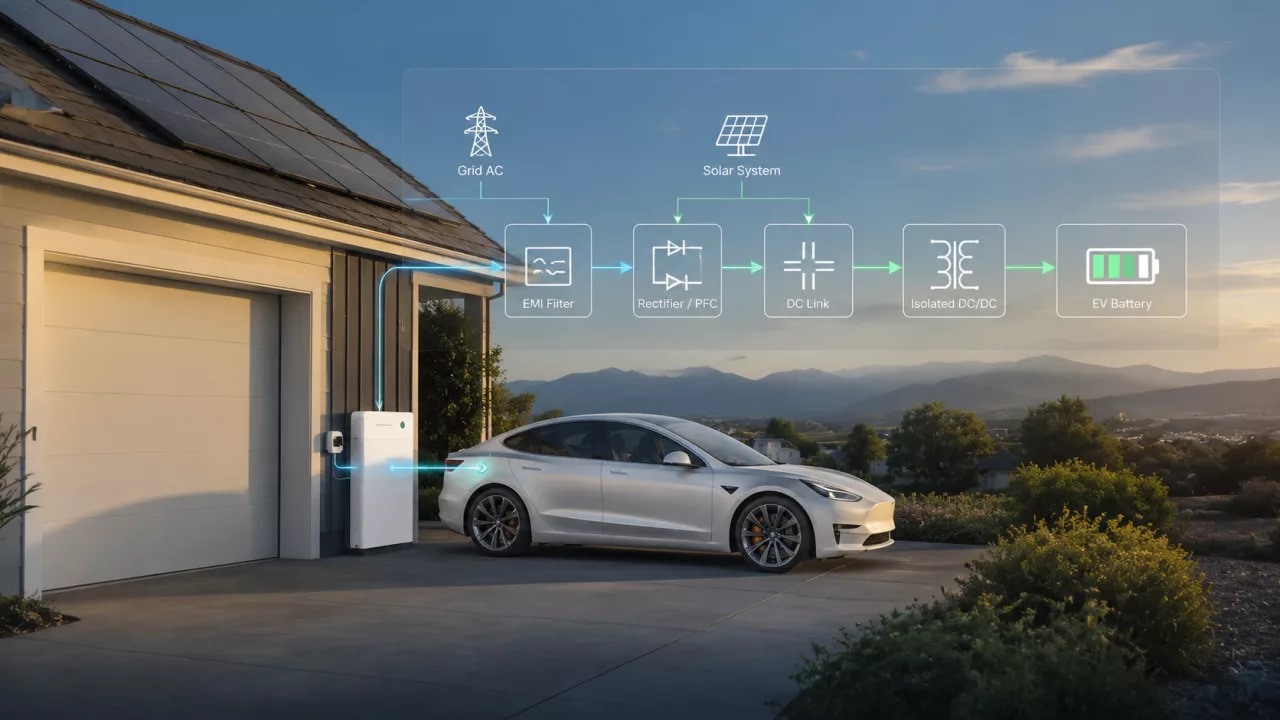
In a home with solar and storage, the energy going into an EV can take a short path or a long one, and DC coupling is the short one. Panels and home batteries both produce direct current already, so our EV DC charging module takes that power and regulates it to the voltage and current the car is asking for. Fewer conversion stages sit in the middle, which lifts overall system efficiency and puts more self-generated energy into the vehicle.
That changes what a charger actually does in the house. In our installations it behaves like part of the household energy system, deciding which source supplies the session, how the power is shaped on the way to the car, and whether the vehicle can send energy back to the home or the grid when that makes sense.
The connector decides compatibility, while the energy path decides running cost and carbon footprint. Two households can use identical plugs and see very different outcomes, because one draws evening grid power and the other draws midday solar through its own DC link.
Home charging is where most of this plays out. The IEA reports that private charging points for light-duty electric vehicles passed 43 million worldwide in 2025, supporting an electric light-duty fleet of roughly 76 million vehicles, and expects home charging to remain the preferred option for drivers with a driveway, garage or dedicated space. Its analysis of EV charging in the Global EV Outlook 2026 is a useful reference here. Because the car sits at home for long hours, small differences in sourcing and conversion compound over a year.
In our SigenStor architecture, PV and battery power reach the vehicle through a shared DC link coordinated by the SigenStor energy management system. Power can flow from PV DC, Sigen Battery DC or the grid into the Sigen EV DC Charging Module, where voltage and current are regulated before reaching the CCS2 connector and the vehicle's battery management system.
Conventional AC wall boxes work differently. They deliver alternating current and rely on the vehicle's onboard charger for conversion, which limits charging power to what the onboard unit can handle and adds extra conversion steps when the energy originally comes from rooftop solar or a home battery. Our SigenStor EV DC charging module works on the DC side, with direct access to power from the batteries and the solar array.
Our SigenStor EVDC supports a 150 V to 1000 V output range through a CCS2 connector, making it suitable for both 400 V and 800 V vehicle platforms. It is purchased at the 12.5 kW level as standard and can be upgraded to 25 kW through a software license in eligible markets and system configurations. These ratings apply specifically to SigenStor EVDC, rather than to DC charging as a category. The module uses the same stackable mounting design as the wider SigenStor system, combines smart air cooling with an IP66-rated enclosure, and removes the need for dust-filter cleaning, so it can be installed outdoors as part of the SigenStor 5-in-One system.
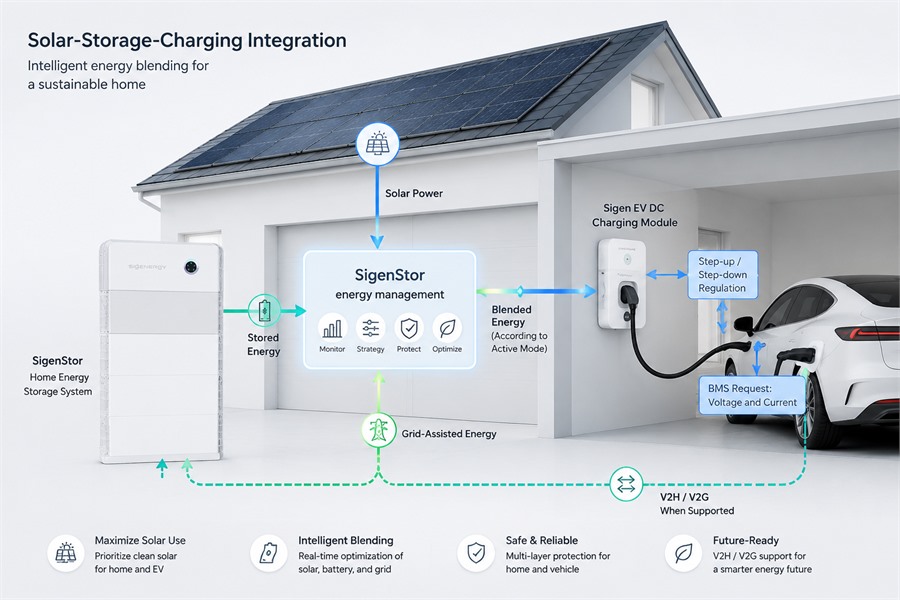
In our system, each charging session is coordinated between the vehicle, our EV DC charging module and the SigenStor energy management layer. Together, they determine how much power is delivered and which source it comes from.
The communication layer behind the second step follows international standards, with ISO 15118-20 covering message sequences for bidirectional power transfer. Adoption varies by manufacturer and model year, which is one reason vehicle support for reverse power flow remains uneven.
Rated power sets a ceiling, and that ceiling is rarely the number a driver sees all session. Our 25 kW module can add roughly 150 km of driving range in an hour under favourable conditions, though the figure on any given afternoon depends on several moving parts.
| Factor | How it shapes delivered power |
|---|---|
| Vehicle BMS limits | The car requests the current, and the module fills that request |
| State of charge | Power tapers as the pack approaches full |
| Battery temperature | A cold or very warm pack accepts less current |
| Active charging mode | Solar-led modes follow generation, while fast charging uses every available source |
| PV output and battery SOC | Surplus and stored energy set how much comes from on-site sources |
| Household loads | Priority settings and household demand determine how much surplus energy remains for the EV |
In commissioning work we regularly watch power step down in small increments as the vehicle recalculates its limits, so the same car on the same module can behave differently on two consecutive days.
We offer three modes for most household charging patterns. Fast Charging maximises power at up to 25 kW by pulling from solar, storage and the grid together, which suits a short turnaround before an evening trip. PV Surplus Charging sends excess solar to the car, with an adjustable surplus PV priority that ranks the charger against other household loads. Battery Boost Charging lifts charging speed using the home battery, with a cut-off state of charge so the house keeps its reserve.
In our mySigen app, owners can set modes and schedules, view live energy flows, and tune the balance between speed and green share, leaning on off-peak windows in winter and surplus solar in summer.
With our SigenStor bidirectional charging, an EV can receive energy and, when supported by the vehicle and local rules, send energy back. V2H sends power from the EV to the home, helping cover household loads during an outage or a peak-price period. When used together with our Sigen Battery, the total available storage can exceed 100 kWh, depending on the EV battery size and the selected Sigen Battery configuration. V2G sends power from the EV to the grid for peak shaving, load balancing or VPP dispatch in markets where this is allowed.
We test V2X with real vehicles because the connector alone does not confirm reverse-power support. Our V2X records cover tested vehicle combinations by brand, model, charging interface, date and country, including CCS1, CCS2, NACS and GB/T vehicles. We list a vehicle when one continuous discharge session reaches 10 kWh, lasts at least 15 minutes or reduces state of charge by 10%. Before planning V2H or V2G, we recommend confirming vehicle support, local grid rules and the selected SigenStor configuration. Our joint white paper on bidirectional charging with The Mobility House Energy explains the wider regulatory and aggregation context.
We usually start with how the household charges and whether reverse power flow matters. The Sigen EV AC Charger comes in 7 kW, 11 kW and 22 kW versions with a Type 2 connector, 4G, WLAN and Ethernet connectivity, dynamic load management, automatic phase switching, off-peak scheduling and solar surplus consumption, all housed in an IP65 enclosure with IK10 reinforced glass. For overnight charging and daily commuting, this combination is hard to beat on cost and simplicity.
For households that want DC-coupled charging from solar and storage, faster daytime replenishment and a path into V2H and V2G, we recommend the EV DC charging module. Both units work within our energy management system, and some households may combine both, depending on their vehicles and charging habits.
Yes, when generation is sufficient. PV Surplus Charging routes excess solar to the vehicle after household loads are covered, so on a clear day a full session can come from the roof. On cloudy days the system blends in stored or grid energy according to the active mode.
Because the vehicle sets the request and the system supplies what is available. Battery temperature, state of charge, the car's voltage platform, the selected mode, PV output and household demand all shape the delivered figure.
No. Reverse power flow requires the vehicle to support it, and availability differs by model, region, software version and local regulation. Checking the current tested model list before ordering is the sensible step.
Overnight charging on a predictable schedule points toward the AC charger. DC-coupled charging from solar and storage, faster daytime sessions and bidirectional operation point toward the EV DC module.
We design charging hardware as part of the energy system around it. That is why our EV charging, storage, inverter and energy management work as one coordinated system, with our SigenStor energy management deciding how solar, stored energy and the grid are combined for each session. Our installer network can help size the right combination for a given roof, tariff and vehicle.




 Cookie Set

These cookies are essential for the proper functioning of my website. Without these cookies, the website would not work properly
| Name | Expiration | Description |
| PHPSESSID | session | Cookie generated by applications based on the PHP language. This is a general purpose identifier used to maintain user session variables. It is normally a random generated number, how it is used can be specific to the site, but a good example is maintaining a logged-in status for a user between pages. |
| cookielist-consent | 1 year | Sets this cookie to remember users' consent preferences so that their preferences are respected on their subsequent visits to this site. It does not collect or store any personal information of the site visitors. |
| sl-session | 1 day | Anti-crawler and machine behavior recognition |
Analytical cookies are used to understand how visitors interact with the website. These cookies help provide information on metrics such as the number of visitors, bounce rate, traffic source, etc.
| Name | Expiration | Description |
| _ga | 1 year | The _ga cookie, installed by Google Analytics, calculates visitor, session and campaign data and also keeps track of site usage for the site's analytics report. The cookie stores information anonymously and assigns a randomly generated number to recognize unique visitors. |
| _ga_6JGTHLPYFN | 1 year | This cookie is installed by Google Analytics. |
| _gcl_au | 3 months | Provided by Google Tag Manager to experiment advertisement efficiency of websites using their services. |