


Necessary



 Login
 Global (English)
05 Nov, 2026
Share
Are home EV chargers AC or DC? Most home EV chargers are AC chargers, especially when the goal is simple overnight charging and daily range recovery. For this use case, Sigenergy offers the Sigen EV AC Charger, which supports daily home charging with solar power, smart tariffs, and Battery Boost Charging.
DC home charging makes more sense when you want the EV to work more closely with SigenStor, solar, storage, home backup, or future V2H and V2G use. For that more advanced setup, Sigenergy offers the SigenStor EV DC.
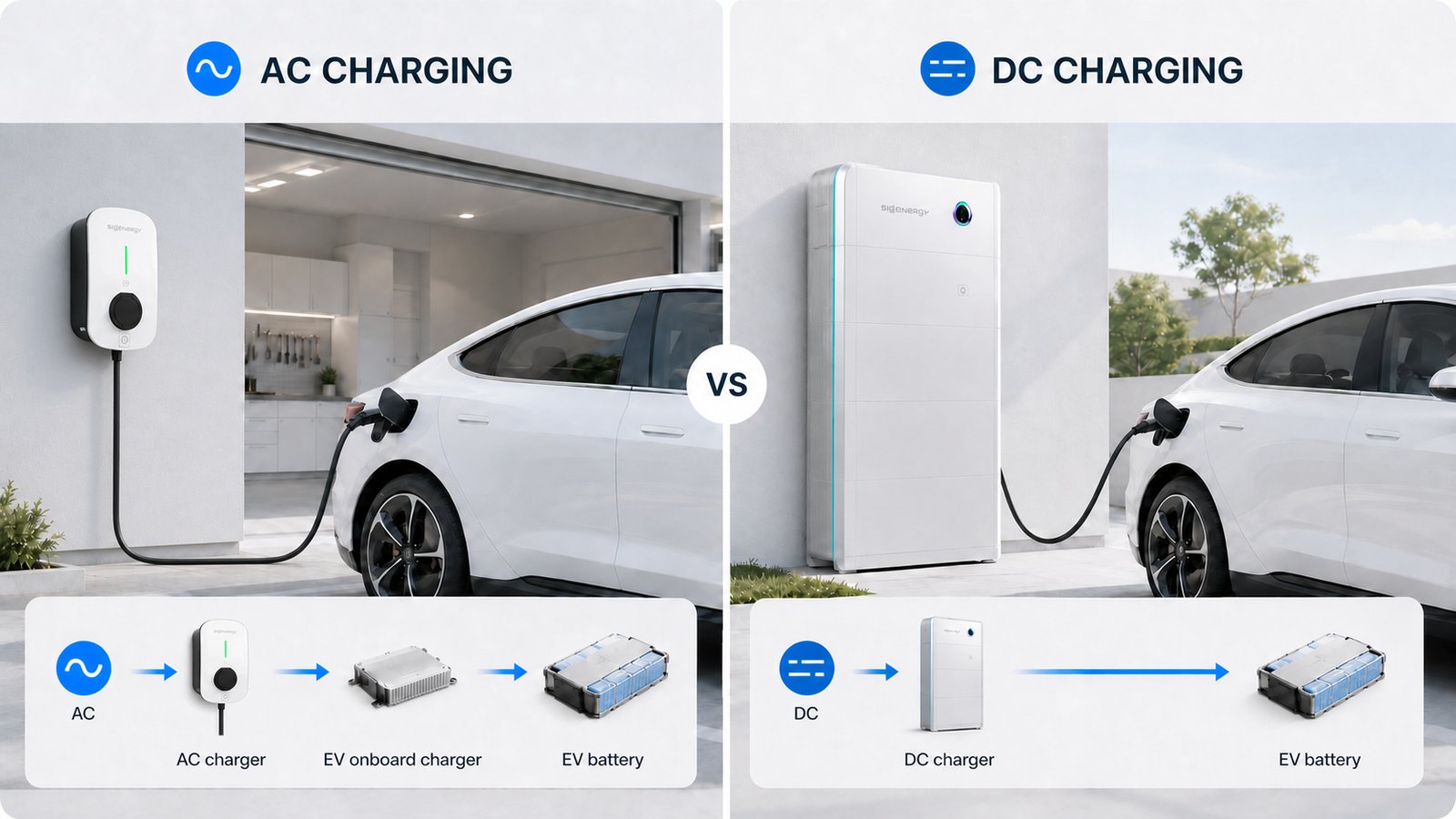
Most drivers do not need a fast-charging station in the garage. They need a charger that works smoothly while the car is parked for several hours or overnight. That is why we designed the Sigen EV AC Charger around everyday home routines: come home, plug in, set your preferences, and let the system manage the charging plan.
AC charging works well at home because your house already receives AC power. The charger sends AC power to the car, and the car’s onboard charger converts it into DC power for the EV battery. The process may sound technical, but the experience should feel simple: the EV charges around your schedule, your driving needs, and your home energy plan.
A basic wall charger sends electricity into the car. In a compatible Sigenergy home energy setup, the Sigen EV AC Charger can do more by responding to solar output, electricity prices, and home battery support through SigenStor.
This helps homeowners use surplus solar power when available, schedule charging around dynamic electricity tariffs, and access Battery Boost Charging when the charger is connected to a compatible Sigenergy setup and the SigenStor configuration supports it. For example, if the EV is plugged in during a sunny afternoon, the system can prioritize surplus solar charging; if the car is out during the solar peak, it can schedule charging for a lower-rate window later in the day while keeping enough range for the next morning.
DC charging is different because the charger delivers DC power more directly to the EV battery. That is why DC chargers are usually associated with faster public charging. At home, DC charging matters most when the EV needs to interact with solar, storage, backup, or bidirectional energy flow.
With SigenStor EV DC connected to SigenStor, solar power, home battery storage, and the EV can work together instead of operating separately. In this setup, the SigenStor EV DC acts as the bridge between the EV battery and the home energy system. For example, on a sunny afternoon when rooftop solar production is higher than household demand, the system can help direct more surplus solar energy into the EV battery instead of exporting it to the grid. If backup power is needed later, a compatible EV and system design may also help support selected essential home loads, depending on the vehicle, installation, and local regulations.
We do not see EV charging as a standalone product category. We see it as one part of a full home energy system. That is why SigenStor 5-in-One Home ESS brings together the solar inverter, EV DC charger, battery PCS, battery pack, and energy management in one integrated platform.
With these parts working in one system, the charging decision is no longer just AC or DC. The system can also decide where solar power should go first, whether the EV should charge during a lower-rate tariff window, and how much energy should be kept for home backup, so homeowners can manage daily charging without making every energy decision manually.
Use AC charging when you mainly need reliable daily range recovery; consider DC charging when you want the EV to work as part of a solar-plus-storage, backup, or bidirectional home energy system.
| Charging type | Best for | Key capability | Limits to check |
|---|---|---|---|
| AC charging with Sigen EV AC Charger | Daily home charging, overnight range recovery, and lower-cost scheduled charging. | Supports up to 22 kW and can work with SigenStor for PV surplus charging, dynamic tariffs, scheduled charging, and Battery Boost Charging. | Actual speed depends on the home electrical setup, charger setting, EV onboard AC charger limit, tariff availability, and installer configuration. It is mainly for one-way charging. |
| DC charging with SigenStor EV DC / Sigen EV DC Charging Module | Faster home charging, solar-plus-storage integration, backup planning, and advanced V2X use cases. | Supports 25 kW bidirectional charging and can connect the EV more directly with SigenStor, solar, battery storage, and home energy management. | V2H or V2G use depends on EV compatibility, software support, system design, installation conditions, and local rules. Actual charging and discharging performance may vary by EV and site. |
In short, AC charging is usually the practical choice for everyday home charging. DC charging makes more sense when you want the EV to become part of a larger home energy system.
Bidirectional charging is the main reason to consider home DC charging. With SigenStor EV DC, the system supports 25 kW bidirectional charging and may enable V2H or V2G use cases when the EV, software, installation design, and local regulations allow it. Traditional charging is one-way: the home charges the car. Bidirectional EV charging opens the door to two-way energy movement, where the EV can also support the home or grid.
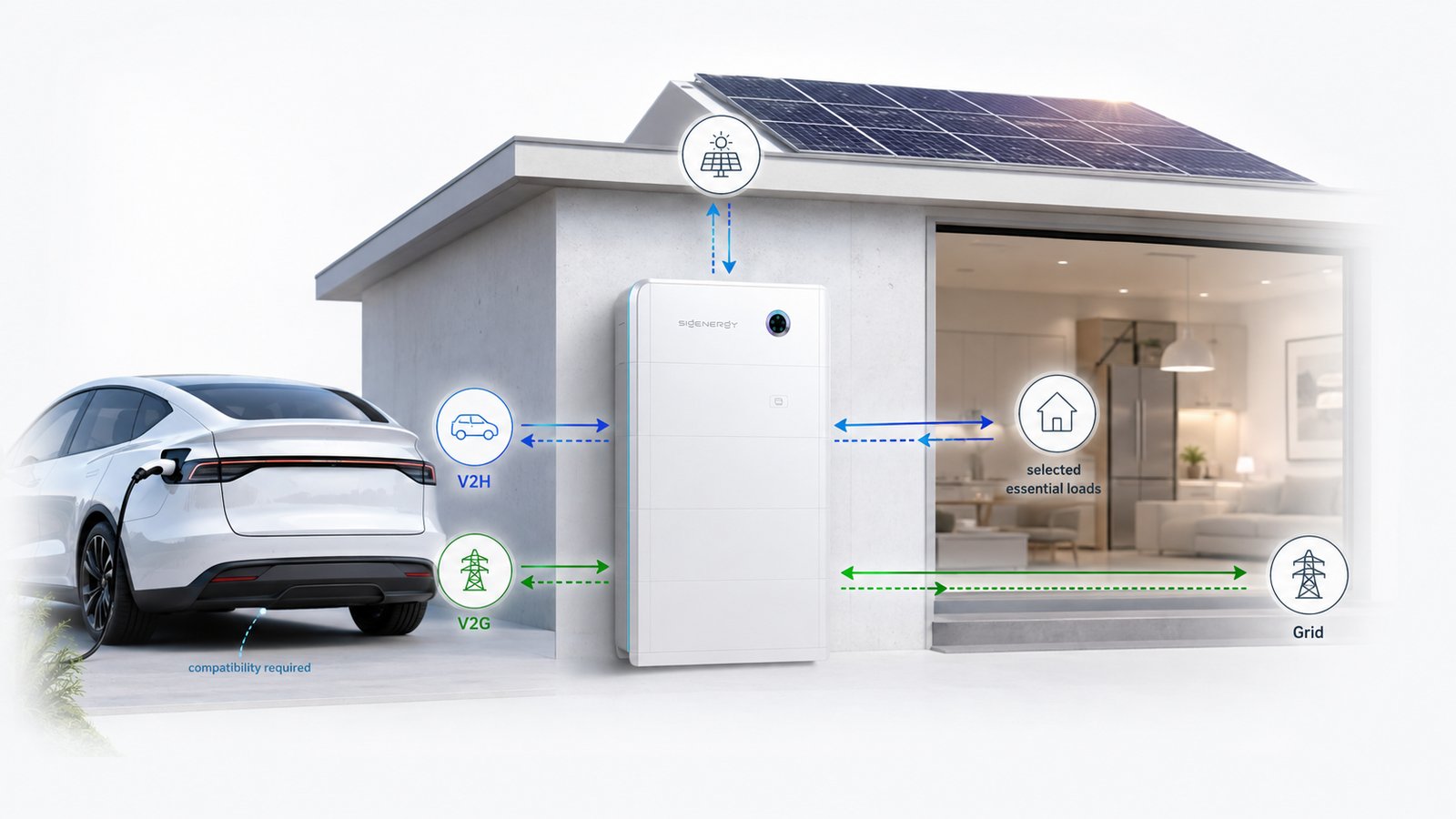
In a solar home, the key question is not only how the EV charges, but how the system decides when the EV can give energy back. A bidirectional setup needs clear rules for discharge permission, driving reserve, home backup reserve, tariff windows, and which essential loads may receive support. These settings depend on the EV model, charger, SigenStor configuration, software support, installation design, and local regulations, so they should be confirmed before planning V2H or V2G.
This is also why we do not treat every EV the same. One vehicle may support bidirectional discharge in a tested setup, while another may only be suitable for one-way charging today. Homeowners and installers can review our global V2X field test results as a starting point, then confirm the details in the compatibility check below.
As EV batteries get bigger, they can become valuable energy resources, not just batteries for driving. With the right charger and system design, they can help make the home more resilient and more efficient. But we are careful about the limits. EV charging is moving from “plug in the car” to “manage energy across the home,” and the best setup starts with confirming what the vehicle and local installation can actually support.
Before planning V2H or V2G, we start with compatibility. First, the homeowner confirms the EV brand, model, model year, and charging interface. The installer can then compare that information with Sigenergy’s global V2X field test results, which list tested vehicle models, charging interfaces, test dates, and test regions. These field test results are a practical starting point for compatibility checks, not vehicle-maker certification. Actual performance and availability may vary by region, software version, and model year.
Next, the installer checks the site conditions: whether the home energy system can support SigenStor EV DC, whether the installation design is suitable, and whether any adapter, connector, or configuration limit applies. The EV’s software version also needs to be confirmed, because V2X behavior may change with updates and regional settings.
Finally, the installer or local Sigenergy service team should confirm local rules before enabling a V2H or V2G use case. A tested vehicle is useful evidence for planning, but final setup still depends on the EV’s capabilities, system design, installation conditions, software settings, and the local regulatory framework.
Solar homes have a special challenge. The sun does not always shine when the car is plugged in, and the car is not always home when solar production is highest. That is why the charger needs to work with the energy system, not against it.
With our AC charging path, homeowners can use PV surplus and tariff-aware charging to make daily charging cleaner and more cost-effective. With our DC charging path and SigenStor, homeowners can go further by connecting the EV more directly with solar, storage, and bidirectional energy use.
We also talk about this broader shift in our bidirectional EV charging guide. The goal is to help the EV charge from surplus solar, reserve enough energy for daily driving, and support selected home loads when V2H conditions are met.
If your main goal is easy, reliable everyday charging, AC is usually the best starting point. The Sigen EV AC Charger supports daily driving with practical smart energy features, including surplus solar use, tariff-aware charging, and battery boost support in a compatible Sigenergy setup.
If you want a more future-ready home energy system, DC may be the better path. In a SigenStor system, the SigenStor EV DC acts as the bridge between the EV battery, solar power, home battery storage, and energy management. This setup can support faster charging, solar-to-EV coordination, backup-ready design, and bidirectional energy options when the EV, software, installation, and local rules allow it.
To confirm the right setup for your home, you can contact Sigenergy or speak with a certified installer about EV compatibility, system design, and local installation requirements.
Sigenergy offers both. The Sigen EV AC Charger is built for everyday home charging, supporting smart charging with solar, dynamic tariffs, and SigenStor integration. For more advanced needs, SigenStor EV DC supports faster DC charging, bidirectional energy flow, and deeper integration with solar, storage, V2H, and V2G.
Yes, for many drivers. If your EV is parked at home for several hours and you mainly need daily range, AC charging is usually practical, reliable, and cost-effective.
We would recommend a DC charger if you want more than basic charging, such as faster charging, V2H readiness, V2G potential, solar-to-EV integration, and stronger connection with your home battery system.
It may be able to, but only when your EV, charger, system design, software, and local regulations support bidirectional operation. That is why we recommend checking tested V2X compatibility before planning a V2H setup.
For simple daily EV charging, we would start with the Sigen EV AC Charger. For a more advanced solar home with storage, backup planning, and bidirectional EV charging goals, we would look at SigenStor EV DC with SigenStor.




 Cookie Set

These cookies are essential for the proper functioning of my website. Without these cookies, the website would not work properly
| Name | Expiration | Description |
| PHPSESSID | session | Cookie generated by applications based on the PHP language. This is a general purpose identifier used to maintain user session variables. It is normally a random generated number, how it is used can be specific to the site, but a good example is maintaining a logged-in status for a user between pages. |
| cookielist-consent | 1 year | Sets this cookie to remember users' consent preferences so that their preferences are respected on their subsequent visits to this site. It does not collect or store any personal information of the site visitors. |
| sl-session | 1 day | Anti-crawler and machine behavior recognition |
Analytical cookies are used to understand how visitors interact with the website. These cookies help provide information on metrics such as the number of visitors, bounce rate, traffic source, etc.
| Name | Expiration | Description |
| _ga | 1 year | The _ga cookie, installed by Google Analytics, calculates visitor, session and campaign data and also keeps track of site usage for the site's analytics report. The cookie stores information anonymously and assigns a randomly generated number to recognize unique visitors. |
| _ga_6JGTHLPYFN | 1 year | This cookie is installed by Google Analytics. |
| _gcl_au | 3 months | Provided by Google Tag Manager to experiment advertisement efficiency of websites using their services. |