


Necessary



 Login
 Global (English)
05 Nov, 2026
Share
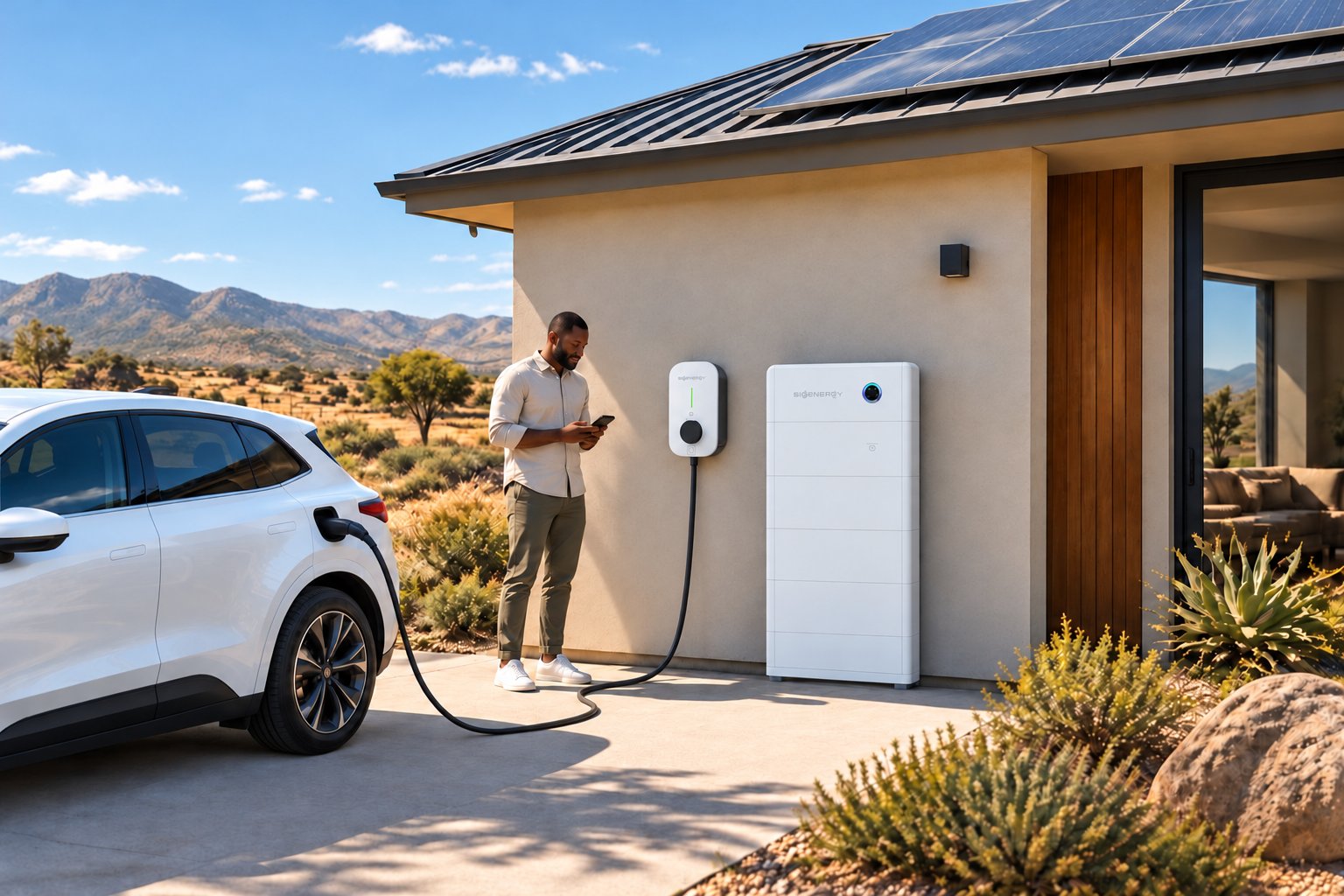
An off-grid solar system can charge an electric vehicle reliably, and the control layer does most of the heavy lifting. An EV battery is often larger than the entire home battery it draws from, so something has to decide, minute by minute, how much sunlight goes to the car, how much protects the house, and how much stays in reserve for the evening. A dependable off grid solar EV charger works as one coordinated energy system covering generation, storage, conversion and management. That is the principle we designed SigenStor around.
Yes, but one condition changes the engineering completely. A grid-connected home has a safety net: if a wallbox draws more power than the solar panels are producing, the shortfall comes from the utility grid. In an off-grid home, every kilowatt-hour sent to the car is one less available for the fridge, heat pump, or lights later that evening. The charger can quickly become one of the home's largest loads.
Two sizing questions usually determine whether the system works day to day. The first is how much energy the EV needs compared with the home's battery capacity. Many current EVs have 50 to 100 kWh battery packs, which can be larger than the usable capacity of a typical residential storage system. Recharging an empty EV in a single off-grid day is therefore rarely realistic, and most drivers do not need to do it. A daily commute usually uses only a fraction of the pack. In practice, the goal is to add enough charge during daylight while keeping the house supplied after sunset.
The second question is how much reserve the system needs for bad weather. Charging on a bright, sunny day is straightforward. The harder part is protecting the home battery during cloudy spells and short winter days, when solar output varies with cloud cover, season, and shading. A fully off-grid home also cannot rely on a cheap overnight tariff. All of its energy has to come from recent solar production or stored battery capacity.
That does not make solar EV charging unusual. The IEA Global EV Outlook 2026 reports that EV owners worldwide charge privately, at home or at work, about 75% of the time. It also says that more than 43 million private chargers served light-duty electric vehicles in 2025. Home charging already supplies most electric miles. An off-grid household faces the same basic question as any other EV owner, but with much less room for wasted energy.
These three scenarios are often discussed together, but they have very different requirements. Separating them early can prevent costly design mistakes. A truly off-grid home has no utility connection. A weak-grid home is connected, but its supply is unreliable or prone to voltage drops, so it needs backup during outages. A grid-connected home has a stable supply and mainly wants to use more of its own solar power. V2H is most relevant to backup and off-grid resilience, while V2G and dynamic tariff optimisation require a grid connection, local regulations, and a compatible vehicle.
This distinction affects both the buying decision and the system design. A true off-grid property needs autonomy, so it requires enough storage and reliable load control. A weak-grid property needs continuity, making backup duration and transfer speed more important. A grid-connected property is usually focused on energy savings, so the system should maximise on-site solar use instead of exporting power when feed-in tariffs are low. Applying advice from one scenario to another can leave you with a system that is oversized, undersized, or poorly controlled.
A reliable off-grid EV charging system is more than a wallbox. It must balance vehicle charging with household demand, battery reserve, and changing solar output. Without that coordination, a system may charge smoothly at midday in summer but struggle during cloudy weather, winter, or evening demand.
Both approaches charge a car from sunlight, and the right choice comes down to how long the vehicle sits at home and how much conversion loss matters to the household. AC charging fits homes where the car parks for long stretches and smart scheduling carries most of the value. DC-coupled charging fits homes where solar and stored energy should reach the vehicle through fewer conversion steps, and where charging speed genuinely counts.
Charging time varies widely with the equipment involved. The US Department of Energy Alternative Fuels Data Center notes that replenishing an EV can range from under 20 minutes with DC fast charging to 20 hours or more on the slowest household equipment, depending on battery state of charge, pack size and the vehicle's onboard charger. That spread carries extra weight off-grid, because a slower charge stretches across more of the solar window.
Range figures reflect our stated performance under suitable conditions and vary with vehicle efficiency, temperature and available generation. They describe these two products specifically and should be read as such, since other chargers on the market will differ.
The Sigen EV AC Charger earns its place in households where the vehicle is parked overnight or through the working day. It follows surplus PV, adjusts power dynamically against household consumption to prevent overloads, and switches between three-phase and single-phase operation where the supply allows. For grid-connected or weak-grid homes on a dynamic tariff, the AI mode reads upcoming prices and concentrates charging into the cheapest and greenest hours. True off-grid properties will lean on the PV surplus and battery boost modes, since tariff optimisation needs a grid connection to work against.
The SigenStor EV DC module takes a different route by tapping DC power directly from the battery and the solar array. Fewer conversion stages mean less energy lost between the roof and the pack, and the module blends solar and stored energy to hold charging power steady while clouds pass. It also runs in reverse, which turns the vehicle into a second reservoir for the house.
Integration keeps an off-grid system predictable. SigenStor coordinates solar generation, battery storage, and compatible EV charging equipment through a unified software architecture. Generation, storage, and vehicle charging are managed through a shared control layer, with charging equipment selected to match the system configuration.
It is designed for homes that rely on their energy system every day. SigenStor uses 314 Ah long-cycle-life cells and five layers of battery protection. Its IP66 rating supports outdoor installation, while 0 ms load-side switching helps keep sensitive equipment running during a fault. The modular battery design lets families start with the capacity they need and expand it as driving patterns change. Each pack has its own DC-DC optimiser, so packs with different ages, capacities, or states of health can operate in parallel without allowing a weaker module to limit the others.
Installation follows the same modular approach. Guided quick connectors engage automatically as modules are stacked. According to our published figures, installation takes about 15 minutes, commissioning takes 5 minutes, OTA upgrades take 2 minutes, and full-system diagnosis is available with one click.
Control determines whether an off-grid system works smoothly day after day. The mySigen app tracks energy from generation to consumption, while the AI-optimised EMS manages the priorities that off-grid living requires. It can balance EV charging against household loads, preserve a reserve in the battery, and set a minimum state of charge so a vehicle top-up does not drain the home's backup reserve.
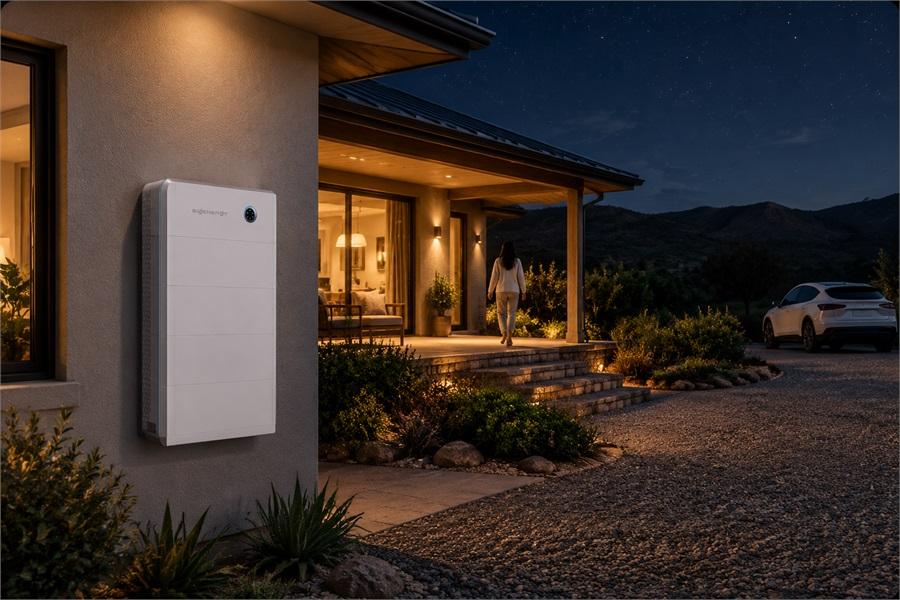
V2H is most useful for off-grid and weak-grid homes. V2G, by contrast, only makes sense where there is a grid connection and local rules support it. With a bidirectional charger, the EV can add to the home's backup capacity when needed. How much extra energy is available depends on the installed Sigen battery capacity and how much charge the vehicle can safely release at that time. For a home that loses power several times a year, a car parked in the driveway can provide a useful additional source of backup power.
For homes considering bidirectional charging, compatibility must be assessed across the vehicle, charger, and home energy system. The Sigen EV DC Charging Module supports bidirectional energy flow, with V2X availability subject to the vehicle's capabilities, software support, and applicable regional requirements. V2H requires a suitable backup configuration, while V2G also requires a grid connection and compliance with local grid and export rules.
Actual performance can still vary with the vehicle's software, model year, and local regulations. We therefore recommend confirming compatibility for the specific vehicle and region before making a purchase.
Off-grid EV charging makes the most sense where the grid is unavailable or unreliable and the vehicle is used every day. Remote homes, farms, and rural properties are a clear fit because extending a utility connection over a long distance can cost more than installing a properly sized solar and storage system. The same applies to properties on weak networks, where voltage drops and seasonal outages make energy independence more valuable.
Homes with a stable grid connection may also benefit. In many markets, feed-in tariffs are well below retail electricity prices, so using surplus solar power to charge an EV can be more valuable than exporting it. Installers see a similar benefit: a complete solar, storage, and charging package with shared commissioning is faster to deliver and easier to support than several separate products with separate warranties.
Good off-grid EV charging design starts from driving behaviour and works backwards to hardware. Typical daily distance sets the energy the vehicle actually needs, and that figure drives everything else. Roof area and orientation then determine realistic generation across the seasons, with the weakest months carrying the most weight. Battery capacity follows from evening consumption plus the buffer required for consecutive low-sun days, and charging power should match what the system can supply while the house stays comfortable.
Three questions round out the picture. Whether the property needs whole-home or partial backup shapes the gateway and load configuration. Whether V2H or V2G is a genuine requirement determines the charger choice, and confirming vehicle compatibility early avoids disappointment later. Local grid codes, permitting rules and export regulations vary considerably by country and region, so a certified installer should confirm the details before equipment is ordered.
Yes. An off-grid solar system charges an electric vehicle when the PV array, battery storage, inverter and energy management system are sized together with the vehicle in mind. The charger has to modulate its power against available generation and protect the household reserve, which puts the control layer at the centre of the design.
The array has to cover daily household consumption, the vehicle's daily energy demand, conversion losses and a margin for poor-weather days. A design built around vehicle demand alone leaves the house short. A certified installer should work from daily driving distance, seasonal solar production and the required backup duration before selecting charger power.
Night charging works from stored energy, though it draws down the same reserve the house depends on until sunrise. A cut-off state of charge in the energy management system keeps a protected buffer for the home while still allowing an overnight top-up.
Both have a clear place. DC-coupled charging moves power from the array and battery to the vehicle through fewer conversion stages, and it supports higher charging speed and bidirectional operation. AC charging fits households where the vehicle parks for long periods and smart scheduling carries most of the value.
No. Vehicle-to-home capability depends on the vehicle's own hardware and software, the connector standard, the model year and the regulations in the installation region. Compatibility should be confirmed for the specific vehicle before a purchase decision.
We built our systems so that the planning process produces one coherent answer, with solar generation, storage, EV charging and energy management working as a unit from day one. Homeowners and installers ready to size an off grid solar EV charger for a specific property can explore the full SigenStor system or find a certified Sigenergy partner nearby to begin the conversation.





 Cookie Set

These cookies are essential for the proper functioning of my website. Without these cookies, the website would not work properly
| Name | Expiration | Description |
| PHPSESSID | session | Cookie generated by applications based on the PHP language. This is a general purpose identifier used to maintain user session variables. It is normally a random generated number, how it is used can be specific to the site, but a good example is maintaining a logged-in status for a user between pages. |
| cookielist-consent | 1 year | Sets this cookie to remember users' consent preferences so that their preferences are respected on their subsequent visits to this site. It does not collect or store any personal information of the site visitors. |
| sl-session | 1 day | Anti-crawler and machine behavior recognition |
Analytical cookies are used to understand how visitors interact with the website. These cookies help provide information on metrics such as the number of visitors, bounce rate, traffic source, etc.
| Name | Expiration | Description |
| _ga | 1 year | The _ga cookie, installed by Google Analytics, calculates visitor, session and campaign data and also keeps track of site usage for the site's analytics report. The cookie stores information anonymously and assigns a randomly generated number to recognize unique visitors. |
| _ga_6JGTHLPYFN | 1 year | This cookie is installed by Google Analytics. |
| _gcl_au | 3 months | Provided by Google Tag Manager to experiment advertisement efficiency of websites using their services. |