


Necessary



 Login
 Global (English)
05 Nov, 2026
Share
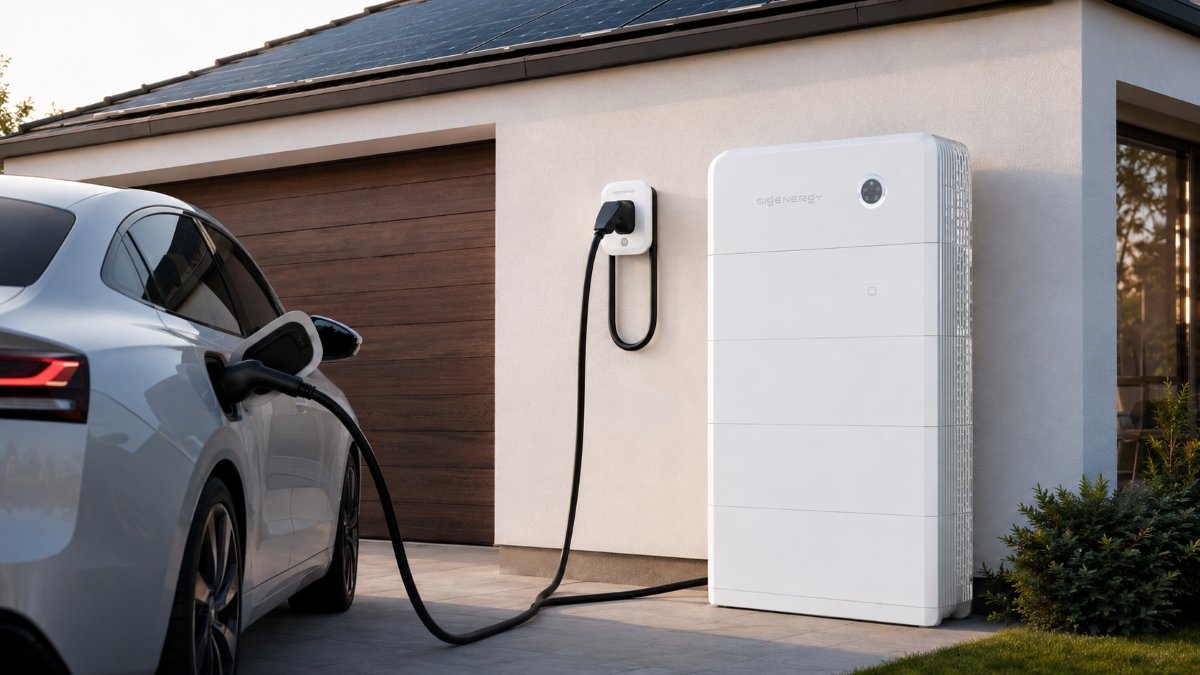
DC charging sends direct current straight to the EV battery, bypassing the vehicle’s onboard AC-to-DC converter. That shorter electrical path is why DC charging is faster. But “faster” is no longer the only question worth asking.
The real shift is that a home EV DC charger is no longer just a charger. Paired with solar panels, a home battery, and intelligent controls, it becomes a node in a bidirectional energy system — one where the EV can receive power, store it, and send it back to the house or grid. That changes the calculus from “how fast” to “how smart.”
This article examines where DC charging delivers real advantages, where AC remains the better fit, and what a DC-coupled home energy system actually does differently.
An EV battery stores electricity as direct current. Grid electricity arrives as alternating current. With AC charging (Level 2), the car’s onboard charger handles the conversion — typically at 7 kW to 22 kW depending on the vehicle and supply phase. An EV DC charger performs that conversion externally and delivers DC directly to the battery at higher power.
In real-world use, Level 2 AC charging is usually enough for overnight replenishment, while DC charging becomes more valuable when dwell time is short, solar surplus is available, or bidirectional energy flow is required.
But speed is only part of it. In a home with solar and battery storage, where the energy comes from before it reaches the car matters as much as how fast it arrives. A traditional AC charger draws from the home’s AC panel — meaning solar-generated DC must first be inverted to AC, then converted back to DC inside the car. A DC-coupled charging module connects directly to the DC bus shared by the solar array and home battery, eliminating that double conversion. Testing of DC-coupled architectures shows this can improve round-trip efficiency by up to 2%. In a system cycling energy daily, that margin compounds into meaningful savings.
DC fast charging generates more heat than slower AC charging, and heat accelerates battery degradation. But modern battery management systems actively regulate voltage, current, and cell temperature in real time — tapering power significantly above 70–80% state of charge to protect cell chemistry.
A study analyzing over 22,700 EVs found average battery degradation of about 2.3% per year. Vehicles using high-power DC fast charging (above 100 kW) more frequently showed slightly higher degradation, but this correlated with higher mileage and more intensive duty cycles overall.
Home DC charging operates at a different scale. A 25 kW home DC module delivers power at roughly one-fifth to one-tenth the rate of a highway 150–350 kW fast charger. Thermal stress at 25 kW is closer to what a 22 kW three-phase AC charger produces. For home use, the battery-health concern is significantly reduced compared with high-power public DC fast charging.
Most EV charging discussions stop at the plug. But in a DC-coupled home energy system, an EV can become more than a device that consumes electricity. When the vehicle, charger, battery, and local regulations all support bidirectional operation, stored energy in the EV can also flow back into the home energy system.
Vehicle-to-Home (V2H) allows a parked EV to support household loads during an outage or a peak-pricing window. Vehicle-to-Grid (V2G) extends that idea to the utility network, where EV batteries may help with peak shaving or virtual power plant dispatch. In practice, these functions require a compatible bidirectional charging interface and a vehicle that supports V2X operation; a standard one-way AC wall box cannot provide this capability.
We have conducted V2X field testing on selected vehicle models in certain markets to evaluate real-world bidirectional discharge through SigenStor EVDC.For testing purposes, a V2X test session is considered successful when a single continuous discharge session delivers at least 10 kWh, lasts at least 15 minutes, or reduces the vehicle’s state of charge by at least 10%. Compatibility and performance are vehicle- and market-specific and may vary by model, model year, software version, charging interface, region, and regulatory requirements.
The practical implication is significant: an EV with a large traction battery can become part of the household energy reserve when connected to a compatible DC-coupled system. Combined with a home battery, it can extend backup duration for essential loads and give homeowners more flexibility in how they store, use, and manage solar energy.
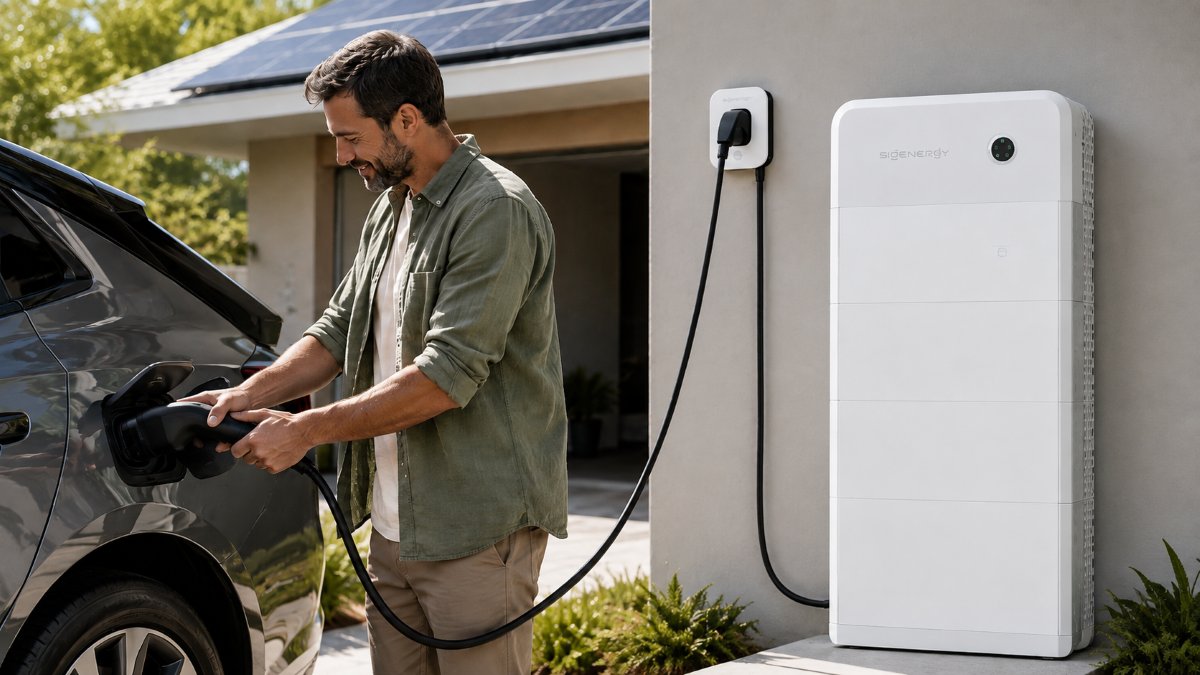
Not every scenario benefits equally from DC. The decision depends on dwell time, energy source, and whether bidirectional capability matters.
For example, a commuter driving 60 km per day does not need highway-level DC power at home. But if that same household has a short midday solar window, a 25 kW home DC charger can recover that distance quickly using surplus PV instead of evening grid power.
| Scenario | Best fit | Why |
|---|---|---|
| Highway stop (15–30 min) | Public DC 50–350 kW | Speed is the only variable. V2X and solar integration are irrelevant at a rest stop. |
| Overnight home (8–10 hrs) | AC 7–22 kW | Ample dwell time. AC is simpler, cheaper, and sufficient for most daily commutes. |
| Solar home, midday top-up | Home DC 12.5–25 kW | DC-coupled path avoids DC→AC→DC conversion loss. Absorbs surplus PV before low feed-in export. |
| Backup / V2H / V2G | Home DC (bidirectional) | Standard AC wall boxes are one-way. Only a DC interface enables reverse energy flow. |
| Office parking (4–8 hrs) | AC 11–22 kW (3-phase) | Medium dwell time, shared infrastructure. DC cost per stall is harder to justify unless fleet V2G is planned. |
In an office car park, the equation changes again. With 4–8 hours of dwell time, AC charging often makes more economic sense per stall. DC becomes easier to justify only when the site needs fast rotation, fleet charging, or future V2G participation.
The clearest case for home DC is when charging, storage, solar, and backup overlap. If none of those layers exist, AC charging remains the pragmatic default.
Spec sheets list dozens of parameters. Most matter only to installers. Four carry real decision weight for homeowners — not because of what they are, but because of what they rule in or out:
Voltage range (150–1000 V): This determines which vehicles the charger can handshake with. A narrow range (e.g. 200–500 V) may exclude newer 800 V-architecture EVs like the Porsche Taycan or Hyundai Ioniq 5. A 150–1000 V range — the spec used in our SigenStor EVDC module— covers a broad range of 400 V and 800 V EV platforms, subject to connector and vehicle compatibility. If the voltage window doesn’t match your car, nothing else on the spec sheet matters.
Protection rating (IP65 vs IP66): Both survive rain. The difference is maintenance. IP65 typically requires a dust filter that needs periodic cleaning. IP66 is fully sealed against dust ingress and pressurized water jets. Our EVDC module uses a filterless IP66 design with an isolation duct heat dissipation architecture, which eliminates scheduled filter maintenance entirely. For an outdoor wall-mounted unit, that distinction is worth more than the number suggests.
Charging power (kW) — matched to driving pattern: At home, the relevant question is the ratio of charger power to daily driving distance. A 25 kW DC charger delivers roughly 150 km of range per hour. If your average daily commute is 60 km, a 90-minute midday solar window fully replenishes the car without drawing from the grid. Match power to your driving pattern, not to the highest number available.
Charging modes / energy logic: This is the spec most people overlook and the one that determines long-term savings. A system with multiple modes — such as PV-surplus-first charging, battery-boost charging with configurable cut-off SOC, and grid-combined fast charging — adapts to daily conditions automatically. On a sunny afternoon it draws free solar; on a cloudy pre-trip morning it pulls from the grid and battery at full 25 kW. Without mode intelligence, a DC charger is a fast dumb pipe. With it, the charger becomes part of an energy strategy.
Speed and efficiency are technical arguments. Cost savings are what most homeowners actually decide on.
In Poland, where dynamic electricity pricing was introduced nationally in 2025, a residential household running a SigenStor system with AI-driven scheduling achieved a 50% reduction in electricity costs and a 220–300% increase in solar revenue through price arbitrage — charging during negative or valley-rate periods and discharging during peaks. A separate commercial deployment in Poland demonstrated up to 48% electricity cost savings using the same AI tariff integration.
These results depend on dynamic tariffs, local solar yield, and system sizing — they are not universal. But they illustrate a structural point: when a DC-coupled system coordinates charging timing with real-time pricing and solar availability, the economic return extends well beyond fuel-cost displacement.
Yes. But the better framing is: DC charging is necessary for the next layer of EV-home integration.
If your only need is refueling a car overnight, AC charging handles it affordably and safely. If your need extends to maximizing solar self-consumption, time-of-use arbitrage, home backup, or V2G revenue — AC cannot physically do those things. A DC interface can.
We built our EV DC Charging Module around that second category — not to replace AC charging, but to serve the use cases where energy flow must be bidirectional, DC-coupled, and software-coordinated. For most households, the right answer involves both: AC for the routine, DC for the architecture.
The best charging choice is not the fastest one. It is the one that fits your driving, your energy system, and the grid conditions around you — and adapts when any of those change.
Not usually. Frequent high-power charging can add stress, but modern EVs manage temperature and charging speed to protect the battery.
For many drivers, yes. AC charging is often enough for overnight charging and regular commuting.
Use it for long trips, quick turnarounds, high-mileage days, or when your home energy system can use surplus solar effectively.
It usually slows down significantly after around 80% because the EV reduces charging power to protect the battery.
It can be worth it if you have solar, battery storage, multiple EVs, high driving needs, or interest in future V2H/V2G functionality.




 Cookie Set

These cookies are essential for the proper functioning of my website. Without these cookies, the website would not work properly
| Name | Expiration | Description |
| PHPSESSID | session | Cookie generated by applications based on the PHP language. This is a general purpose identifier used to maintain user session variables. It is normally a random generated number, how it is used can be specific to the site, but a good example is maintaining a logged-in status for a user between pages. |
| cookielist-consent | 1 year | Sets this cookie to remember users' consent preferences so that their preferences are respected on their subsequent visits to this site. It does not collect or store any personal information of the site visitors. |
| sl-session | 1 day | Anti-crawler and machine behavior recognition |
Analytical cookies are used to understand how visitors interact with the website. These cookies help provide information on metrics such as the number of visitors, bounce rate, traffic source, etc.
| Name | Expiration | Description |
| _ga | 1 year | The _ga cookie, installed by Google Analytics, calculates visitor, session and campaign data and also keeps track of site usage for the site's analytics report. The cookie stores information anonymously and assigns a randomly generated number to recognize unique visitors. |
| _ga_6JGTHLPYFN | 1 year | This cookie is installed by Google Analytics. |
| _gcl_au | 3 months | Provided by Google Tag Manager to experiment advertisement efficiency of websites using their services. |