


Necessary



 Login
 Global (English)
05 Nov, 2026
Share
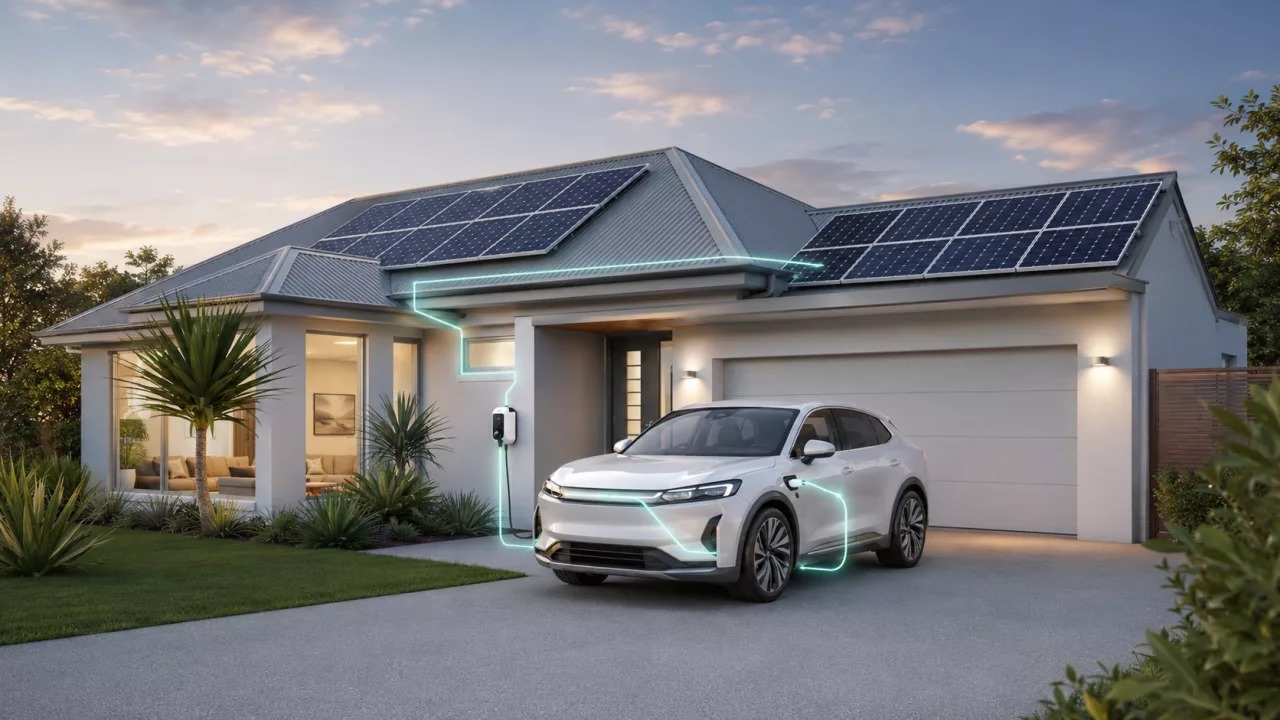
A lot of new EV owners get thrown by one thing. The battery in your car runs on DC, but the charger you use at home puts out AC, so it feels like the two shouldn't work together. They do. An AC EV charger just feeds ordinary alternating current into your car, and the car has a converter inside it that changes that AC into the DC the battery needs. This is the charger most people use every day, whether at home, at work, or parked out in public. For regular driving it does the job fine, because plugging in for a few hours or leaving it overnight is usually enough to keep the car topped up.
Once you understand how AC charging works, you can charge overnight for less than public fast chargers cost and pick a home setup that saves you time and money for years.
With AC charging, your car does the hard part. When you plug in, AC power flows from the wall charger into a small unit inside your car called the onboard charger. That unit changes the AC into DC, the only form your battery can store. So the box on the wall isn't really the "charger" doing the work. It just delivers power. Your car is what actually converts it.
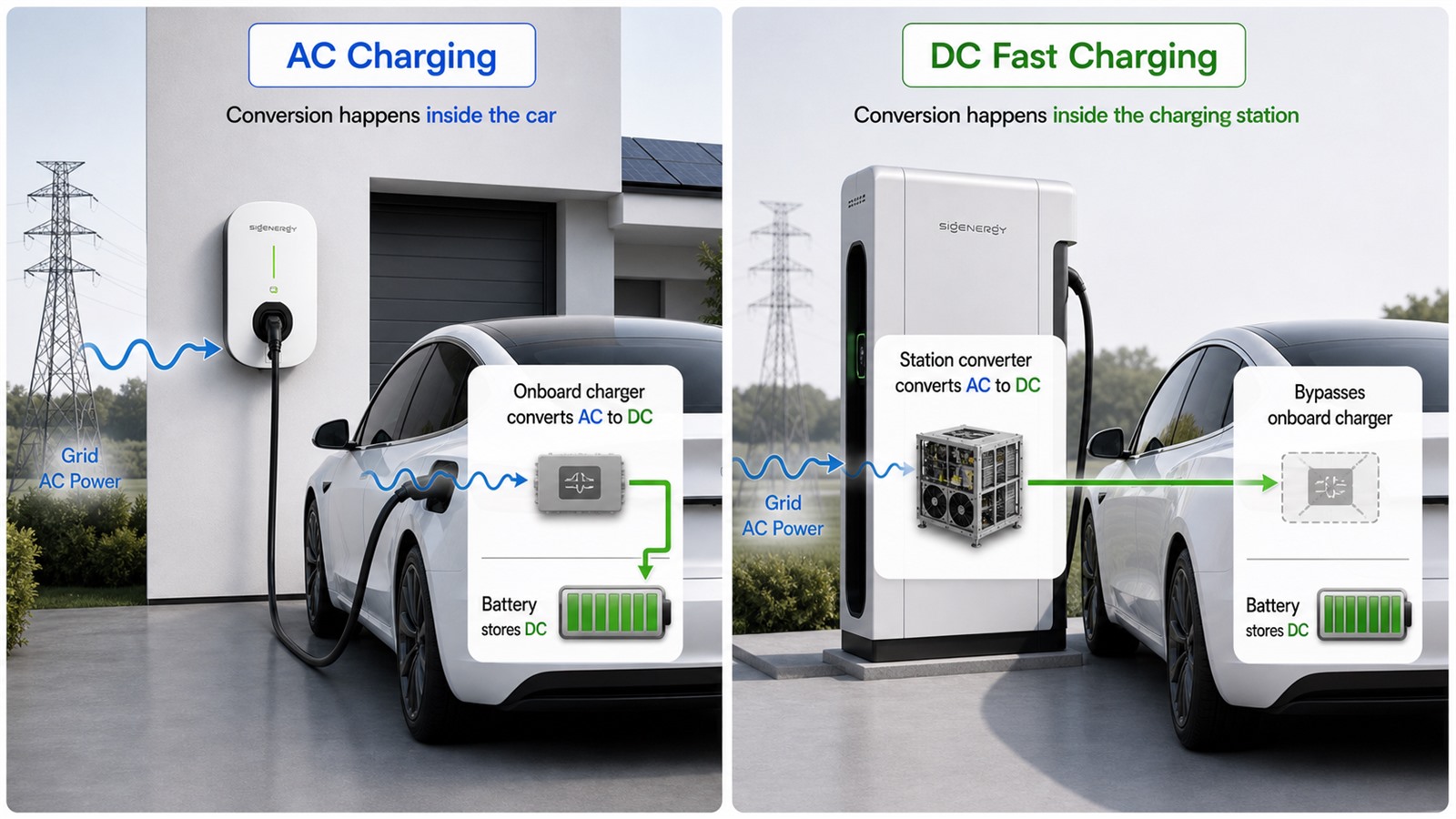
The power coming out of the grid is AC. That is simply how electricity is sent over long distances, because AC is easy to push through the network and step up or down in voltage as needed. Your battery, though, can only hold DC. So no matter how you charge, the power has to be converted from AC to DC somewhere before it reaches the battery. The only real question is where that conversion takes place.
With AC charging, the conversion happens inside the car. The wall unit sends AC to the vehicle, and the onboard charger turns it into DC. With DC fast charging, the conversion happens inside the charging station instead. The station is big enough to hold a large, powerful converter, so it changes the power to DC first and then sends DC straight to the battery, skipping the car's onboard charger for the heavy lifting.
That is the whole difference in a nutshell. AC charging leans on the small converter built into your car, while DC fast charging uses a much bigger converter built into the station. If you want to go deeper on how the levels compare, an overview of charging levels from the U.S. Department of Energy lays out the same distinction. Everything people find confusing about charging speed and cost traces back to this one point.
Most home AC charging runs between 7 kW and 22 kW, which is enough to add roughly 40 to 120 km of range for every hour plugged in, so a typical overnight charge easily replaces a full day of driving. A dedicated home DC charging system, such as our Sigen EV DC Charging Module, steps above typical AC charging at up to 25 kW, adding range faster while also supporting direct DC-coupled energy flow from solar and storage. The reason for the gap is simple. AC charging relies on the small converter inside your car, and because it fits in a tight space and has to stay within the car's heat and electrical limits, it can only handle so much power at once. A DC charger has more room for dedicated power electronics, so it can push more than a typical home AC setup.
The real speed is set by the slowest part of the setup, not the biggest number on the box. Three things matter: your home circuit, the wall charger, and your car's onboard charger, and whichever is lowest wins. Put in a 22 kW charger but drive a car that only accepts 11 kW on AC, and you charge at 11 kW, with the extra headroom sitting unused.
Charging is usually sorted into three levels. The first two are AC, and the third is DC. The figures below are typical ranges. Your real numbers depend on your charger, your home supply and what your car can accept.
| Type | Power | Where you find it | Best for |
|---|---|---|---|
| Level 1 (AC, standard outlet) | ~2-2.4 kW | Any household power point | Backup, plug-in hybrids, very low daily mileage |
| Level 2 (AC home/workplace charger) | 7-22 kW | Home wall chargers, workplaces, public car parks | Everyday charging, overnight top-ups |
| DC home charging / bidirectional DC charging | Up to 25 kW | Homes with SigenStor energy systems | Faster home charging, solar charging, and V2H/V2G-ready energy use |
For most drivers, Level 2 AC charging at home covers daily needs on its own, quietly putting back the range you used during the day while the car sits parked overnight.
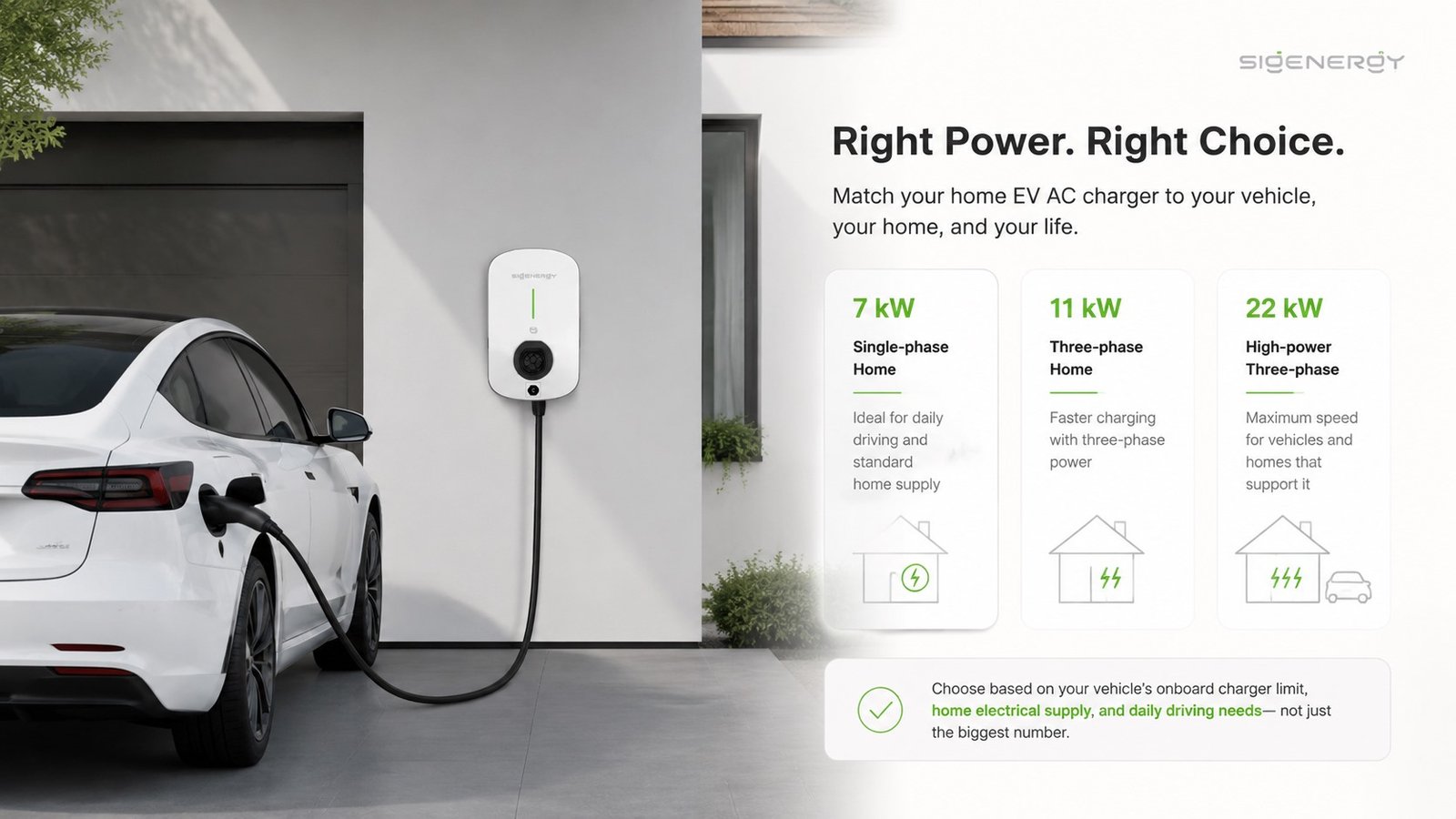
My first piece of advice is always to ignore the "bigger is better" instinct. I've watched people buy a 22 kW charger only to find their car pulls 11 kW at most, so half of what they paid for never gets used. The opposite happens just as often: someone saves money up front, buys too small, then their driving changes a year later and they're paying an electrician a second time to redo it.
This is the gap the Sigen EV AC Charger is built to close. It comes in 7 kW, 11 kW and 22 kW versions, so the charger can be matched to your car's onboard limit, your home supply and your daily driving rather than guessed at. The idea is to set a sensible power ceiling before anything gets installed, so you avoid an oversized unit that can never run flat out and an undersized one that forces a costly change later.
Your home's supply plays a big part here too. Many homes run on single-phase power, which usually supports AC charging up to around 7 kW. Stepping up to 11 kW or 22 kW generally needs a three-phase supply, and adding three-phase can carry real cost. Before you settle on a charger, it is worth confirming your supply type with a licensed electrician so the power level you choose is one your home can actually deliver.
For everyday use, AC charging is the gentler option, and there is a simple reason. DC fast charging pushes a lot of power in a short time, and that generates more heat in the battery. Leaning on it constantly can contribute to faster wear over the years, depending on the car. AC charging trickles power in more slowly and predictably, which is easier on the battery day to day. The sensible habit for most people is AC at home for routine charging and DC fast charging saved for trips and quick top-ups. Whatever you drive, follow the guidance in your owner's manual, since manufacturers tune this differently.
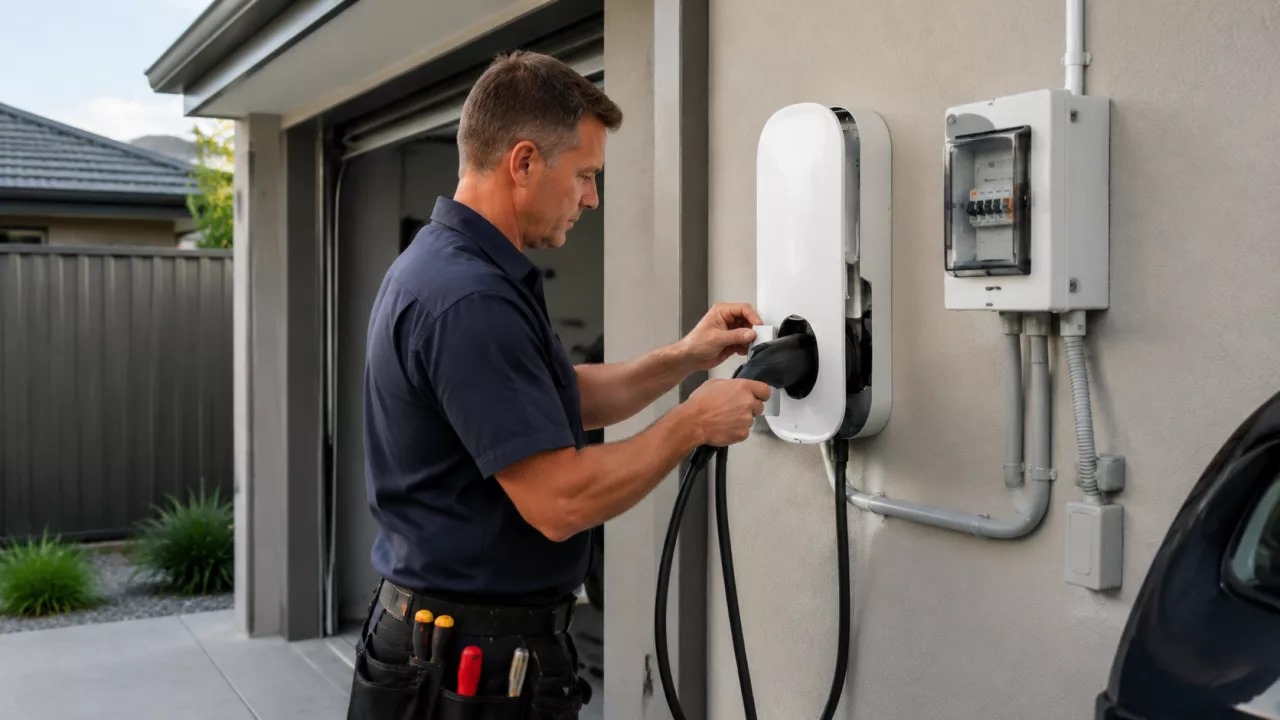
A standard household outlet is fine for the occasional slow charge and makes a handy backup, but for regular charging a dedicated Level 2 AC charger on its own circuit is the safer choice. Always have a licensed electrician install it, and skip extension cords or multi-plug adapters, since they are not made to carry high current for hours. If a plug, power point or cable ever feels hot, smells odd or looks discoloured, stop charging and have it checked.
It also pays to have the electrician look at your whole home, since the charger is only one part of the picture. Your EV is a heavy, continuous load, and it has to share your supply with big appliances like the oven, air conditioner or a home battery without tripping anything. Many chargers simply draw their full rated power and leave that balancing act to your switchboard. The Sigen EV AC Charger works differently, quietly dialling its power up or down to fit whatever capacity the house has spare at the time, so you can run the dryer or the air conditioner while the car charges without nuisance trips, and in many cases avoid paying for a switchboard or supply upgrade you would otherwise need. You can read through the datasheets and installation manuals with your electrician beforehand, so there are no surprises on install day.
For nearly everyone, it comes down to using both, just for different jobs. AC charging is what you will rely on almost all the time, at home or work, because it is cheap, easy on the battery and more than quick enough overnight. DC fast charging is the one you turn to on a road trip or whenever you need a lot of range in a hurry. So if you are setting up charging at home, a properly installed Level 2 AC charger matched to your daily driving, your supply and your car's onboard limit will handle the vast majority of what you need.
Having a DC charger at home only starts to make sense if you are after much higher power, or two-way features like using the car to help run the house. If that appeals to you, a dedicated DC charging module is a bigger, more involved piece of kit, so it is best thought of as its own project rather than part of a typical home AC setup.
You can, but it is slow. A standard outlet is fine for occasional use, but for daily charging a dedicated Level 2 AC charger installed by a licensed electrician is a much better fit.
Your car or your home supply is probably the limit. Charging speed depends on the charger, the circuit and the car's onboard charger together, so a 22 kW charger may only deliver 7 kW or 11 kW in practice.
It can if the circuit is overloaded. EV charging is a continuous load, so your supply capacity and the other appliances running at the same time need to be considered before installation.
It is not recommended. EV charging can draw high current for hours, and cords or adapters that are not rated for it may overheat.
Usually no. For daily use, many EVs are better kept below full unless you need the whole range for a trip. Check your owner's manual for the recommendation on your car.




 Cookie Set

These cookies are essential for the proper functioning of my website. Without these cookies, the website would not work properly
| Name | Expiration | Description |
| PHPSESSID | session | Cookie generated by applications based on the PHP language. This is a general purpose identifier used to maintain user session variables. It is normally a random generated number, how it is used can be specific to the site, but a good example is maintaining a logged-in status for a user between pages. |
| cookielist-consent | 1 year | Sets this cookie to remember users' consent preferences so that their preferences are respected on their subsequent visits to this site. It does not collect or store any personal information of the site visitors. |
| sl-session | 1 day | Anti-crawler and machine behavior recognition |
Analytical cookies are used to understand how visitors interact with the website. These cookies help provide information on metrics such as the number of visitors, bounce rate, traffic source, etc.
| Name | Expiration | Description |
| _ga | 1 year | The _ga cookie, installed by Google Analytics, calculates visitor, session and campaign data and also keeps track of site usage for the site's analytics report. The cookie stores information anonymously and assigns a randomly generated number to recognize unique visitors. |
| _ga_6JGTHLPYFN | 1 year | This cookie is installed by Google Analytics. |
| _gcl_au | 3 months | Provided by Google Tag Manager to experiment advertisement efficiency of websites using their services. |