


Necessary



 Login
 Global (English)
05 Nov, 2026
Share
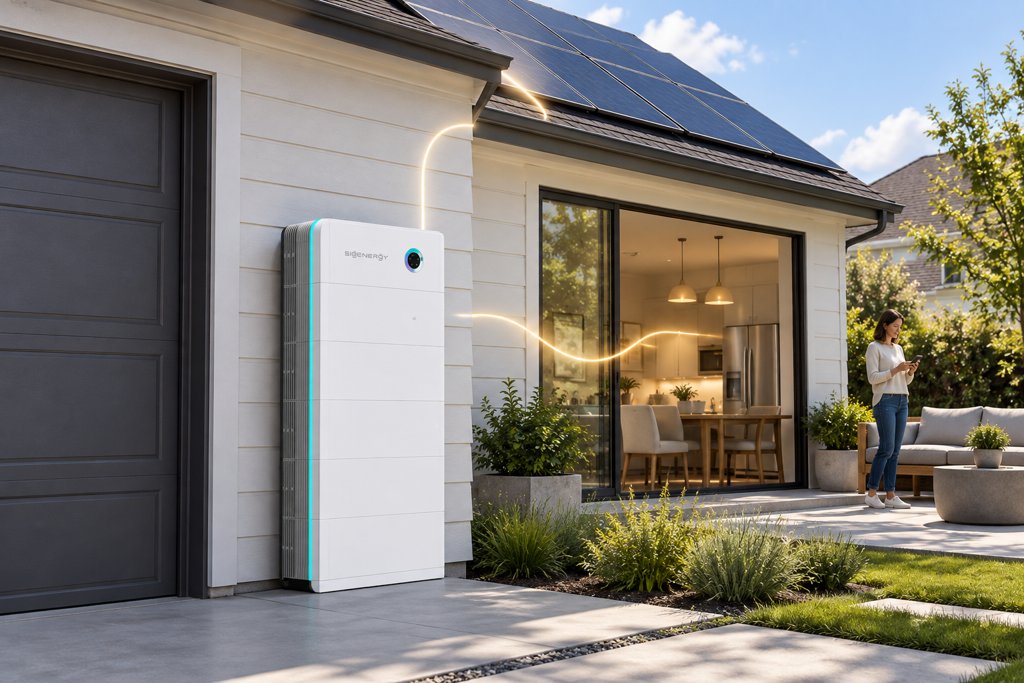
A 10kWh battery can power a steady 1kW load for approximately 9–10 hours. At 500W, runtime increases to around 18–20 hours. With a 2kW load, it drops to about 4.5–5 hours. Actual runtime varies with usable battery capacity, the battery’s state of charge when the outage begins, the off-grid discharge cut-off setting, system losses, and solar generation.
Choosing the right battery also depends on which appliances need backup power and their continuous and peak power requirements. Our SigenStor system provides 10.4kWh of usable energy with two SigenStor BAT 5.0 modules, based on the published specifications. Its modular design supports battery stacking and parallel expansion, allowing the system to grow as your energy needs increase.
Battery runtime depends on how much energy is available and how much power your appliances use. The basic formula is:
Estimated runtime (hours) = available battery energy (kWh) ÷ average load (kW)
For example, a 10kWh battery powering a steady 1kW load can run for 10 hours under ideal conditions. Actual runtime depends on usable battery capacity, remaining charge, the off-grid discharge cut-off setting, and power conversion losses. Temperature and battery age can also affect performance. The battery's published specifications help provide a more accurate estimate.
For perspective, the U.S. Energy Information Administration reported that the average U.S. residential electricity customer received 865kWh from the grid per month in 2024, equivalent to about 28.4kWh per day. This national average does not include all electricity generated and consumed on-site from rooftop solar, and it should not be used to estimate backup needs for an individual home. For a more reliable runtime estimate, use your own electricity data and calculate the average demand of the appliances or circuits you plan to back up.
The table below shows how average power demand affects the runtime of a 10kWh battery.
| Average Backed-Up Load | Ideal 10kWh Runtime | Typical Backup Situation |
|---|---|---|
| 0.5kW | 20 hours | Essential appliances such as lighting, internet equipment, and intermittent refrigeration |
| 1.0kW | 10 hours | Several household essentials operating together |
| 2.0kW | 5 hours | More appliances running simultaneously, increasing overall power demand |
| 5.0kW | 2 hours | Heavy electrical loads requiring higher continuous and peak power |
These estimates assume the full 10kWh is available. For a more practical example, applying a 10% planning allowance leaves 9kWh. At an average load of 0.5kW, the battery would last approximately 18 hours. Runtime decreases to 9 hours at 1kW and 4.5 hours at 2kW.
A 10kWh battery's runtime depends on the equipment it powers. Appliances such as pumps, compressors, and air conditioners often need extra power when starting. The inverter must handle these brief power surges along with the normal running load.
Several factors help determine the right battery configuration:
Battery capacity (kWh) determines how much energy is available and affects how long the system can run. Power output (kW) determines how much equipment can operate at the same time. A suitable backup system needs enough capacity and power to support the selected circuits while meeting local connection requirements.
Our SigenStor system combines a solar inverter, battery PCS, battery pack, and energy management system in one platform. An EV DC charging module is also available.
For a system close to 10kWh, two SigenStor BAT 5.0 modules provide 10.4kWh of usable battery capacity. Each BAT 5.0 module offers 5.2kWh, while the BAT 8.0 provides 7.8kWh. Both use LiFePO4 chemistry. Published specifications also list IP66 protection and an operating temperature range of -20°C to 55°C.
The table below compares available battery configurations and their typical uses.
| Battery Configuration | Usable Capacity | Suitable Application |
|---|---|---|
| One SigenStor BAT 5.0 | 5.2kWh | Short backup periods for essential appliances |
| Two SigenStor BAT 5.0 modules | 10.4kWh | Backup systems designed around 10kWh of storage |
| One SigenStor BAT 8.0 | 7.8kWh | More battery capacity from a single module |
| Six SigenStor BAT 8.0 modules | 46.8kWh | Larger energy storage needs and longer backup periods |
With 10.4kWh of usable energy, a two-module SigenStor configuration can theoretically support a steady 1kW load for 10.4 hours. Actual runtime depends on backup settings, conversion losses, and the appliances in use. Our system design considers the property's power demand and required backup duration to determine the suitable battery configuration.
SigenMate 2700 Ultra offers a plug-in solar battery solution for supported European markets. The main unit has 2.688kWh of nominal battery capacity. Adding three BAT 2700 expansion batteries increases the total to 10.752kWh, making it the closest configuration to 10kWh. Each main unit supports up to six expansion batteries, providing approximately 18.8kWh of nominal storage capacity. Actual usable energy depends on the system's operating settings.
During an outage, a single SigenMate main unit can continuously supply up to 1,400W, with a 10-second peak output of 1,800W. It powers loads connected to its two backup ports rather than automatically supplying every socket or circuit in the home. Adding BAT 2700 expansion batteries increases stored energy and potential runtime, but it does not increase the main unit's AC output.
For higher output and larger energy needs, two or three SigenMate systems can be connected using supported AC parallel cables. Two connected systems can provide up to 2,800W of off-grid output, while three can provide up to 3,600W. Three fully expanded systems offer approximately 56.4kWh of nominal storage. The mySigen app also supports centralized management of up to ten SigenMate units across different locations. This app-based management operates separately from the supported three-system AC parallel connection. The SigenMate 2700 Ultra specifications and calculator provide further details on capacity and available configurations.
SigenMate is designed for smaller plug-in solar storage applications, with the flexibility to add batteries as energy needs grow. SigenStor serves larger, professionally designed energy systems that require integrated backup, optional EV charging, and multi-system expansion. Our home battery capacity guide explains how daily electricity use can help determine the right SigenMate storage capacity.
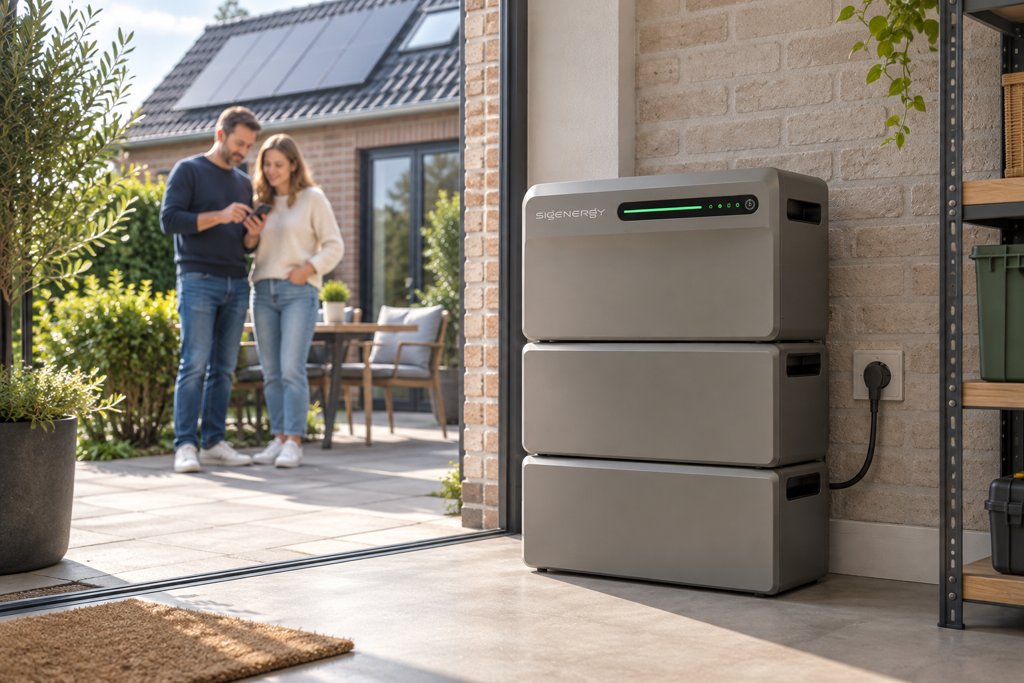
Solar panels can help a 10kWh battery provide power for longer during an outage when the system supports solar generation in backup mode. During the day, solar energy can power household appliances and recharge the battery. The battery supplies electricity at night or when sunlight is limited. Backup duration therefore depends on daily electricity use, solar production, and the amount of power appliances need.
For example, suppose essential appliances consume 12kWh over 24 hours, and the battery starts with 10.4kWh of usable energy. If solar panels provide 6kWh of usable electricity during the outage, the battery would need to supply approximately 6kWh over the day. This could provide enough energy for a full day of backup, provided solar energy can be used or stored when available.
Solar production varies with weather and sunlight conditions. Cloudy days may provide less energy for recharging, increasing the amount of electricity drawn from the battery. For reliable backup planning, the system should also be assessed against expected electricity use during periods of low solar production.
Charging time equals the energy added divided by the available charging power.
SigenStor BAT 5.0 modules provide 10.4kWh of usable capacity and up to 5.0kW of combined charging power, giving a theoretical charging time of about 2.08 hours. For comparison, the separate Sigen Battery 10.0 model has 8.76kWh of usable capacity and 4.6kW maximum charging power, resulting in about 1.9 hours theoretically.
A SigenMate main unit with three BAT 2700 batteries provides 10.752kWh of nominal capacity. The theoretical charging time is about 2.69 hours from a continuous 4.0kW PV input or 7.68 hours from its 1.4kW grid-charging limit. Actual times depend on the required SOC increase, system configuration, temperature, household loads, and power availability.
Use this estimate:
Number of panels = target charging energy ÷ (panel power × peak sun hours × system yield)
For example, charging a 10.752kWh SigenMate configuration with 500W panels, four peak sun hours, and an 80% system yield requires approximately seven panels. The final design must also comply with the system’s PV power, MPPT voltage, current, and wiring limits. SigenMate supports up to 4,000W of PV input.
Yes. SigenStor supports scheduled grid charging through Time-based Control Mode in the mySigen App. SigenMate 2700 Ultra also supports grid charging through TOU Mode or AI Mode. Availability and charging behavior depend on the system configuration, local grid rules, and electricity tariff.
Yes, but it will generally provide only a partial EV charge. SigenStor supports compatible EV charging through the Sigen EV DC Charging Module and Battery Boost Charging. SigenMate can provide limited emergency EV charging in suitable configurations, but its lower output makes it less suitable for routine charging. Actual energy delivered depends on the battery’s SOC, discharge settings, system losses, power limits, and simultaneous household loads.
A 10kWh battery can provide reliable backup power when its capacity matches your household's energy needs. The appliances you use, your required backup hours, and available solar power all influence how long the battery lasts. A suitable configuration helps maintain essential electricity during outages while allowing room for future energy needs.
The right battery setup depends on your home's electricity use and backup priorities. For guidance on choosing a suitable SigenStor or SigenMate configuration, you can request a home battery storage consultation from Sigenergy. Our team can help you explore options that fit your household and long-term energy plans.




 Cookie Set

These cookies are essential for the proper functioning of my website. Without these cookies, the website would not work properly
| Name | Expiration | Description |
| PHPSESSID | session | Cookie generated by applications based on the PHP language. This is a general purpose identifier used to maintain user session variables. It is normally a random generated number, how it is used can be specific to the site, but a good example is maintaining a logged-in status for a user between pages. |
| cookielist-consent | 1 year | Sets this cookie to remember users' consent preferences so that their preferences are respected on their subsequent visits to this site. It does not collect or store any personal information of the site visitors. |
| sl-session | 1 day | Anti-crawler and machine behavior recognition |
Analytical cookies are used to understand how visitors interact with the website. These cookies help provide information on metrics such as the number of visitors, bounce rate, traffic source, etc.
| Name | Expiration | Description |
| _ga | 1 year | The _ga cookie, installed by Google Analytics, calculates visitor, session and campaign data and also keeps track of site usage for the site's analytics report. The cookie stores information anonymously and assigns a randomly generated number to recognize unique visitors. |
| _ga_6JGTHLPYFN | 1 year | This cookie is installed by Google Analytics. |
| _gcl_au | 3 months | Provided by Google Tag Manager to experiment advertisement efficiency of websites using their services. |