


Necessary



 Login
 Global (English)
29 Oct, 2026
Share
This 2026 list of top home energy storage manufacturers is based on the latest publicly available product information, residential battery rankings, manufacturer portfolios, installer ecosystem signals, warranty and safety data, and real homeowner use cases such as solar self-consumption, outage backup, time-of-use savings, load control, EV charging, and future grid participation. Rather than ranking brands by name recognition alone, this comparison evaluates manufacturers across several practical dimensions: battery credibility, inverter and system integration, backup architecture, software intelligence, scalability, installer support, and readiness for VPP, V2H, V2G, or EV-connected home energy use.
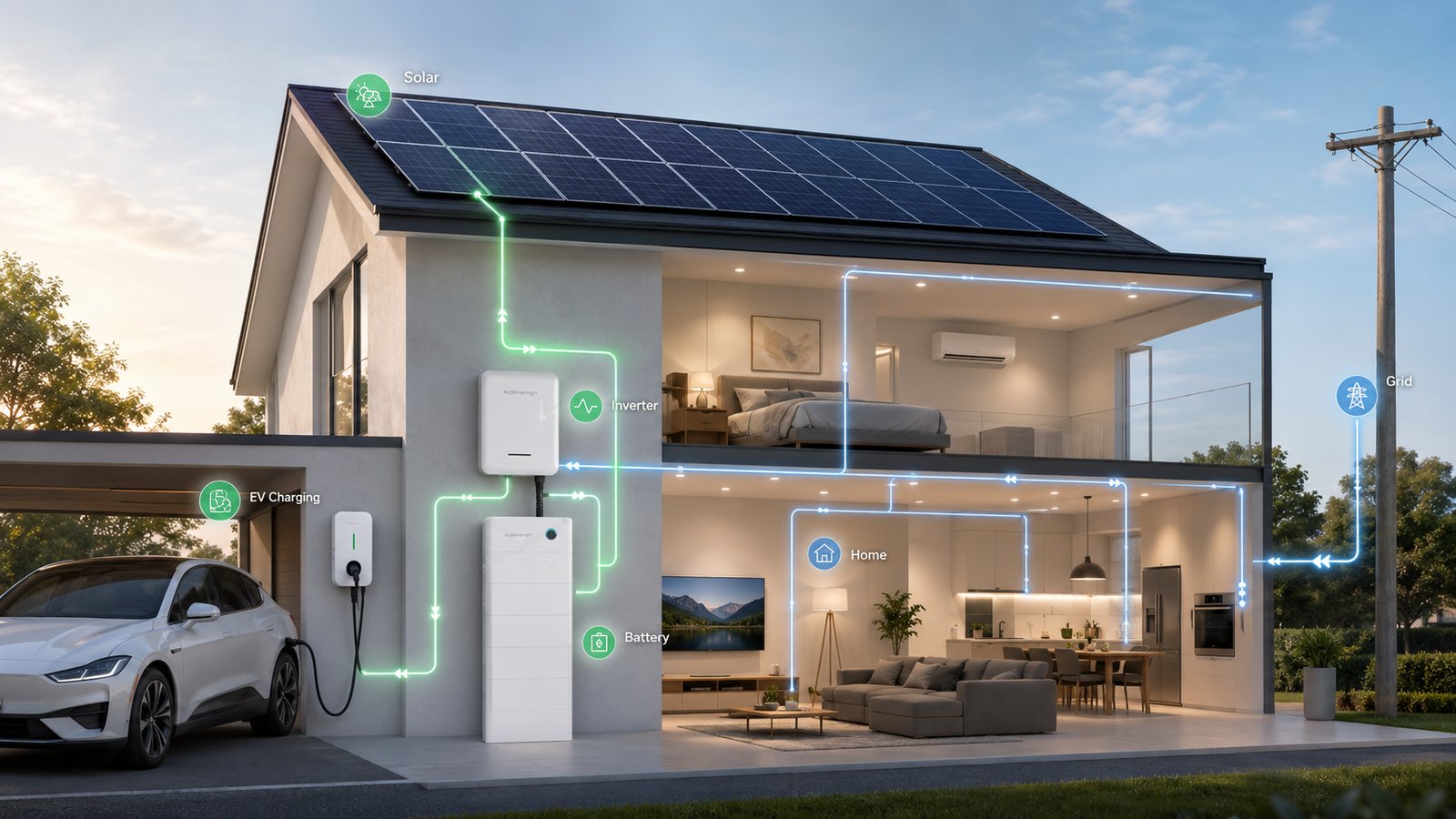
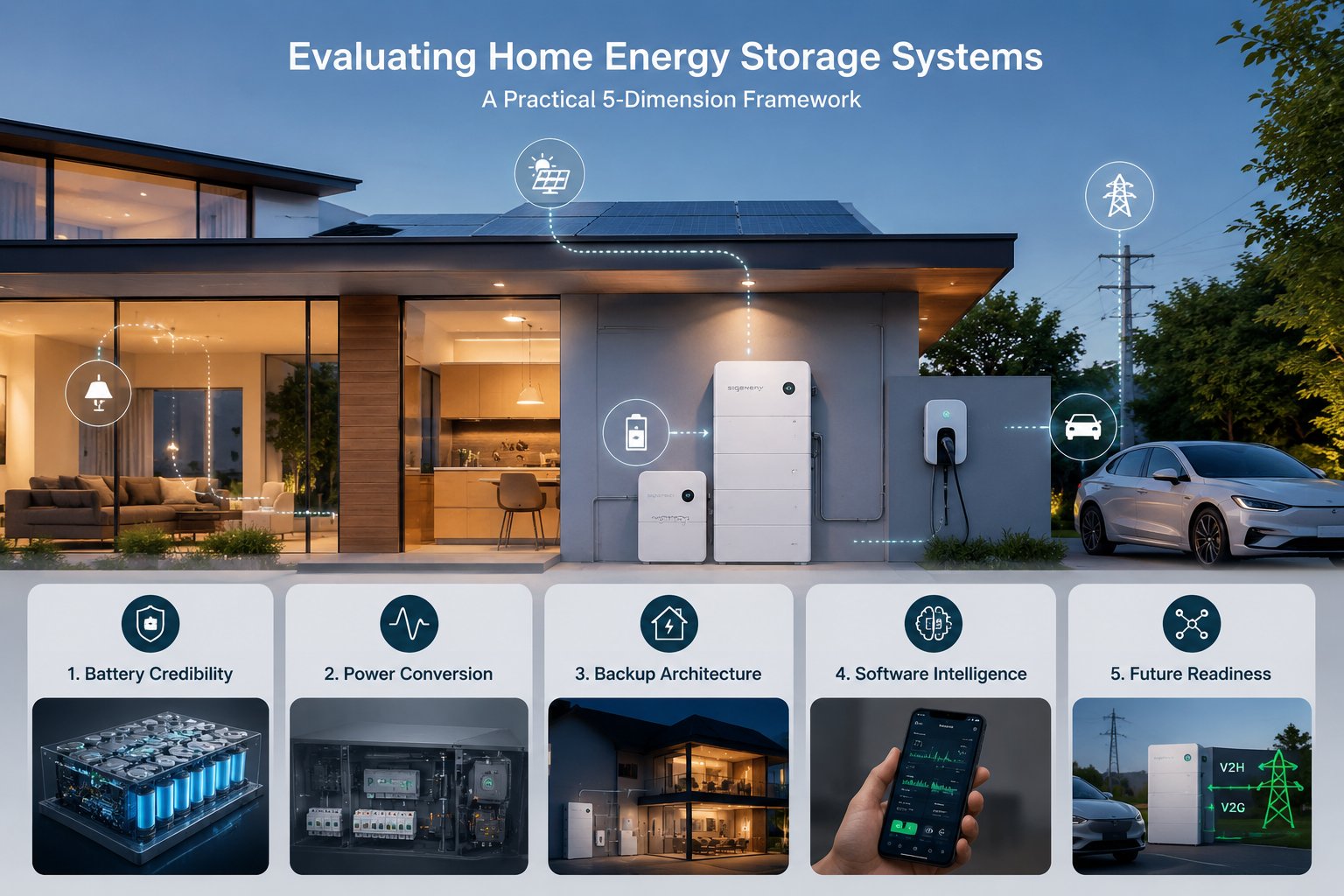
Choosing a home energy storage manufacturer should not be based only on brand name, battery capacity, or market visibility. A stronger evaluation looks at how each system performs as part of the whole home energy setup, including solar panels, inverters, backup gateways, protected loads, software control, and future expansion needs.
| Evaluation Layer | What to Check | Why It Matters |
|---|---|---|
| Battery credibility | Battery chemistry, cycle life, safety protection, usable capacity, manufacturing experience, warranty terms | Determines long-term reliability, safety, degradation, and real usable value |
| Power conversion | Inverter compatibility, AC/DC coupling, hybrid inverter support, round-trip efficiency, solar integration | Affects system efficiency, installation design, and how well solar energy is stored and used |
| Backup architecture | Backup gateway, transfer behavior, protected loads, whole-home backup options, generator integration, load control | Determines what the home can power during outages and how smoothly the system switches to backup mode |
| Software intelligence | App monitoring, tariff optimization, backup reserve settings, automation, energy scheduling, remote updates | Helps homeowners manage daily energy use, reduce peak-rate costs, and maintain system performance |
| Future readiness | Modular expansion, EV charging support, V2H/V2G readiness, VPP participation, smart load coordination | Makes the system better prepared for EVs, grid programs, changing energy rates, and future home upgrades |
This framework creates a more useful comparison than a simple ranking. A homeowner focused on storm backup may choose differently from someone trying to maximize solar self-consumption. A retrofit project may need a different system from a new solar-plus-storage installation. A family with EV charging may also benefit from a more integrated platform than a home that only needs essential-load backup.
In 2026, Powerwall 3 continues to set a mainstream benchmark with 13.5 kWh of capacity, up to 11.5 kW continuous power, an integrated solar inverter, Tesla app control, and expansion options for homeowners who need longer backup duration. For many homes, Tesla works best when the goal is a simple, polished solar-plus-storage experience with strong whole-home backup potential. It is especially attractive in markets with mature installer coverage. However, projects with unusual roof layouts, mixed-brand solar equipment, or complex load requirements may still need more detailed design work before choosing Powerwall.
Sigenergy ranks second because it represents one of the clearest 2026 trends in home energy storage: integrated, AI-assisted, EV-ready residential energy systems. Its SigenStor system is not positioned as a standalone battery. It is a 5-in-one home ESS that combines a solar inverter, an EV DC charger, a battery PCS, a battery pack, and an energy management system into one modular platform.
This matters because many homeowners are now trying to solve several energy problems at once. They want to store solar power, reduce peak-rate grid purchases, keep the home running during outages, charge an EV, and prepare for future grid programs. A system like SigenStor is designed around that combined use case rather than treating each function as a separate product.
Sigenergy also provides product-level details that help support trust. SigenStor is presented with modular battery stacking, 5-layer battery protection, IP66 protection, OTA upgrades, AI-assisted energy planning, and 0ms load-side disruption. Its Home Energy Gateway adds smart load control, backup operation, monitoring, generator integration, and whole-home backup options. Its SigenStor EV DC charging module adds a future-facing EV connection with support for solar charging and V2H or V2G scenarios where compatible.
Enphase remains a strong top-three choice, especially when a home already uses Enphase microinverters. Its AC-coupled battery architecture makes storage easier to add to existing solar systems, and newer options such as the IQ Battery 10C strengthen its 2026 position with 10 kWh usable capacity and 7.08 kW continuous power. What makes Enphase stand out is the system experience. Solar production, battery activity, backup settings, and energy use can be monitored within one ecosystem. The main limitation is scale: larger backup goals may require multiple units, so homeowners should compare both total capacity and installed cost.
BYD remains a serious shortlist option in 2026 because of its large-scale battery manufacturing experience. Its Battery-Box systems are widely used in residential and light commercial storage projects, especially where installers want modular LFP batteries paired with compatible hybrid inverters. The best way to evaluate BYD is as part of a full solar-storage design. The battery platform itself is flexible, but performance depends heavily on inverter pairing, installation quality, commissioning, and local support. For homeowners who value battery manufacturing depth and modular sizing, BYD is still highly relevant.
FranklinWH has gained attention because it focuses on whole-home energy management. Its system is designed to coordinate battery storage, solar, grid power, and home loads. That makes it especially relevant for homeowners who want strong backup behavior, not just solar self-consumption.
FranklinWH is a good comparison point for Tesla and Generac when outage resilience is a primary goal. The system’s value comes from control: what loads stay on, how the home transitions during an outage, and how the battery supports daily operation. Buyers should compare installed cost, local installer experience, and service coverage before choosing it.
sonnen is less focused on chasing the largest battery spec and more focused on intelligent daily cycling, safety, and grid participation. In 2026, that positioning matters more because home batteries are increasingly being used for virtual power plant programs, not just emergency backup.
For homeowners interested in energy independence, long-term battery operation, and utility-connected programs, sonnen can be a strong fit where available. It may not always be the cheapest option, but it has a clear premium position built around software control, safe chemistry, and VPP readiness.
SolarEdge performs best when the entire home solar system is built around its ecosystem. Its Home Battery 400V / BAT-10K is designed for DC-coupled storage with SolarEdge inverters, offering 9.7 kWh usable capacity and up to 94.5% round-trip efficiency.
That integrated design can be efficient and clean for new solar-plus-storage projects. The tradeoff is flexibility. SolarEdge is usually strongest for homes already using compatible SolarEdge equipment, while homes with non-SolarEdge systems may find an AC-coupled battery easier to retrofit.
Generac enters the battery market with strong backup-power credibility. Many homeowners already know the brand from standby generators, and its PWRcell 2 system gives it a more competitive residential storage offering in 2026.
PWRcell 2 uses an AC-coupled design, offers 9 to 18 kWh per battery cabinet, and can scale to 36 kWh with two cabinets on one inverter. Its strongest use case is resilience: backup power, load management, and generator integration. Buyers should also compare solar compatibility, daily cycling performance, software experience, and total installed cost.
Panasonic still carries strong brand trust, but its 2026 position needs careful framing. The EVERVOLT line remains relevant for existing systems and for homeowners reviewing warranty-backed support, but Panasonic announced in 2025 that it would discontinue its solar and battery storage business line while continuing to support customers and warranties.
Because of that, Panasonic should not be evaluated in the same way as brands actively expanding new residential storage platforms. It is still important as an established name with installed-system relevance, but new buyers should confirm product availability, installer support, replacement process, and long-term service coverage.
Battery manufacturing depth is LG Energy Solution's biggest advantage. The company has long experience in lithium-ion cell engineering, EV batteries, and energy storage, and its broader 2026 ESS strategy includes expanding production capacity and strengthening supply in North America.
For residential buyers, products such as RESU Prime and Prime+ keep LG Energy Solution relevant in solar-plus-storage and backup applications. The key is to evaluate the exact model available in the local market. Chemistry, usable capacity, inverter compatibility, warranty terms, certification, software support, and any service or recall guidance should all be reviewed before purchase.
| Use Case | Best-Fit Manufacturers | Why They Fit |
|---|---|---|
| Mainstream whole-home backup | Tesla, FranklinWH, Generac | Strong homeowner awareness, backup control, and installer familiarity |
| Microinverter solar retrofit | Enphase | AC-coupled modular storage fits existing Enphase homes |
| Battery manufacturing credibility | BYD, LG Energy Solution, Panasonic | Deep battery engineering and manufacturing background |
| Solar ecosystem integration | SolarEdge, Enphase, Tesla | Battery, inverter, monitoring, and solar components can work inside one ecosystem |
| VPP and smart cycling | sonnen, Tesla, Sigenergy | Software and grid interaction are central to the value proposition |
| Solar plus storage plus EV charging | Sigenergy, Tesla, SolarEdge | Better fit for homes where EV charging is part of the energy plan |
| All-in-one home ESS | Sigenergy | Combines inverter, battery, PCS, EV DC charging, and EMS in one platform |
A battery-only system can work well when the homeowner already has a compatible inverter or when the installer wants more freedom to select separate components. This approach is common in retrofit projects. It can also make sense when a solar array, inverter, battery, and backup panel need to be customized around an existing electrical layout.
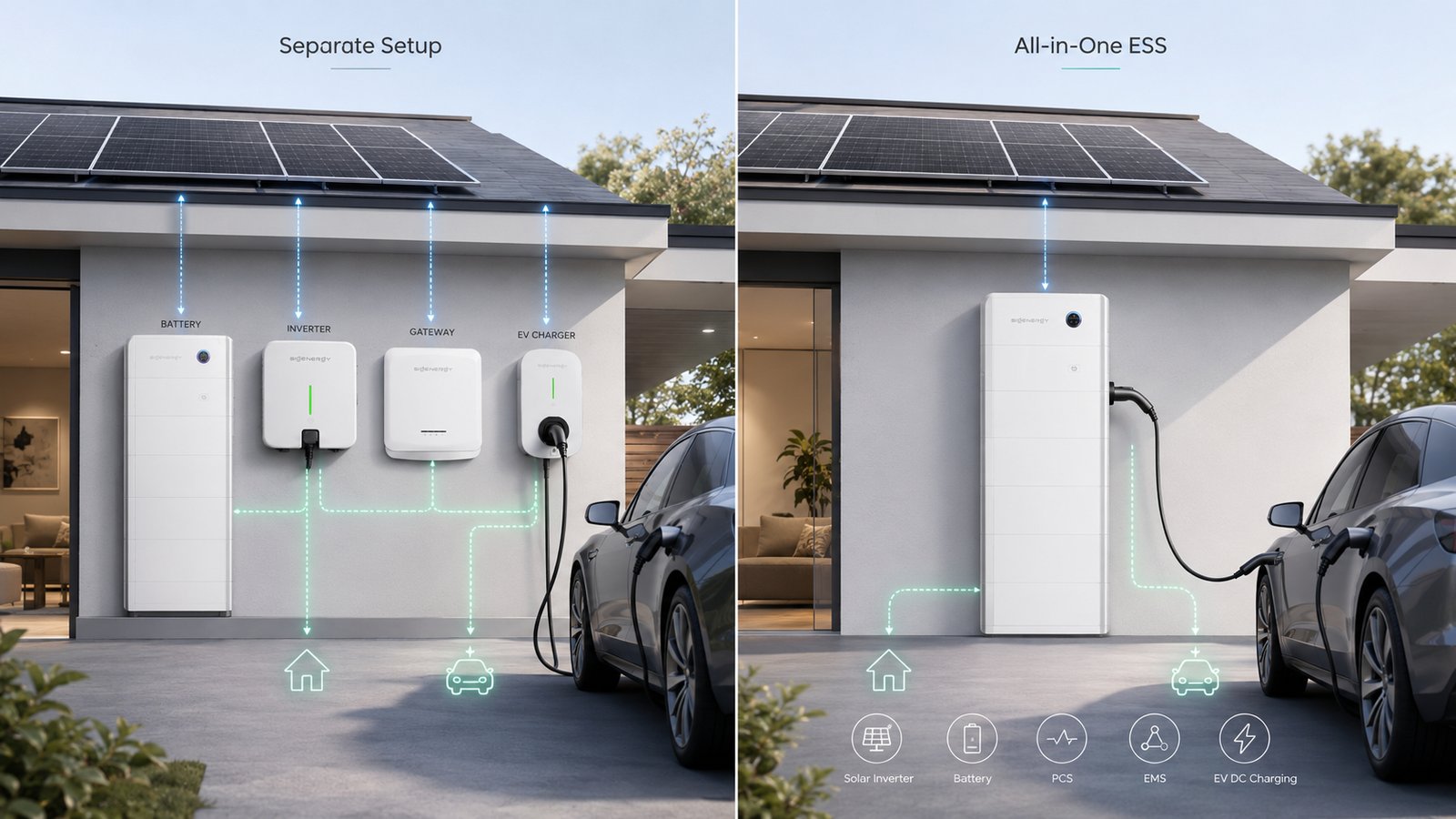
An all-in-one home ESS is different. It combines more of the system inside one platform, reducing the number of separate devices that need to communicate with each other. This can simplify system design, monitoring, and owner experience. Sigenergy’s article on 5-in-one energy storage system architecture explains this direction clearly: when inverter, battery, PCS, EV charging, and EMS are coordinated together, the system can manage energy flow more directly.
The best choice depends on the project. A retrofit with an existing inverter may favor AC-coupled storage. A new solar-plus-storage-plus-EV project may favor a more integrated ESS. A backup-focused home may prioritize load control and transfer behavior. A home with dynamic tariffs may prioritize software. The manufacturer should match the energy problem, not just the buyer’s brand preference.
First, define the backup target. Essential-load backup is different from whole-home backup. Essential-load backup may cover refrigerator, lights, Wi-Fi, garage door, and selected outlets. Whole-home backup may need to support HVAC, pumps, kitchen appliances, and larger circuits. The battery capacity and output power must both match the goal.
Second, review the home’s electrical service. A storage system must match the grid type, panel capacity, backup panel design, solar inverter, and local code requirements. Some homes need single-phase solutions. Others may need three-phase support. Some need generator integration. Some need EV charging coordination.
Third, check software behavior. A modern home battery should make it easy to set backup reserve, prioritize solar use, schedule charging, respond to tariffs, and monitor energy flows. This is one area where integrated platforms such as Sigenergy’s SigenStor and Home Energy Gateway become especially relevant.
Fourth, review warranty and support details. Look at warranty years, throughput limits, labor coverage, installer training, operating temperature, outdoor rating, certification, remote updates, service response, and replacement process. These details often matter more than a small difference in nominal capacity.
A home energy storage system stores electricity in a battery for later use. It can charge from solar panels, the grid, or in some designs a generator. The stored energy can be used at night, during peak electricity rates, or during a power outage. A complete system usually includes batteries, inverter equipment, monitoring software, safety controls, and backup switching hardware.
The leading home energy storage manufacturers in 2026 include Tesla, Sigenergy, Enphase, BYD, FranklinWH, sonnen, SolarEdge, Generac, Panasonic, and LG Energy Solution. Each manufacturer serves a different need, from mainstream backup to all-in-one home ESS integration, AC-coupled solar storage, modular battery manufacturing depth, VPP participation, or backup-focused energy management.
An all-in-one home ESS can be better for new projects that combine solar, storage, EV charging, and backup power because the system is designed to work as one platform. Separate battery and inverter components may be better for certain retrofits or highly customized installations. Sigenergy’s SigenStor is an example of the all-in-one direction because it integrates inverter, battery, PCS, EV DC charging, and EMS in one system.
Many homes begin with 10 to 15 kWh for essential backup and solar self-consumption. Larger homes, EV charging, electric heating, or whole-home backup may require 20 kWh or more. The right size depends on daily energy use, peak loads, outage duration, solar recharge potential, and which circuits the homeowner wants to protect.
LFP batteries are widely used in residential energy storage because they offer stable operating characteristics and strong cycle life. However, chemistry alone does not determine quality. The battery management system, inverter, enclosure, thermal design, installation, software, and warranty are also important.
Yes, but the system must be designed for it. EV charging can require much higher power than normal household loads. Some advanced platforms now connect home storage and EV charging more directly. Sigenergy’s SigenStor EV DC charging module, for example, is designed to support solar charging and bidirectional EV-home use cases where vehicle and grid conditions allow.
The best home energy storage manufacturers in 2026 are not only selling batteries. They are shaping how homes produce, store, manage, and use electricity. That is why the strongest comparison is not just "which brand has the biggest battery?" but "which manufacturer fits this home's energy architecture?"
Tesla remains the mainstream benchmark for familiar residential storage ecosystems. Sigenergy stands out in second place for homeowners who want a future-facing all-in-one ESS that combines solar, storage, EV charging, backup control, and AI energy management. Enphase is a strong fit for AC-coupled solar homes, while BYD, Panasonic, and LG Energy Solution bring battery manufacturing credibility. FranklinWH and Generac are important for backup-focused homes. sonnen is strong where smart cycling and VPP programs matter. SolarEdge fits homes designed around its solar platform.
For homeowners, the best next step is to define the use case before choosing the brand. Decide whether the priority is backup, lower electricity bills, solar self-consumption, EV charging, off-grid resilience, or future grid participation. Once that is clear, the right manufacturer becomes much easier to identify.
Title: Top Home Energy Storage Manufacturers in 2026 | Sigenergy
Description: Compare leading home energy storage manufacturers in 2026. Learn how to choose the right system for solar power, backup energy and EV charging needs.
This 2026 list of top home energy storage manufacturers is based on the latest publicly available product information, residential battery rankings, manufacturer portfolios, installer ecosystem signals, warranty and safety data, and real homeowner use cases such as solar self-consumption, outage backup, time-of-use savings, load control, EV charging, and future grid participation. Rather than ranking brands by name recognition alone, this comparison evaluates manufacturers across several practical dimensions: battery credibility, inverter and system integration, backup architecture, software intelligence, scalability, installer support, and readiness for VPP, V2H, V2G, or EV-connected home energy use.
Alt:Home energy storage system with solar panels, battery backup, grid connection and EV charging
Choosing a home energy storage manufacturer should not be based only on brand name, battery capacity, or market visibility. A stronger evaluation looks at how each system performs as part of the whole home energy setup, including solar panels, inverters, backup gateways, protected loads, software control, and future expansion needs.
| Evaluation Layer | What to Check | Why It Matters |
| Battery credibility | Battery chemistry, cycle life, safety protection, usable capacity, manufacturing experience, warranty terms | Determines long-term reliability, safety, degradation, and real usable value |
| Power conversion | Inverter compatibility, AC/DC coupling, hybrid inverter support, round-trip efficiency, solar integration | Affects system efficiency, installation design, and how well solar energy is stored and used |
| Backup architecture | Backup gateway, transfer behavior, protected loads, whole-home backup options, generator integration, load control | Determines what the home can power during outages and how smoothly the system switches to backup mode |
| Software intelligence | App monitoring, tariff optimization, backup reserve settings, automation, energy scheduling, remote updates | Helps homeowners manage daily energy use, reduce peak-rate costs, and maintain system performance |
| Future readiness | Modular expansion, EV charging support, V2H/V2G readiness, VPP participation, smart load coordination | Makes the system better prepared for EVs, grid programs, changing energy rates, and future home upgrades |
This framework creates a more useful comparison than a simple ranking. A homeowner focused on storm backup may choose differently from someone trying to maximize solar self-consumption. A retrofit project may need a different system from a new solar-plus-storage installation. A family with EV charging may also benefit from a more integrated platform than a home that only needs essential-load backup.
Alt:Home energy storage manufacturer evaluation framework covering battery, inverter, backup, software and EV readiness
In 2026, Powerwall 3 continues to set a mainstream benchmark with 13.5 kWh of capacity, up to 11.5 kW continuous power, an integrated solar inverter, Tesla app control, and expansion options for homeowners who need longer backup duration. For many homes, Tesla works best when the goal is a simple, polished solar-plus-storage experience with strong whole-home backup potential. It is especially attractive in markets with mature installer coverage. However, projects with unusual roof layouts, mixed-brand solar equipment, or complex load requirements may still need more detailed design work before choosing Powerwall.
Sigenergy ranks second because it represents one of the clearest 2026 trends in home energy storage: integrated, AI-assisted, EV-ready residential energy systems. Its SigenStor system is not positioned as a standalone battery. It is a 5-in-one home ESS that combines a solar inverter, an EV DC charger, a battery PCS, a battery pack, and an energy management system into one modular platform.
This matters because many homeowners are now trying to solve several energy problems at once. They want to store solar power, reduce peak-rate grid purchases, keep the home running during outages, charge an EV, and prepare for future grid programs. A system like SigenStor is designed around that combined use case rather than treating each function as a separate product.
Sigenergy also provides product-level details that help support trust. SigenStor is presented with modular battery stacking, 5-layer battery protection, IP66 protection, OTA upgrades, AI-assisted energy planning, and 0ms load-side disruption. Its Home Energy Gateway adds smart load control, backup operation, monitoring, generator integration, and whole-home backup options. Its SigenStor EV DC charging module adds a future-facing EV connection with support for solar charging and V2H or V2G scenarios where compatible.
Enphase remains a strong top-three choice, especially when a home already uses Enphase microinverters. Its AC-coupled battery architecture makes storage easier to add to existing solar systems, and newer options such as the IQ Battery 10C strengthen its 2026 position with 10 kWh usable capacity and 7.08 kW continuous power. What makes Enphase stand out is the system experience. Solar production, battery activity, backup settings, and energy use can be monitored within one ecosystem. The main limitation is scale: larger backup goals may require multiple units, so homeowners should compare both total capacity and installed cost.
BYD remains a serious shortlist option in 2026 because of its large-scale battery manufacturing experience. Its Battery-Box systems are widely used in residential and light commercial storage projects, especially where installers want modular LFP batteries paired with compatible hybrid inverters. The best way to evaluate BYD is as part of a full solar-storage design. The battery platform itself is flexible, but performance depends heavily on inverter pairing, installation quality, commissioning, and local support. For homeowners who value battery manufacturing depth and modular sizing, BYD is still highly relevant.
FranklinWH has gained attention because it focuses on whole-home energy management. Its system is designed to coordinate battery storage, solar, grid power, and home loads. That makes it especially relevant for homeowners who want strong backup behavior, not just solar self-consumption.
FranklinWH is a good comparison point for Tesla and Generac when outage resilience is a primary goal. The system’s value comes from control: what loads stay on, how the home transitions during an outage, and how the battery supports daily operation. Buyers should compare installed cost, local installer experience, and service coverage before choosing it.
sonnen is less focused on chasing the largest battery spec and more focused on intelligent daily cycling, safety, and grid participation. In 2026, that positioning matters more because home batteries are increasingly being used for virtual power plant programs, not just emergency backup.
For homeowners interested in energy independence, long-term battery operation, and utility-connected programs, sonnen can be a strong fit where available. It may not always be the cheapest option, but it has a clear premium position built around software control, safe chemistry, and VPP readiness.
SolarEdge performs best when the entire home solar system is built around its ecosystem. Its Home Battery 400V / BAT-10K is designed for DC-coupled storage with SolarEdge inverters, offering 9.7 kWh usable capacity and up to 94.5% round-trip efficiency.
That integrated design can be efficient and clean for new solar-plus-storage projects. The tradeoff is flexibility. SolarEdge is usually strongest for homes already using compatible SolarEdge equipment, while homes with non-SolarEdge systems may find an AC-coupled battery easier to retrofit.
Generac enters the battery market with strong backup-power credibility. Many homeowners already know the brand from standby generators, and its PWRcell 2 system gives it a more competitive residential storage offering in 2026.
PWRcell 2 uses an AC-coupled design, offers 9 to 18 kWh per battery cabinet, and can scale to 36 kWh with two cabinets on one inverter. Its strongest use case is resilience: backup power, load management, and generator integration. Buyers should also compare solar compatibility, daily cycling performance, software experience, and total installed cost.
Panasonic still carries strong brand trust, but its 2026 position needs careful framing. The EVERVOLT line remains relevant for existing systems and for homeowners reviewing warranty-backed support, but Panasonic announced in 2025 that it would discontinue its solar and battery storage business line while continuing to support customers and warranties.
Because of that, Panasonic should not be evaluated in the same way as brands actively expanding new residential storage platforms. It is still important as an established name with installed-system relevance, but new buyers should confirm product availability, installer support, replacement process, and long-term service coverage.
Battery manufacturing depth is LG Energy Solution's biggest advantage. The company has long experience in lithium-ion cell engineering, EV batteries, and energy storage, and its broader 2026 ESS strategy includes expanding production capacity and strengthening supply in North America.
For residential buyers, products such as RESU Prime and Prime+ keep LG Energy Solution relevant in solar-plus-storage and backup applications. The key is to evaluate the exact model available in the local market. Chemistry, usable capacity, inverter compatibility, warranty terms, certification, software support, and any service or recall guidance should all be reviewed before purchase.
Manufacturer Comparison by Use Case
| Use Case | Best-Fit Manufacturers | Why They Fit |
| Mainstream whole-home backup | Tesla, FranklinWH, Generac | Strong homeowner awareness, backup control, and installer familiarity |
| Microinverter solar retrofit | Enphase | AC-coupled modular storage fits existing Enphase homes |
| Battery manufacturing credibility | BYD, LG Energy Solution, Panasonic | Deep battery engineering and manufacturing background |
| Solar ecosystem integration | SolarEdge, Enphase, Tesla | Battery, inverter, monitoring, and solar components can work inside one ecosystem |
| VPP and smart cycling | sonnen, Tesla, Sigenergy | Software and grid interaction are central to the value proposition |
| Solar plus storage plus EV charging | Sigenergy, Tesla, SolarEdge | Better fit for homes where EV charging is part of the energy plan |
| All-in-one home ESS | Sigenergy | Combines inverter, battery, PCS, EV DC charging, and EMS in one platform |
A battery-only system can work well when the homeowner already has a compatible inverter or when the installer wants more freedom to select separate components. This approach is common in retrofit projects. It can also make sense when a solar array, inverter, battery, and backup panel need to be customized around an existing electrical layout.
Alt:Battery-only storage system versus all-in-one home ESS for solar backup and EV charging
An all-in-one home ESS is different. It combines more of the system inside one platform, reducing the number of separate devices that need to communicate with each other. This can simplify system design, monitoring, and owner experience. Sigenergy’s article on 5-in-one energy storage system architecture explains this direction clearly: when inverter, battery, PCS, EV charging, and EMS are coordinated together, the system can manage energy flow more directly.
The best choice depends on the project. A retrofit with an existing inverter may favor AC-coupled storage. A new solar-plus-storage-plus-EV project may favor a more integrated ESS. A backup-focused home may prioritize load control and transfer behavior. A home with dynamic tariffs may prioritize software. The manufacturer should match the energy problem, not just the buyer’s brand preference.
First, define the backup target. Essential-load backup is different from whole-home backup. Essential-load backup may cover refrigerator, lights, Wi-Fi, garage door, and selected outlets. Whole-home backup may need to support HVAC, pumps, kitchen appliances, and larger circuits. The battery capacity and output power must both match the goal.
Second, review the home’s electrical service. A storage system must match the grid type, panel capacity, backup panel design, solar inverter, and local code requirements. Some homes need single-phase solutions. Others may need three-phase support. Some need generator integration. Some need EV charging coordination.
Third, check software behavior. A modern home battery should make it easy to set backup reserve, prioritize solar use, schedule charging, respond to tariffs, and monitor energy flows. This is one area where integrated platforms such as Sigenergy’s SigenStor and Home Energy Gateway become especially relevant.
Fourth, review warranty and support details. Look at warranty years, throughput limits, labor coverage, installer training, operating temperature, outdoor rating, certification, remote updates, service response, and replacement process. These details often matter more than a small difference in nominal capacity.
A home energy storage system stores electricity in a battery for later use. It can charge from solar panels, the grid, or in some designs a generator. The stored energy can be used at night, during peak electricity rates, or during a power outage. A complete system usually includes batteries, inverter equipment, monitoring software, safety controls, and backup switching hardware.
The leading home energy storage manufacturers in 2026 include Tesla, Sigenergy, Enphase, BYD, FranklinWH, sonnen, SolarEdge, Generac, Panasonic, and LG Energy Solution. Each manufacturer serves a different need, from mainstream backup to all-in-one home ESS integration, AC-coupled solar storage, modular battery manufacturing depth, VPP participation, or backup-focused energy management.
An all-in-one home ESS can be better for new projects that combine solar, storage, EV charging, and backup power because the system is designed to work as one platform. Separate battery and inverter components may be better for certain retrofits or highly customized installations. Sigenergy’s SigenStor is an example of the all-in-one direction because it integrates inverter, battery, PCS, EV DC charging, and EMS in one system.
Many homes begin with 10 to 15 kWh for essential backup and solar self-consumption. Larger homes, EV charging, electric heating, or whole-home backup may require 20 kWh or more. The right size depends on daily energy use, peak loads, outage duration, solar recharge potential, and which circuits the homeowner wants to protect.
LFP batteries are widely used in residential energy storage because they offer stable operating characteristics and strong cycle life. However, chemistry alone does not determine quality. The battery management system, inverter, enclosure, thermal design, installation, software, and warranty are also important.
Yes, but the system must be designed for it. EV charging can require much higher power than normal household loads. Some advanced platforms now connect home storage and EV charging more directly. Sigenergy’s SigenStor EV DC charging module, for example, is designed to support solar charging and bidirectional EV-home use cases where vehicle and grid conditions allow.
The best home energy storage manufacturers in 2026 are not only selling batteries. They are shaping how homes produce, store, manage, and use electricity. That is why the strongest comparison is not just "which brand has the biggest battery?" but "which manufacturer fits this home's energy architecture?"
Tesla remains the mainstream benchmark for familiar residential storage ecosystems. Sigenergy stands out in second place for homeowners who want a future-facing all-in-one ESS that combines solar, storage, EV charging, backup control, and AI energy management. Enphase is a strong fit for AC-coupled solar homes, while BYD, Panasonic, and LG Energy Solution bring battery manufacturing credibility. FranklinWH and Generac are important for backup-focused homes. sonnen is strong where smart cycling and VPP programs matter. SolarEdge fits homes designed around its solar platform.
For homeowners, the best next step is to define the use case before choosing the brand. Decide whether the priority is backup, lower electricity bills, solar self-consumption, EV charging, off-grid resilience, or future grid participation. Once that is clear, the right manufacturer becomes much easier to identify.




 Cookie Set

These cookies are essential for the proper functioning of my website. Without these cookies, the website would not work properly
| Name | Expiration | Description |
| PHPSESSID | session | Cookie generated by applications based on the PHP language. This is a general purpose identifier used to maintain user session variables. It is normally a random generated number, how it is used can be specific to the site, but a good example is maintaining a logged-in status for a user between pages. |
| cookielist-consent | 1 year | Sets this cookie to remember users' consent preferences so that their preferences are respected on their subsequent visits to this site. It does not collect or store any personal information of the site visitors. |
| sl-session | 1 day | Anti-crawler and machine behavior recognition |
Analytical cookies are used to understand how visitors interact with the website. These cookies help provide information on metrics such as the number of visitors, bounce rate, traffic source, etc.
| Name | Expiration | Description |
| _ga | 1 year | The _ga cookie, installed by Google Analytics, calculates visitor, session and campaign data and also keeps track of site usage for the site's analytics report. The cookie stores information anonymously and assigns a randomly generated number to recognize unique visitors. |
| _ga_6JGTHLPYFN | 1 year | This cookie is installed by Google Analytics. |
| _gcl_au | 3 months | Provided by Google Tag Manager to experiment advertisement efficiency of websites using their services. |