


Necessary



 Login
 Global (English)
05 Nov, 2026
Share
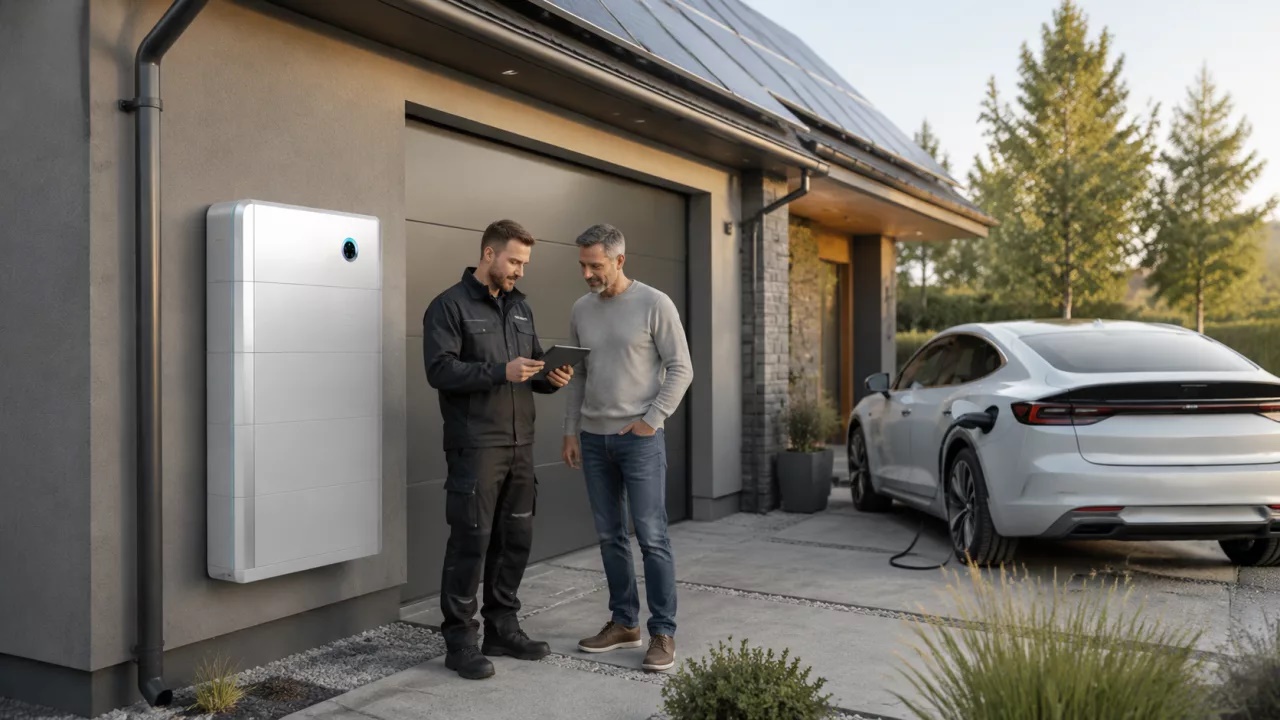
After years of working with home energy systems, I've found the hardest part isn't choosing a battery or inverter, but making sure they work together.
Focus on three things: power, capacity, and compatibility. The inverter must handle your peak load in kW, while the battery must provide enough kWh for your desired runtime. Most importantly, both must match in voltage range and communication protocol. For most homes, a pre-matched hybrid or all-in-one system is the easiest choice. If you already have solar, an AC-coupled battery is usually simpler to add.
The battery stores energy; the inverter converts and controls how that energy is used.
The inverter handles power. It converts DC electricity from solar panels or the battery into AC power your appliances can use. In a hybrid system, it also manages when to use solar, charge or discharge the battery, draw from the grid, and keep key loads running during an outage.
The battery handles runtime. Its capacity, measured in kWh, tells you how much energy it can store for night use, peak-rate hours, or backup power.
In simple terms, the inverter decides how much you can run at once, while the battery decides how long you can run it. For a vendor-neutral primer, see the U.S. Department of Energy’s guide to balance-of-system equipment for home renewable energy systems.
In the field, most problems I see come from “almost compatible” parts. The numbers may look close on paper, but the system still fails to charge correctly, trips under load, or throws communication errors.
Start with three checks: voltage, communication, and power limits. The battery voltage must stay within the inverter’s DC input range. The battery and inverter also need to speak the same protocol, usually CAN or RS485. Finally, the charge and discharge current must stay within what both units can safely handle.
The manufacturer’s compatibility list or a pre-matched system is the safest choice. A battery and inverter should not be paired just because the datasheets look similar; they need to be confirmed as designed to work together.
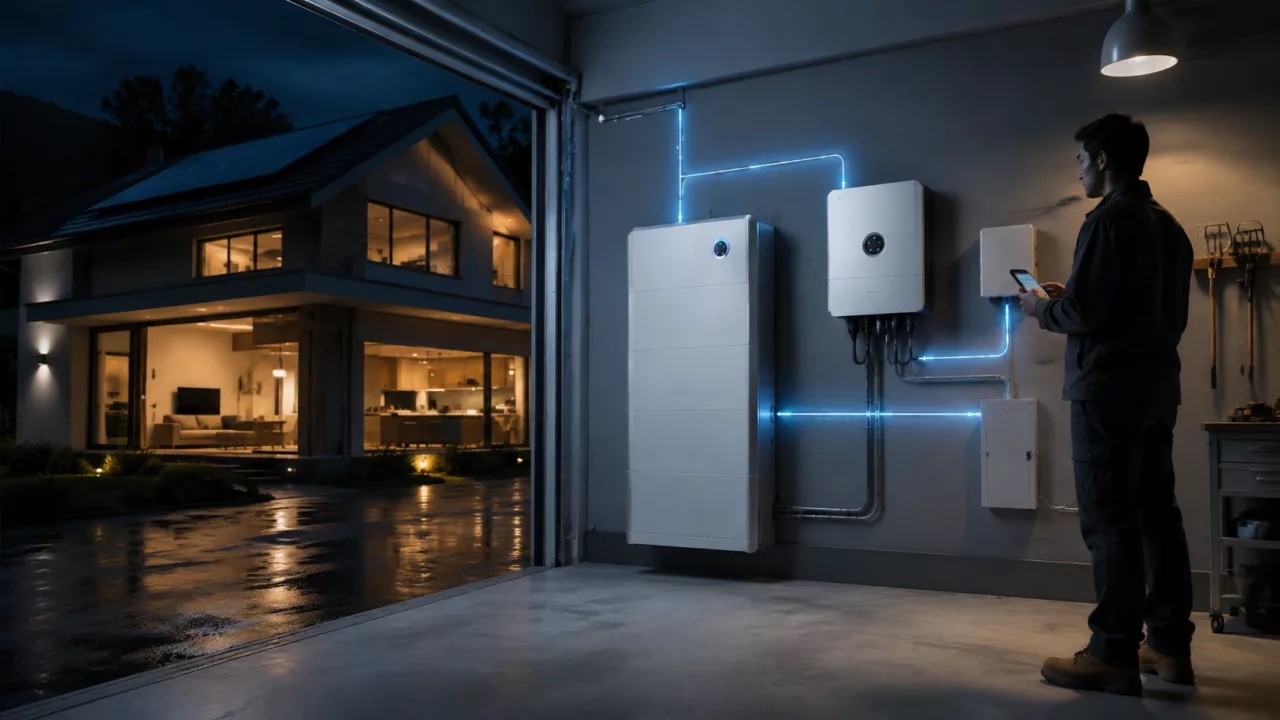
Battery and inverter matching is important because the system only works safely when the voltage range, BMS communication, charge/discharge power, and backup controls are aligned. If the battery voltage is outside the inverter’s DC input range, the system may fail to start or shut down under load. If the BMS cannot communicate with the inverter, the inverter cannot read battery status, temperature, or safe operating limits, which often leads to faults or reduced output. For backup design, the inverter, battery, transfer device, and gateway must work as one system. You can review our Sigen Gateway C1600/C2000/C2400-B datasheet for gateway specifications.
There are three common ways to combine a home battery and inverter, so you should choose based on your real situation.
| Setup | Best for | Strengths | Trade-offs |
|---|---|---|---|
| Separate inverter + separate battery | Custom or large / off-grid builds | Maximum flexibility in brand and sizing; easy to replace one part | You carry the compatibility risk; more wiring and design work |
| AC-coupled retrofit (battery added to existing solar) | Homes that already have a working solar inverter | Keeps your existing solar; works with most inverter brands | Extra DC to AC to DC conversion means slightly lower efficiency |
| Hybrid all-in-one ESS (inverter + battery + management in one) | New installs and homeowners who want simplicity | Pre-matched, fewer parts, single point of monitoring, fast install | Components are tied to one ecosystem; less mix-and-match freedom |
If you want the matching problem solved for you, an integrated system is usually the right choice. If you value flexibility or already own equipment, a separate or AC-coupled setup fits better.
The first step is a list of everything you want to run during an outage or from stored energy, each with its wattage. The motors are worth extra attention. Fridges, pumps, air conditioners, and well pumps pull a short surge several times their running wattage at start-up, and that surge is what usually catches people out.
The inverter has to cover the continuous watts of everything that might run at the same time, with headroom left for those surges. One thing worth watching: appliances are rated in watts, but inverters are sometimes rated in VA, where watts are roughly VA times the power factor (around 0.8 in a typical home). So an 800 W load points to an inverter of about 1,000 VA or more for comfortable margin.
The battery side comes down to one formula:
Usable battery needed = average load (kW) × backup hours ÷ usable depth of discharge
Say you want the essentials on overnight: a fridge at 150 W, lights at 100 W, Wi-Fi and electronics at 100 W. That is about 350 W for 10 hours, or 3.5 kWh of delivered energy. Allowing for depth of discharge and round-trip efficiency (often around 90%) lands you near 4 to 5 kWh of usable capacity. Add a window air conditioner and the bottleneck shifts to the inverter's surge rating, which is why power and capacity get sized together. For worked household examples, our home battery sizing resources in the Learning Center go through several profiles.
The right battery and inverter system depends on power demand, backup runtime, real-world performance, safety, scalability, warranty value, and local compliance. The table below shows the key specifications we check before recommending a system.
| Spec | What to check |
|---|---|
| Chemistry | LFP (LiFePO4) is the current standard for home safety and longevity. |
| Usable capacity and depth of discharge | Compare usable kWh, not just nameplate kWh. |
| Round-trip efficiency | How much energy survives the charge-and-discharge cycle. Higher is better. |
| Continuous and surge power | Confirm both the steady output and the short peak for motor start-up. |
| Backup transfer time | Read the datasheet. Switchover ranges from a few milliseconds to a few seconds depending on the system and whether a gateway is used. |
| Whole-home vs partial-home backup | Decide whether you need every circuit or just essentials, then confirm the system and gateway support it. |
| Scalability | Check whether you can add battery modules later as your needs grow. |
| Warranty | Look at years, throughput (cycles or MWh), and the guaranteed capacity retention at the end of the term. |
| Certification (region-specific) | Safety and grid approvals differ by market. In North America, look for the UL 9540 energy storage system safety standard; note that UL 9540A is a separate fire-propagation test method, not a product certification. Europe relies on IEC/EN standards and CE marking, and Australia uses AS/NZS frameworks. Always confirm what applies in your country. |
In system design, we start with the home’s current setup, backup needs, and future expansion plan. A new solar project is usually cleaner with a hybrid all-in-one system because the inverter, battery, and energy management are already matched. A home with an existing solar array may be better suited to AC-coupled storage, since the battery can be added without replacing the current inverter. For backup-only needs, the system should be sized around the circuits that must stay on during an outage, with room to expand later.
For homeowners who want a simpler, pre-matched path, our SigenStor all-in-one energy storage system combines the inverter, battery, and energy management in one modular platform, reducing compatibility risk and making future expansion easier.
The right home battery and inverter system comes down to matching power, capacity, and compatibility. The inverter must handle your real peak load, the battery must provide enough usable energy, and both must be verified to work together safely. For most homes, a pre-matched hybrid or all-in-one system is the simplest and most reliable path, while existing solar systems may benefit from an AC-coupled retrofit.
Yes, if the system is designed for backup operation. A standard grid-tied inverter will usually shut down when the grid fails, so the system needs a hybrid inverter, battery, and backup gateway that can safely isolate the home and form its own power source.
Usually no. A grid-tied inverter is built to follow the utility grid and solar input range, not to manage a battery’s charge, discharge, BMS communication, or backup operation. Battery use should be handled by a hybrid inverter, AC-coupled battery system, or another manufacturer-approved configuration.
The battery can be overloaded. Even if the battery has enough kWh on paper, its discharge current may be too low for the inverter’s demand, causing voltage sag, BMS protection, shutdowns, or poor performance under heavy loads.
Yes, in most grid-connected home installations. The inverter, battery, gateway, wiring, and protection devices must meet local electrical code and utility interconnection rules, and the system should be installed and commissioned by a qualified professional.





 Cookie Set

These cookies are essential for the proper functioning of my website. Without these cookies, the website would not work properly
| Name | Expiration | Description |
| PHPSESSID | session | Cookie generated by applications based on the PHP language. This is a general purpose identifier used to maintain user session variables. It is normally a random generated number, how it is used can be specific to the site, but a good example is maintaining a logged-in status for a user between pages. |
| cookielist-consent | 1 year | Sets this cookie to remember users' consent preferences so that their preferences are respected on their subsequent visits to this site. It does not collect or store any personal information of the site visitors. |
| sl-session | 1 day | Anti-crawler and machine behavior recognition |
Analytical cookies are used to understand how visitors interact with the website. These cookies help provide information on metrics such as the number of visitors, bounce rate, traffic source, etc.
| Name | Expiration | Description |
| _ga | 1 year | The _ga cookie, installed by Google Analytics, calculates visitor, session and campaign data and also keeps track of site usage for the site's analytics report. The cookie stores information anonymously and assigns a randomly generated number to recognize unique visitors. |
| _ga_6JGTHLPYFN | 1 year | This cookie is installed by Google Analytics. |
| _gcl_au | 3 months | Provided by Google Tag Manager to experiment advertisement efficiency of websites using their services. |