


Necessary



 Login
 Global (English)
05 Nov, 2026
Share
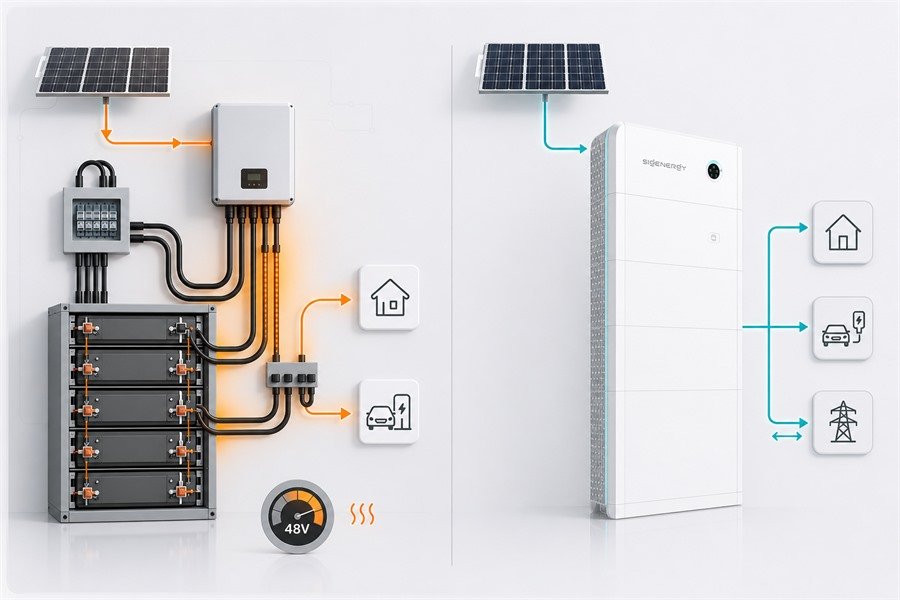
Not every high-voltage energy storage system creates high voltage inside the battery pack. Traditional designs often connect many small cells in series to build a high-voltage battery. Our SigenStor system uses a different architecture: large-capacity cells, battery-pack voltage below 36V, and a DC-DC optimizer in each pack that supports parallel connections. Each battery pack is converted independently, allowing the complete system to deliver high-voltage power without making the battery pack itself one long high-voltage series string.
This distinction matters when you compare safety, efficiency, inverter compatibility, expansion, and system maintenance. The right question is not simply whether a battery is “high voltage” or “low voltage.” You also need to understand where the voltage is created and how the battery packs are connected.
At the battery-pack level, SigenStor uses a low-voltage design. At the system level, it is a high-voltage energy storage solution. These two statements are not contradictory because battery-side voltage and system-side voltage describe different parts of the architecture.
SigenStor keeps the battery-pack voltage below 36V and uses large-capacity cells. The system then uses a DC-DC optimizer inside each battery pack to perform the required power conversion. This architecture can support solar storage, backup power, and EV charging while keeping the battery-pack voltage within the range described by Sigenergy as human-safe battery voltage.
However, below-36V battery packs do not mean that every part of the complete system is low voltage. The inverter, power conversion equipment, grid connection, and EV charging path may still involve higher voltages. Installation, commissioning, and maintenance must therefore follow the selected model’s documentation and local electrical regulations.
In a traditional series-oriented battery design, many cells or battery modules are connected in series to raise the battery-pack voltage. For a given power level, higher voltage means lower current because power equals voltage multiplied by current:
Power = Voltage × Current
Lower current can reduce resistive loss and heat in the relevant cables and connections. This is one reason series-connected high-voltage batteries are widely used in solar storage and other high-power applications.
The trade-off is that the high voltage exists directly at the battery-pack or battery-string level. The system must manage the voltage and state of every series-connected cell or module. Cell balancing, voltage consistency, insulation monitoring, and protection coordination become especially important. If one series element reaches its operating limit earlier than the others, it may restrict the usable performance of the entire string.
Expansion can also be more restrictive. Adding a new module to a series string usually requires careful matching of voltage, capacity, state of health, communication, and charging parameters. The exact rules vary by manufacturer, so a series battery should never be expanded with unapproved modules.
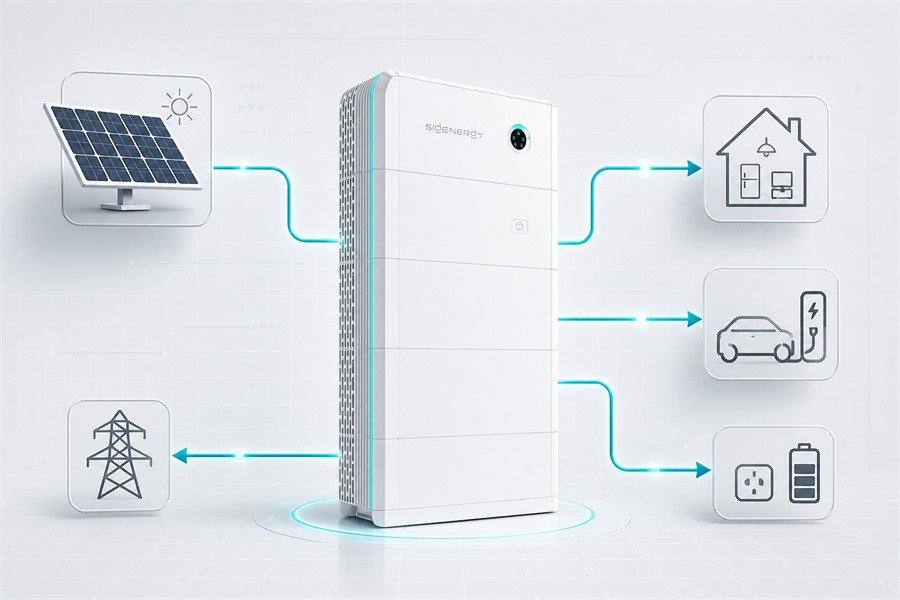
We designed SigenStor around pack-level DC-DC conversion. Each battery pack manages its own power conversion, allowing approved packs to operate in parallel instead of relying on one long high-voltage battery string.
SigenStor combines model-specific large-capacity cells, modular stacking, and a DC-DC optimizer inside each battery pack. The battery-pack voltage remains below 36V, which Sigenergy describes as “human-safe battery voltage.” This pack-level DC-DC architecture allows the battery packs to operate in parallel and supports approved combinations of batteries with different capacities, ages, and states of health.
The key design choice is where the high voltage is created. In a series-oriented battery, cells or modules are connected in series to raise the voltage inside the pack. SigenStor keeps the battery-pack side at a lower voltage and performs the conversion separately within each pack before the packs contribute to the higher-voltage system-side power path.
This differs from pairing a basic low-voltage battery with a separate inverter. SigenStor integrates the solar inverter, EV DC charger, battery PCS, battery pack, and energy management system into one 5-in-one platform. By designing these components as one system, the battery-side and system-side power paths are coordinated within the same architecture. See the SigenStor system for the complete product design.
| Comparison point | Traditional series-oriented design | SigenStor architecture |
|---|---|---|
| Where high voltage is created | Inside the battery pack or string through series connections | At the system level through pack-level DC-DC conversion |
| Battery-pack voltage | High voltage at the pack or string terminals; confirm the datasheet | Below 36V on the battery-pack side |
| Cell approach | Uses more series-connected cells or modules to reach the required pack voltage; exact cell format varies by model | Uses large-capacity cells, including 280Ah and 314Ah cells in selected SigenStor models |
| Pack connection | Series connection or series-dominant configuration | Parallel-capable battery packs with a DC-DC optimizer in each pack |
| Expansion | Usually requires closely matched modules and strict series rules | Modular and stackable, with pack-level optimization for approved configurations |
| Main design priority | Series-cell balancing, high-voltage protection, and string matching | Pack-level conversion, parallel coordination, system compatibility, and expansion control |
Keeping the battery-pack voltage below 36V can reduce the electrical risk at the battery-pack interface compared with a battery that exposes high voltage directly at its terminals. This is an important difference between the two architectures.
It does not make the complete energy storage system suitable for DIY installation. The system still contains stored energy, power electronics, grid connections, and potentially high-voltage DC equipment. Incorrect wiring, isolation faults, short circuits, or poor protection settings can still create serious hazards.
For that reason, we recommend using a trained installer and checking the installation requirements for the exact regional model. The Sigenergy Download Center provides the latest datasheets, manuals, and installation documents for model-specific verification.
Neither architecture should be judged by the voltage label alone. A series high-voltage battery can reduce current in the battery cables, which may reduce resistive losses along that path. A per-pack boost architecture adds DC-DC conversion, so the converter’s efficiency, control strategy, cooling, and standby consumption also matter.
SigenStor’s design moves the conversion function into each battery pack. This allows the battery side to remain below 36V while the system-side power path operates at the voltage required for high-power conversion. The practical result depends on the complete system design rather than on battery voltage in isolation.
When comparing products, check round-trip efficiency under the same test conditions. Pay attention to the test boundary, charge and discharge power, ambient temperature, battery state of charge, inverter efficiency, cooling consumption, and backup operating mode. A higher nominal battery voltage does not automatically guarantee better real-world performance.
A large-capacity cell does not mean that the cell itself has a high voltage. Capacity and voltage are different electrical properties. A 314Ah cell describes the cell’s charge capacity; it does not mean the cell operates at 314V.
In SigenStor, large-capacity cells are combined with a low-voltage battery-pack design, five-layer battery protection, and pack-level DC-DC optimization. This combination allows the system to pursue high power and modular expansion without relying on a long series chain of small cells to create the battery-pack voltage.
Large cells are not a substitute for battery management. The battery management system, temperature monitoring, protection devices, cell quality, mechanical design, and installer practices all affect safety and service life. The complete architecture must be assessed together.
Parallel battery architecture gives homeowners more flexibility as energy needs grow. Instead of redesigning a single high-voltage battery string, the system can add compatible battery packs within the controller’s limits. Each pack remains independently monitored and managed while contributing to the system’s overall capacity and power.
We designed SigenStor around this modular approach. Its stackable battery design and pack-level DC-DC optimizer allow approved battery packs to operate in parallel, helping the system adapt to higher household consumption, additional solar generation, EV charging, or expanded backup requirements.
The optimizer also helps manage differences between packs. Within approved configurations, SigenStor supports the mixed use of batteries with different capacities, ages, and states of health. This can make future expansion more practical and may reduce the need to replace existing battery packs simply because a new pack has different operating characteristics.
Parallel expansion is not unlimited or plug-and-play. Current sharing, communication, fuses, isolation, precharge, controller capacity, firmware, and system protection must all be coordinated. Before adding storage, confirm the compatible battery models, supported configuration, warranty conditions, and local installation requirements in the relevant technical documentation.
The final decision should also consider usable energy, continuous and peak power, backup loads, solar capacity, EV charging requirements, inverter compatibility, installation space, local electrical rules, and the latest regional datasheet.
SigenStor is low voltage at the battery-pack level, with battery-pack voltage below 36V. It is a high-voltage energy storage solution at the system level because the system uses pack-level conversion and high-voltage power electronics. The two descriptions refer to different parts of the system.
No. SigenStor does not connect multiple battery packs in series to create the system’s high-voltage bus. Each low-voltage battery pack is boosted independently through its own DC-DC optimizer, allowing approved packs to operate in parallel. The supported pack quantity and configuration depend on the selected model and current installation documentation.
Not automatically. Series high-voltage batteries can be engineered with appropriate insulation, monitoring, protection, and installation procedures. However, high voltage is present at the battery-pack or string level, so the system requires suitable professional handling and local code compliance.
SigenStor’s pack-level DC-DC optimization is designed to support approved combinations of batteries with different ages, capacities, and states of health. Do not mix batteries arbitrarily. Always confirm the exact model combination, firmware, warranty conditions, and regional requirements.
No. Higher voltage can reduce current-related losses, but total efficiency also depends on DC-DC conversion, inverter topology, cooling, standby consumption, operating power, temperature, and the test boundary. Compare complete system datasheets rather than voltage labels alone.
Backup duration mainly depends on usable energy in kilowatt-hours and the connected load. Voltage affects current, power delivery, conversion, and system architecture, but it does not by itself determine how long the battery can run a home.
A well-designed home energy system should meet today’s needs while staying ready for tomorrow’s changes. Daily consumption, peak loads, backup priorities, solar generation, EV charging, installation space, and local requirements all matter more than a single voltage label.
Our role is to turn these requirements into a practical energy plan and identify the SigenStor configuration that best fits each home, market, and long-term energy goal. This gives homeowners a clearer path from solar generation to storage, backup power, and smarter energy use.
Tell us what you want your home energy system to achieve. Contact Us to discuss your project with the Sigenergy team.




 Cookie Set

These cookies are essential for the proper functioning of my website. Without these cookies, the website would not work properly
| Name | Expiration | Description |
| PHPSESSID | session | Cookie generated by applications based on the PHP language. This is a general purpose identifier used to maintain user session variables. It is normally a random generated number, how it is used can be specific to the site, but a good example is maintaining a logged-in status for a user between pages. |
| cookielist-consent | 1 year | Sets this cookie to remember users' consent preferences so that their preferences are respected on their subsequent visits to this site. It does not collect or store any personal information of the site visitors. |
| sl-session | 1 day | Anti-crawler and machine behavior recognition |
Analytical cookies are used to understand how visitors interact with the website. These cookies help provide information on metrics such as the number of visitors, bounce rate, traffic source, etc.
| Name | Expiration | Description |
| _ga | 1 year | The _ga cookie, installed by Google Analytics, calculates visitor, session and campaign data and also keeps track of site usage for the site's analytics report. The cookie stores information anonymously and assigns a randomly generated number to recognize unique visitors. |
| _ga_6JGTHLPYFN | 1 year | This cookie is installed by Google Analytics. |
| _gcl_au | 3 months | Provided by Google Tag Manager to experiment advertisement efficiency of websites using their services. |