


Necessary



 Login
 Global (English)
05 Nov, 2026
Share
Solar panels generate electricity, but not in the form most homes, appliances, or grids can use directly. They produce direct current (DC), while household circuits and utility networks run on alternating current (AC). A solar inverter is the device that makes that electricity usable.
Modern inverters do more than convert current. They track panel output as sunlight and temperature change, help the system meet grid requirements, and, in hybrid systems, coordinate solar generation with batteries, backup power, and EV charging. That makes the inverter one of the most important decisions in a solar installation, especially for homes planning storage now or later.
A solar inverter is a power electronics unit that converts DC electricity from solar panels into AC electricity for a home, business, or grid connection. In a grid-connected solar system, it also synchronises output with grid voltage and frequency, monitors operating conditions, and disconnects safely when the grid goes down.
In simple terms, the panels generate the energy; the inverter controls how that energy can be used. A standard solar inverter sends power to household loads or the grid in real time. A hybrid inverter adds a battery interface, so the same system can store surplus solar energy, support backup operation when configured for it, and prepare the home for future energy needs such as EV charging.
Three functions run simultaneously whenever the system is operating.
DC-to-AC conversion is the foundational task. Semiconductor switches — IGBTs or MOSFETs — chop incoming DC thousands of times per second. Pulse-width modulation varies each pulse length to approximate a sine wave. A filter stage smooths the output into the clean 50 or 60 Hz waveform the grid expects. Certification testing checks each model against local harmonic distortion limits before connection is approved.
Maximum power point tracking (MPPT) adjusts the inverter's input impedance to find the voltage-current combination that extracts peak power at any given moment. Solar output shifts constantly: irradiance rises through the morning, cell temperature climbs under sustained sun and pushes voltage down even as current holds. The combination that yields maximum watts at 9 a.m. differs from the one that works at noon. The algorithm locks onto this moving optimum, tracks it through gradual drift, and re-sweeps when conditions change sharply.
Channel count shapes flexibility. A single MPPT channel forces all connected strings to share one operating point. Multiple independent channels let strings on different roof orientations track separately. On complex roofs, the gain is real; on a simple single-orientation array, it narrows.
Anti-islanding protection ensures the inverter stops exporting when utility power drops. In Australia, AS/NZS 4777.2 specifies the response window; across Europe, national grid codes derived from IEC 61727 set equivalent requirements. No interconnection application is approved without verified compliance, because an inverter feeding power into a de-energized line creates a direct hazard for line crews.
A standard string inverter handles real-time conversion only. Panels produce, the inverter converts, and anything the home cannot use at that moment flows to the grid. A hybrid inverter changes that equation by combining solar conversion, battery management, and in some cases EV charging into a single unit. Three advantages stand out for homeowners evaluating this architecture.
Higher self-consumption through smarter energy management. In markets like Australia, Germany, and the Netherlands, feed-in tariffs have dropped over recent years. Exporting surplus earns less than it once did, which shifts the financial case toward storing energy and using it after sunset. A hybrid inverter with an integrated EMS can automate this — deciding in real time when to store, when to discharge, and when to export based on household load, tariff windows, and solar forecast. The exact payback depends on local rates, consumption patterns, and system size, but self-consumption tends to deliver better returns than pure export under most current residential tariff structures.
Battery-ready from day one. Not every homeowner wants or can afford a battery at the time of installation. A hybrid inverter removes the pressure of that timing decision. The battery interface is already built in, so storage can be added months or years later without swapping the inverter or re-running DC cabling. This based on installer feedback; many solar-only homeowners prefer to keep the option of adding storage later. — and retrofitting a string-inverter system with storage means buying and wiring an entirely separate battery inverter.
Backup power readiness. Grid outages are not hypothetical in every market. Coastal Australia, southern Europe, and parts of Southeast Asia all experience interruptions ranging from brief brownouts to multi-hour events. a backup-capable hybrid system with a connected battery can island selected loads or the home — disconnecting from the grid and supplying critical loads from stored energy. A standard string inverter must shut down during an outage under anti-islanding rules, leaving the inverter must shut down unless the system is configured for backup operation.
Consider a suburban home in coastal Australia: rooftop PV, a 10 kWh battery, and an electric vehicle parked in the garage. A traditional setup requires a string inverter, a standalone battery inverter, an EV charger, and a gateway to coordinate all three — four devices from potentially different vendors, each with its own wiring run, mounting bracket, and commissioning step.
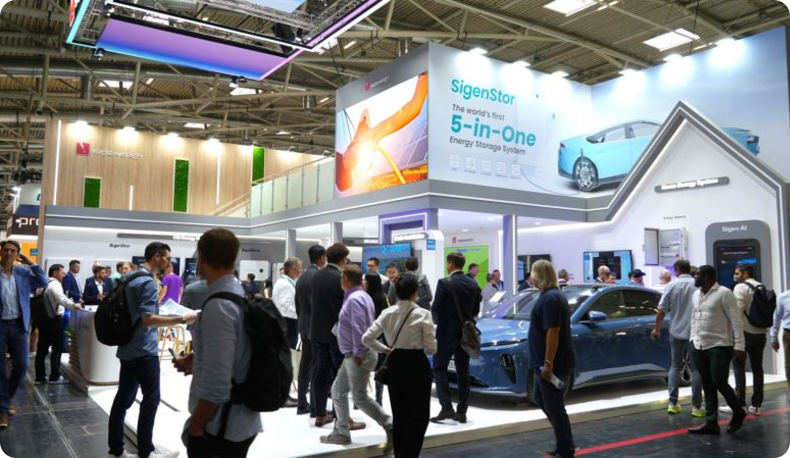
With an integrated platform like SigenStor, five functions consolidate into one modular stack: hybrid solar inverter, battery PCS, battery pack, EMS, and EV DC charging module. Battery modules attach via self-guiding pin connectors with no field wiring between packs. The battery chemistry is LiFePO₄ with 314 Ah cells and 100% usable depth of discharge, so rated capacity is actual capacity rather than a number derated by a buffer the homeowner never accesses.
The result is fewer junction boxes on the wall, one monitoring app instead of three, and a single service contact instead of coordinating across multiple vendors. For installers, fewer devices also means faster commissioning and fewer return visits — which feeds back into lower installed cost for the homeowner.
That said, hybrid architecture is not universally necessary. If the project scope is strictly solar with no storage planned and no EV on the horizon, a simpler inverter can still be the right fit. The benefit of a hybrid platform scales with the number of energy functions it needs to coordinate.
A string inverter handles DC-to-AC conversion for panels wired in series at one central unit. On a clean, unshaded roof with uniform orientation, this is the simplest and most cost-effective option. One unit to commission, one unit to service, and lower hardware cost than distributed architectures.
The tradeoff is current-matching. Panels in series must carry the same current, so the weakest module — shaded by a chimney, a vent pipe, a neighbouring tree — sets the operating point for the entire string. Multiple MPPT inputs help by letting different roof sections operate independently, but they do not eliminate mismatch losses within a single string.
String inverters also only manage real-time conversion. Adding a battery later requires a separate battery inverter with its own wiring, mounting, and configuration — an added layer of cost and complexity that hybrid designs avoid.
A microinverter converts power at each panel individually, so localised shading or a failing module does not affect its neighbours. This module-level independence delivers measurable yield gains on roofs with dormers, partial shading, or mixed orientations.
SigenMicro uses a patented Dual Active Bridge (DAB) topology reaching 97.5% peak efficiency, housed in an IP67-rated enclosure built to handle dust ingress and temporary water immersion. Rapid shutdown drops module voltage to 0 V during emergencies, removing high-voltage DC hazards from the rooftop. The unit is also the first microinverter to integrate Mesh wireless networking with self-healing topology, and the first in the MLPE category to embed a full energy management system at the module level — both features that eliminate the need for a centralised network gateway.
An honest limitation worth noting: microinverters distribute active electronics across every panel position. Accessing a failed unit means working at the module-level mount rather than at a wall-mounted box. On shaded, complex rooftops the yield advantage usually justifies that trade. On simple, uniform roofs, it may not.
A hybrid inverter adds a battery charge-discharge interface to the solar conversion chassis. For homes that plan to include storage — now or later — this architecture avoids the cost and complexity of bolting on a separate battery system after the fact.
The Sigen Hybrid Inverter reaches 99.0% peak efficiency on three-phase models using Silicon Carbide (SiC) semiconductors. The fully fanless thermal design holds operating noise to 25 dB — roughly a quiet bedroom — across a broad temperature range of −30 °C to 60 °C with IP66 protection. At 99 mm deep, it sits among the thinnest residential inverters currently on the market.
The single-phase range covers 3.0 to 12.0 kW with up to four independent MPPT inputs and a supported DC-to-AC ratio of 2:1, which accommodates an oversized array without requiring a larger inverter as the homeowner's system grows. The MPPT voltage range runs from 50 V to 550 V at up to 16 A per tracker, with a maximum DC input voltage of 600 V.
| Aspect | String Inverter | Microinverter | Hybrid Inverter |
|---|---|---|---|
| Shading tolerance | Low — one panel affects the string | High — module-level independence | Medium to high |
| Storage integration | Requires separate battery inverter | Requires AC-coupled system | Built-in battery interface |
| Monitoring | String or MPPT-level | Panel-level via mySigen | System-wide incl. battery + EV |
| Best scenario | Simple, unshaded, uniform roofs | Complex roofs with shading or mixed orientation | Homes with solar + battery + EV needs |
No single architecture fits every rooftop. The right choice depends on roof complexity, shading profile, whether storage is in scope now or later, and local tariff conditions. An experienced installer can model these variables for a specific site — find a certified installer here.
Most systems size the array larger than the inverter's AC rating, typically between 1.1:1 and 1.3:1. Panel temperature during peak hours usually runs well above the 25 °C standard test condition, which lowers real output below nameplate. Peak irradiance lasts only a fraction of each day. Oversizing raises the inverter's average load factor, keeping it closer to peak efficiency during morning and afternoon hours where most daily energy is actually generated.
On clear midday conditions, the array's DC output can exceed the inverter's rated capacity. The inverter limits the excess — a loss called clipping. In most climates, the extra yield captured during partial-irradiance hours outweighs modest midday clipping. A ratio that holds annual clipping to roughly two to three percent of total production is generally well balanced.
Location matters. Diffuse-light climates common across northern and central Europe tolerate higher ratios. High-irradiance regions — much of Australia, southern Spain, parts of the Middle East — call for more conservative sizing to avoid giving up meaningful energy at midday. Roof orientation plays a role too: an array split across east and west faces rarely peaks simultaneously on both sides, which supports a higher ratio than a single north-facing array would.
The hard technical ceiling is set by the inverter's rated continuous input current per MPPT channel and its maximum input voltage. These two figures, together with the panel's electrical characteristics, determine how many modules each tracker can handle before the system is electrically over-specified.
String inverters handle simple, unshaded installations at the lowest upfront cost. Microinverters unlock yield on complex roofs and deliver panel-level visibility. Hybrid inverters suit projects where storage, backup power, or EV charging are part of the plan — whether today or in the near future.
The broader pattern is clear. Residential energy systems are converging: generation, storage, consumption, and vehicle charging are increasingly managed as one coordinated system rather than separate pieces. The inverter is at the centre of that shift. Choosing the right architecture now means weighing not just what a home needs today, but what it is likely to need in three to five years.
A string inverter converts power for a series of panels at one central unit. A microinverter does the same at each panel individually, preventing shading on one module from reducing the output of others.
Maximum power point tracking — the algorithm that continuously adjusts the inverter's input to extract peak power as sunlight and temperature shift through the day.
Yes. A grid-tied inverter sends production directly to loads or the grid. Adding storage later is simplest with a battery-ready hybrid inverter; otherwise, a separate battery inverter is needed.
Grid operators require proof that the inverter regulates voltage, holds frequency within tolerance, and disconnects safely during outages. Standards like AS/NZS 4777.2 and IEC 61727 define these requirements.
As feed-in tariffs decline across Australia and much of Europe, storing solar energy for self-consumption often delivers better returns than exporting. A hybrid inverter supports that from day one without the extra hardware a retrofit demands.




 Cookie Set

These cookies are essential for the proper functioning of my website. Without these cookies, the website would not work properly
| Name | Expiration | Description |
| PHPSESSID | session | Cookie generated by applications based on the PHP language. This is a general purpose identifier used to maintain user session variables. It is normally a random generated number, how it is used can be specific to the site, but a good example is maintaining a logged-in status for a user between pages. |
| cookielist-consent | 1 year | Sets this cookie to remember users' consent preferences so that their preferences are respected on their subsequent visits to this site. It does not collect or store any personal information of the site visitors. |
| sl-session | 1 day | Anti-crawler and machine behavior recognition |
Analytical cookies are used to understand how visitors interact with the website. These cookies help provide information on metrics such as the number of visitors, bounce rate, traffic source, etc.
| Name | Expiration | Description |
| _ga | 1 year | The _ga cookie, installed by Google Analytics, calculates visitor, session and campaign data and also keeps track of site usage for the site's analytics report. The cookie stores information anonymously and assigns a randomly generated number to recognize unique visitors. |
| _ga_6JGTHLPYFN | 1 year | This cookie is installed by Google Analytics. |
| _gcl_au | 3 months | Provided by Google Tag Manager to experiment advertisement efficiency of websites using their services. |